







What is the story about?
India and the European Union are poised to unveil a landmark free trade agreement (FTA) on January 27, capping years of negotiations and signalling a decisive shift in how both sides approach economic partnerships in an increasingly fragmented global trade environment.
The agreement, finalised after prolonged deliberations and last-minute compromises, is expected to influence the trade flows between two of the world’s largest economic entities.
Collectively, India and the 27-member European Union represent nearly one-quarter of global economic output and a combined market of roughly two billion people.
Bilateral trade in goods has already crossed $136 billion, but policymakers and economists believe the new agreement could significantly deepen integration across value chains, lower costs, and strengthen India’s position as a global manufacturing and export hub.
“This will be a balanced, forward-looking deal for better economic integration with the EU. The deal will propel trade and investment between both sides,” India’s Trade Secretary Rajesh Agrawal said.
Negotiations between New Delhi and Brussels were originally launched more than a decade ago but stalled for nine years due to disagreements over market access, tariffs and regulatory standards.
Talks were formally revived in 2022, reflecting a growing recognition on both sides that strategic economic diversification had become essential.
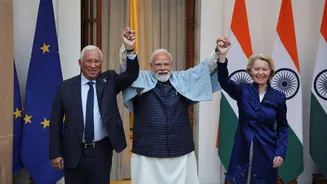
Momentum accelerated last year after Prime Minister Narendra Modi and European Commission President Ursula von der Leyen agreed to fast-track discussions.
For the EU, strengthening ties with India has also become part of a broader strategy to diversify supply chains and reduce dependence on any single market.
Brussels has recently concluded trade agreements with Mercosur and several Asian economies, while India has moved ahead with deals involving Britain, New Zealand and Oman.
Against this backdrop, both sides worked to resolve their remaining differences, even as negotiations went down to the wire on politically sensitive issues such as automobiles, steel and regulatory barriers.
India has committed to substantially lowering import duties on several European products, while the EU will provide improved market access for a wide range of Indian exports across manufacturing, chemicals, textiles and electronics.
Automobiles emerged as the most contentious sector during negotiations. India currently imposes import duties that can exceed 100 per cent on foreign-made cars, particularly in the premium segment.
Under the agreement, tariffs on vehicles manufactured in the EU are expected to be reduced to around 40 per cent.
Reuters previously reported that India was considering slashing car import duties from levels as high as 110 per cent as part of the deal.
Such a move would significantly alter the economics of exporting vehicles from Europe to India and could encourage global manufacturers to expand their footprint in the country.
For European carmakers such as Volkswagen, BMW, Mercedes-Benz and Renault, the agreement opens the door to deeper participation in one of the world’s fastest-growing automotive markets.
Luxury electric vehicles, in particular, stand to benefit from lower import duties.
Industry executives note that India currently levies import duty of about 100 per cent on European automobiles with a landed cost above $40,000, a threshold that applies to high-end electric vehicles.
These luxury EVs, while a niche segment, represent a growing category with prices often starting around Rs.1 crore.
With tariffs expected to fall under the FTA, European manufacturers will be able to price their vehicles more competitively.
Models such as BMW’s iX and i4, Mercedes-Benz’s EQS and EQE sedans, Audi’s Q8 e-tron and Volvo’s XC40 Recharge have already found steady demand among affluent Indian buyers seeking advanced technology and hybrid or electric drivetrains.
At the same time, Indian negotiators have sought to preserve protections for domestic manufacturers and mass-market segments.
Budget electric vehicles, which are largely produced within India and dominated by domestic players, are expected to remain insulated from direct competition, according to
The Economic Times.
While automobiles have attracted the most attention, the FTA covers a far broader spectrum of goods. India is expected to lower import duties on European wines, while the EU will provide greater access for Indian exports including textiles, garments, jewellery, chemicals, pharmaceuticals and electronics.
Negotiators have also addressed sensitive industrial sectors cautiously to avoid sudden disruptions to domestic producers.
Certain farm and dairy products have been excluded entirely from the agreement, reflecting India’s longstanding concerns about safeguarding the livelihoods of millions of small farmers.
India has repeatedly raised objections to what it sees as non-tariff barriers imposed by the EU, particularly carbon-related levies affecting steel, aluminium and cement exports.
New Delhi has also expressed concern over Brussels scaling back preferential tariff treatment for Indian goods under the EU’s Generalised System of Preferences, a move that has impacted exports worth nearly $2 billion.
Officials believe the FTA will help offset some of these pressures by creating alternative avenues for competitiveness.
In the fiscal year ending March 2025, bilateral goods trade between India and EU exceeded $136 billion. Indian exports to the EU stood at $75.9 billion, while imports from the bloc amounted to $60.7 billion.
Refined petroleum products formed India’s largest export category to the EU at $15.0 billion. Diesel shipments accounted for $9.3 billion of this total, while aviation turbine fuel exports were valued at $5.4 billion.
These products, however, are unlikely to see major changes under the FTA, as they already face minimal tariffs and are influenced more by global energy prices than trade barriers.
Electronics emerged as the second-largest export segment at $11.3 billion. Smartphones alone accounted for $4.3 billion, highlighting India’s growing role as a large-scale assembly and manufacturing base for global electronics.
Textiles and apparel remain a cornerstone of India’s trade with Europe. Garment exports totalled $4.5 billion, with specific categories such as girls’ suits contributing $822 million.
Textile exports were valued at $1.6 billion, while made-up textile products added another $1.2 billion. These are industries that Europe largely exited decades ago, making Indian exports complementary rather than competitive.
Other key export categories included organic chemicals worth $5.1 billion, machinery and computers at $5.0 billion, iron and steel at $4.9 billion, and pharmaceuticals at $3.0 billion.
Gems and jewellery shipments totalled $2.5 billion, driven primarily by cut and polished diamonds valued at $1.6 billion.
Automotive exports to the EU reached $2.2 billion. Auto parts accounted for $1.6 billion, followed by tractors at $181.8 million, motorcycles and scooters at $164.7 million, dumpers at $72.2 million and cars at $32 million.
Labour-intensive exports such as tyres ($890 million), footwear ($809 million) and coffee ($775 million) also featured prominently.
Despite the broad scope of the agreement, alcohol trade remains a relatively minor component of India-EU commerce. India exported wines worth $1.4 million and spirits valued at $24.5 million to the EU in FY2025.
Imports from Europe were higher, with wines valued at $7.9 million and spirits at $87.8 million, reflecting Europe’s dominance in premium alcohol categories.
India’s imports from the EU are concentrated in capital-intensive, technology-driven and input-heavy sectors. According to data for FY2025, high-end machinery was the largest import category at $13 billion.
This included turbojets valued at $810 million, industrial control valves worth $418 million and specialised industrial machinery amounting to $343 million.
India does not manufacture such advanced equipment at scale and relies on these imports for infrastructure development, industrial production and energy projects.
Electronics imports from the EU stood at $9.4 billion, led by mobile phone components worth $3.7 billion and integrated circuits valued at $890.5 million. These inputs are critical for India’s electronics manufacturing ecosystem and smartphone assembly operations.
Aircraft imports totalled $6.3 billion, while medical devices and scientific instruments were valued at $3.8 billion. India also imported specialised medicines worth $1.4 billion, products that are largely not produced domestically at sufficient scale or technological sophistication.
Waste and scrap imports amounted to $2.1 billion, including aluminium scrap worth $632 million and brass scrap valued at $534 million. Analysts note that India’s recycling industry and MSMEs depend heavily on imported scrap due to limited domestic availability.
The Global Trade Research Initiative (GTRI) has argued that the India-EU FTA is unlikely to harm domestic industry and instead will lower costs and expand trade volumes.
According to the think tank, tariff reductions will primarily reduce input costs for Indian producers, deepen value-chain integration and enhance competitiveness.
As global trade becomes increasingly shaped by tariffs and supply-chain realignments, GTRI said the India-EU economic “relationship stands out for its clarity of purpose.”
The two economies operate at different points along the value chain, with India focusing on labour-intensive and downstream production, while the EU supplies capital goods, advanced technology and industrial inputs.
Indian exports to Europe largely substitute for the EU’s imports from third countries rather than displacing European manufacturing. Conversely, EU exports feed directly into India’s factories, recycling industry and MSME clusters, improving productivity and export capacity.
Although negotiations have concluded, the agreement will not take effect immediately. The text will undergo a legal scrubbing process lasting five to six months, followed by formal signing and ratification procedures.
Approval by the European Parliament will be required before the pact can be implemented.
Officials on both sides expect the agreement to become operational within about a year.
In the meantime, political scrutiny is likely, particularly from industries concerned about increased competition. Even so, the India-EU free trade agreement represents
one of the most consequential economic alignments India has pursued in recent years.
With inputs from agencies
The agreement, finalised after prolonged deliberations and last-minute compromises, is expected to influence the trade flows between two of the world’s largest economic entities.
Collectively, India and the 27-member European Union represent nearly one-quarter of global economic output and a combined market of roughly two billion people.
Bilateral trade in goods has already crossed $136 billion, but policymakers and economists believe the new agreement could significantly deepen integration across value chains, lower costs, and strengthen India’s position as a global manufacturing and export hub.
“This will be a balanced, forward-looking deal for better economic integration with the EU. The deal will propel trade and investment between both sides,” India’s Trade Secretary Rajesh Agrawal said.
Why India and the EU pushed to close the deal now
Negotiations between New Delhi and Brussels were originally launched more than a decade ago but stalled for nine years due to disagreements over market access, tariffs and regulatory standards.
Talks were formally revived in 2022, reflecting a growing recognition on both sides that strategic economic diversification had become essential.
Momentum accelerated last year after Prime Minister Narendra Modi and European Commission President Ursula von der Leyen agreed to fast-track discussions.
For the EU, strengthening ties with India has also become part of a broader strategy to diversify supply chains and reduce dependence on any single market.
Brussels has recently concluded trade agreements with Mercosur and several Asian economies, while India has moved ahead with deals involving Britain, New Zealand and Oman.
Against this backdrop, both sides worked to resolve their remaining differences, even as negotiations went down to the wire on politically sensitive issues such as automobiles, steel and regulatory barriers.
How automobile cuts will benefit Indians
India has committed to substantially lowering import duties on several European products, while the EU will provide improved market access for a wide range of Indian exports across manufacturing, chemicals, textiles and electronics.
Automobiles emerged as the most contentious sector during negotiations. India currently imposes import duties that can exceed 100 per cent on foreign-made cars, particularly in the premium segment.
Under the agreement, tariffs on vehicles manufactured in the EU are expected to be reduced to around 40 per cent.
Reuters previously reported that India was considering slashing car import duties from levels as high as 110 per cent as part of the deal.
Such a move would significantly alter the economics of exporting vehicles from Europe to India and could encourage global manufacturers to expand their footprint in the country.
For European carmakers such as Volkswagen, BMW, Mercedes-Benz and Renault, the agreement opens the door to deeper participation in one of the world’s fastest-growing automotive markets.
Luxury electric vehicles, in particular, stand to benefit from lower import duties.
Industry executives note that India currently levies import duty of about 100 per cent on European automobiles with a landed cost above $40,000, a threshold that applies to high-end electric vehicles.
These luxury EVs, while a niche segment, represent a growing category with prices often starting around Rs.1 crore.
With tariffs expected to fall under the FTA, European manufacturers will be able to price their vehicles more competitively.
Models such as BMW’s iX and i4, Mercedes-Benz’s EQS and EQE sedans, Audi’s Q8 e-tron and Volvo’s XC40 Recharge have already found steady demand among affluent Indian buyers seeking advanced technology and hybrid or electric drivetrains.
At the same time, Indian negotiators have sought to preserve protections for domestic manufacturers and mass-market segments.
Budget electric vehicles, which are largely produced within India and dominated by domestic players, are expected to remain insulated from direct competition, according to
What Europe gets and what India gains
While automobiles have attracted the most attention, the FTA covers a far broader spectrum of goods. India is expected to lower import duties on European wines, while the EU will provide greater access for Indian exports including textiles, garments, jewellery, chemicals, pharmaceuticals and electronics.
Negotiators have also addressed sensitive industrial sectors cautiously to avoid sudden disruptions to domestic producers.
Certain farm and dairy products have been excluded entirely from the agreement, reflecting India’s longstanding concerns about safeguarding the livelihoods of millions of small farmers.
India has repeatedly raised objections to what it sees as non-tariff barriers imposed by the EU, particularly carbon-related levies affecting steel, aluminium and cement exports.
New Delhi has also expressed concern over Brussels scaling back preferential tariff treatment for Indian goods under the EU’s Generalised System of Preferences, a move that has impacted exports worth nearly $2 billion.
Officials believe the FTA will help offset some of these pressures by creating alternative avenues for competitiveness.
How India-EU trade is faring today
In the fiscal year ending March 2025, bilateral goods trade between India and EU exceeded $136 billion. Indian exports to the EU stood at $75.9 billion, while imports from the bloc amounted to $60.7 billion.
Refined petroleum products formed India’s largest export category to the EU at $15.0 billion. Diesel shipments accounted for $9.3 billion of this total, while aviation turbine fuel exports were valued at $5.4 billion.
These products, however, are unlikely to see major changes under the FTA, as they already face minimal tariffs and are influenced more by global energy prices than trade barriers.
Electronics emerged as the second-largest export segment at $11.3 billion. Smartphones alone accounted for $4.3 billion, highlighting India’s growing role as a large-scale assembly and manufacturing base for global electronics.
Textiles and apparel remain a cornerstone of India’s trade with Europe. Garment exports totalled $4.5 billion, with specific categories such as girls’ suits contributing $822 million.
Textile exports were valued at $1.6 billion, while made-up textile products added another $1.2 billion. These are industries that Europe largely exited decades ago, making Indian exports complementary rather than competitive.
Other key export categories included organic chemicals worth $5.1 billion, machinery and computers at $5.0 billion, iron and steel at $4.9 billion, and pharmaceuticals at $3.0 billion.
Gems and jewellery shipments totalled $2.5 billion, driven primarily by cut and polished diamonds valued at $1.6 billion.
Automotive exports to the EU reached $2.2 billion. Auto parts accounted for $1.6 billion, followed by tractors at $181.8 million, motorcycles and scooters at $164.7 million, dumpers at $72.2 million and cars at $32 million.
Labour-intensive exports such as tyres ($890 million), footwear ($809 million) and coffee ($775 million) also featured prominently.
Despite the broad scope of the agreement, alcohol trade remains a relatively minor component of India-EU commerce. India exported wines worth $1.4 million and spirits valued at $24.5 million to the EU in FY2025.
Imports from Europe were higher, with wines valued at $7.9 million and spirits at $87.8 million, reflecting Europe’s dominance in premium alcohol categories.
What India imports from Europe and why it matters
India’s imports from the EU are concentrated in capital-intensive, technology-driven and input-heavy sectors. According to data for FY2025, high-end machinery was the largest import category at $13 billion.
This included turbojets valued at $810 million, industrial control valves worth $418 million and specialised industrial machinery amounting to $343 million.
India does not manufacture such advanced equipment at scale and relies on these imports for infrastructure development, industrial production and energy projects.
Electronics imports from the EU stood at $9.4 billion, led by mobile phone components worth $3.7 billion and integrated circuits valued at $890.5 million. These inputs are critical for India’s electronics manufacturing ecosystem and smartphone assembly operations.
Aircraft imports totalled $6.3 billion, while medical devices and scientific instruments were valued at $3.8 billion. India also imported specialised medicines worth $1.4 billion, products that are largely not produced domestically at sufficient scale or technological sophistication.
Waste and scrap imports amounted to $2.1 billion, including aluminium scrap worth $632 million and brass scrap valued at $534 million. Analysts note that India’s recycling industry and MSMEs depend heavily on imported scrap due to limited domestic availability.
Why economists see structural gains for India
The Global Trade Research Initiative (GTRI) has argued that the India-EU FTA is unlikely to harm domestic industry and instead will lower costs and expand trade volumes.
According to the think tank, tariff reductions will primarily reduce input costs for Indian producers, deepen value-chain integration and enhance competitiveness.
As global trade becomes increasingly shaped by tariffs and supply-chain realignments, GTRI said the India-EU economic “relationship stands out for its clarity of purpose.”
The two economies operate at different points along the value chain, with India focusing on labour-intensive and downstream production, while the EU supplies capital goods, advanced technology and industrial inputs.
Indian exports to Europe largely substitute for the EU’s imports from third countries rather than displacing European manufacturing. Conversely, EU exports feed directly into India’s factories, recycling industry and MSME clusters, improving productivity and export capacity.
What comes next
Although negotiations have concluded, the agreement will not take effect immediately. The text will undergo a legal scrubbing process lasting five to six months, followed by formal signing and ratification procedures.
Approval by the European Parliament will be required before the pact can be implemented.
Officials on both sides expect the agreement to become operational within about a year.
In the meantime, political scrutiny is likely, particularly from industries concerned about increased competition. Even so, the India-EU free trade agreement represents
With inputs from agencies