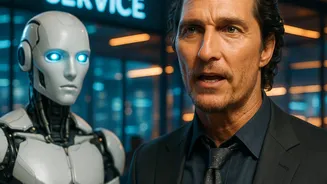

McConaughey has taken the legal route to trademark himself and protect the unauthorized use of AI. It has not been easy. The Interstellar star has had eight trademark applications approved by the U.S. Patent and Trademark Office featuring him staring, smiling and talking.
The strike that shook Hollywood due to AI
Back in 2023, after a 148-day strike, Hollywood screenwriters secured significant guardrails against the use of artificial intelligence in one of the first major labor battles over generative AI in the workplace.
During the nearly five-month walkout, no issue resonated more than the use of AI in script writing. What was once a seemingly lesser demand of the Writers Guild of America became
The strike was also about streaming-era economics, writers room minimums and residuals — not exactly compelling picket-sign fodder. But the threat of AI vividly cast the writers’ plight as a human-versus-machine clash, with widespread implications for other industries facing a radically new kind of automation.
In the next few weeks, WGA members voted on whether to ratify a tentative agreement, which required studios and production companies to disclose to writers if any material given to them has been generated by AI partially or in full. AI cannot be a credited writer. AI cannot write or rewrite “literary material.” AI-generated writing cannot be source material.
The tentative agreement between the Writers Guild and the Alliance of Motion Picture and Television Producers, which negotiated on behalf of the studios, didn't prohibit all uses of artificial intelligence. Both sides acknowledged it could be a worthwhile tool in many aspects of filmmaking, including script writing.