







What is the story about?
For the third straight month, Ukraine in May regained more territory from occupying Russian forces than it lost, according to the data.
On the back of efficient drone strikes on the front lines as well as deep inside Russia, the Ukrainian military has been on the offensive for the first time in nearly three years. Importantly, the forces have sustained the momentum as they have consistently expanded their gains over the months.
In May, Ukraine regained 93 square miles more land than it lost, according to an analysis by the Institute for the Study of War (ISW).
This was considerably more than the 46 square miles of net gains Ukraine recorded in April and the 10 square miles of net gains in March.
The ISW has also reported that these past few months are not a fluke but part of a trend that has set in on the battlefield over the past six months.
Between December 2025 and May 2026, Ukraine registered net gains of 92.85 square miles as it regained 108.54 square miles of territory and lost just 15.69 square miles.
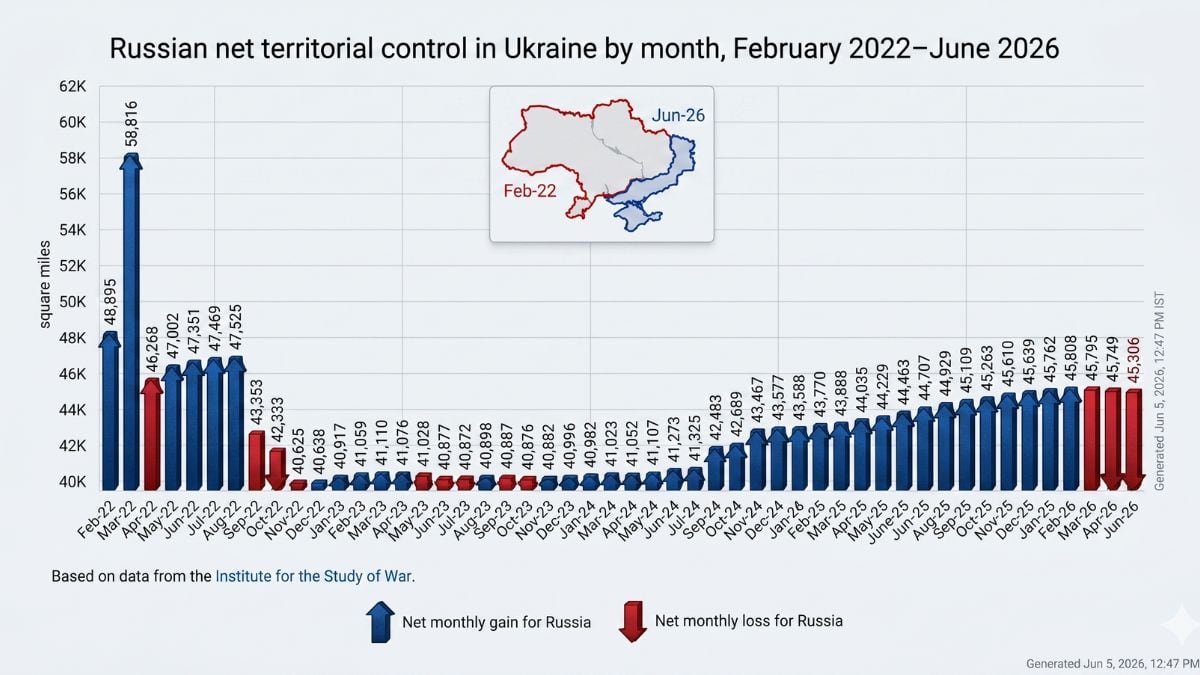
As shown in the graph below, the Russian occupation of Ukrainian territory has begun to decline in recent months after remaining stagnant for much of the past year. In any case, it is significantly down from the peak of 2022 as Ukraine has since regained large swathes of territory in multiple counteroffensives.
The ongoing Ukrainian campaign differs from previous counter-offensives as the military is relying on its mastery of drone warfare to saturate the front lines, denying Russia the ability to assemble armour and waves of footsoldiers that it had relied on over the past four years to storm positions.
At the same time, Ukraine has consistently struck deep inside Russia to hammer the country’s critical infrastructure, comprising oil and gas facilities, weapons manufacturing units, airfields, and other military installations. Such long-range attacks have coincided with the worsening Russian economy, which has forced Russian leader Vladimir Putin’s inner circle to make nearly unprecedented public pleas to end the war at the earliest as it is becoming increasingly unaffordable.
But Putin does not appear to be in any mood to de-escalate as he has doubled down on his attempt to break Ukrainian morale by striking civilians across the country to pressure President Volodymyr Zelenskyy into accepting his maximalist terms.
For weeks, Russia has stopped focusing on the front lines and has instead attacked Ukrainian civilians in hospitals and apartment blocks across the country, including in Kyiv, with thousands of missiles and drones.
Observers have flagged that, while such a campaign has killed dozens of Ukrainian civilians, injured hundreds, and caused widespread damage to infrastructure, it has brought little to no military benefit to Russia. Instead, the barrage has significantly reduced stockpiles of some of the most advanced hypersonic and intermediate-range ballistic missiles that Russia has launched in recent weeks.
Ukraine’s allies have sought to turn the momentum into leverage to bring Putin to the negotiating table. As US President Donald Trump is bogged down in the West Asian conflict, and as he has anyway switched sides to join hands with Putin, Ukraine’s European allies —France, Germany, and the United Kingdom— are reportedly working on a plan to initiate European-led negotiations with Putin.
On the back of efficient drone strikes on the front lines as well as deep inside Russia, the Ukrainian military has been on the offensive for the first time in nearly three years. Importantly, the forces have sustained the momentum as they have consistently expanded their gains over the months.
In May, Ukraine regained 93 square miles more land than it lost, according to an analysis by the Institute for the Study of War (ISW).
This was considerably more than the 46 square miles of net gains Ukraine recorded in April and the 10 square miles of net gains in March.
The ISW has also reported that these past few months are not a fluke but part of a trend that has set in on the battlefield over the past six months.
Between December 2025 and May 2026, Ukraine registered net gains of 92.85 square miles as it regained 108.54 square miles of territory and lost just 15.69 square miles.
As shown in the graph below, the Russian occupation of Ukrainian territory has begun to decline in recent months after remaining stagnant for much of the past year. In any case, it is significantly down from the peak of 2022 as Ukraine has since regained large swathes of territory in multiple counteroffensives.
Data: Institute for the Study of War (ISW)
Russia battered by Ukrainian drones, spiralling economy
The ongoing Ukrainian campaign differs from previous counter-offensives as the military is relying on its mastery of drone warfare to saturate the front lines, denying Russia the ability to assemble armour and waves of footsoldiers that it had relied on over the past four years to storm positions.
At the same time, Ukraine has consistently struck deep inside Russia to hammer the country’s critical infrastructure, comprising oil and gas facilities, weapons manufacturing units, airfields, and other military installations. Such long-range attacks have coincided with the worsening Russian economy, which has forced Russian leader Vladimir Putin’s inner circle to make nearly unprecedented public pleas to end the war at the earliest as it is becoming increasingly unaffordable.
But Putin does not appear to be in any mood to de-escalate as he has doubled down on his attempt to break Ukrainian morale by striking civilians across the country to pressure President Volodymyr Zelenskyy into accepting his maximalist terms.
For weeks, Russia has stopped focusing on the front lines and has instead attacked Ukrainian civilians in hospitals and apartment blocks across the country, including in Kyiv, with thousands of missiles and drones.
Observers have flagged that, while such a campaign has killed dozens of Ukrainian civilians, injured hundreds, and caused widespread damage to infrastructure, it has brought little to no military benefit to Russia. Instead, the barrage has significantly reduced stockpiles of some of the most advanced hypersonic and intermediate-range ballistic missiles that Russia has launched in recent weeks.
Ukraine’s allies have sought to turn the momentum into leverage to bring Putin to the negotiating table. As US President Donald Trump is bogged down in the West Asian conflict, and as he has anyway switched sides to join hands with Putin, Ukraine’s European allies —France, Germany, and the United Kingdom— are reportedly working on a plan to initiate European-led negotiations with Putin.