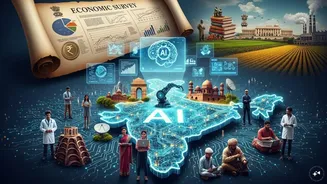

A Firstpost reported earlier, India’s strategy stands apart from that of the US and China, which are investing heavily in resource-intensive AI projects. Yet, India continues to make impressive strides. The country was recently ranked third in the world for AI capability in Stanford University’s Global AI Vibrancy Index 2025.
Why India is rejecting the Big-Tech model
Globally, AI is mirroring an arms race. The United States and China together control more than 75 per cent of global compute capacity for training large-scale models. The survey highlights that building a main-stream AI model now takes a huge amount of resources. According to a research, by Epoch AI, it almost costs around $2 billion (approx Rs 18,393 crore).
Looking at such a massive number, the Economic Survey 2025-2026 states, "India's access to cutting-edge compute infrastructure is limited, financial resources for large-scale model training are scarce, and private participation in foundational AI research remains relatively muted compared to global leaders. These constraints render the pursuit of foundational models as the centrepiece of an AI strategy challenging. A bottom-up approach to AI development aligns more closely with these realities."
On the infrastructure side, the Survey highlights the country’s shortage of compute. India accounts for barely 2 per cent of the world’s AI-ready GPU clusters, a gap it hopes to close through public-private partnerships and domestic semiconductor capacity.
Instead, the Survey urges policymakers and startups to focus on “application-specific AI”, lightweight models trained for agriculture, healthcare, logistics, and local-language services. These models can run on consumer-grade hardware or mid-range smartphones, expanding accessibility far beyond large corporate or academic labs.
The document proposes an “AI-OS Mission”, designed as a public digital platform similar to UPI or Aadhaar, where government and private players pool resources to build open datasets, model libraries, and shared compute hubs. The goal is to democratise access to AI infrastructure, not centralise it in a few hands.
By focusing on small, efficient, and explainable models, India could leapfrog high-cost AI economies. These systems are cheaper to build, easier to audit, and more energy-efficient. A local health-diagnostic model trained on regional data, for instance, can deliver life-saving impact at a fraction of Silicon Valley’s cost.
India is betting on substance
Adding on, the survey adds that it is human talent, and not hardware, that will define the next phase of AI development. India produces over one million engineers every year, yet only a fraction are trained in machine learning or data science. The government is therefore pushing for “earn-and-learn” skilling programmes that link AI education to industry apprenticeships, ensuring employability alongside innovation.
From the Economic Survey 2025-2026, it is clear that India's AI future will be inclusive, data-efficient, and human-centred. In a world chasing size, India is betting on substance.