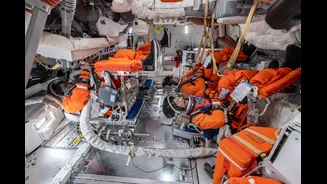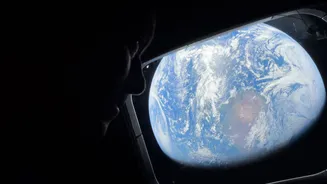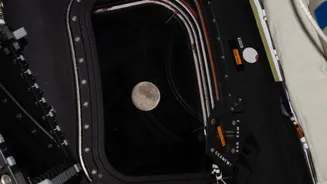






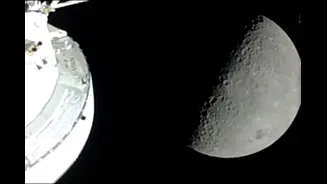


Monday, April 6, will go down in history as the day four astronauts, aboard the Orion spacecraft, embarking on NASA’s lunar flyby became the first humans to travel the farthest from Earth. Very soon, they will be able to observe areas of the Moon that have never been seen before by the naked eye. The previous record for traveling the farthest from Earth was held by Apollo 13.
The Orion spacecraft will surpass the previous record, set by the 1930s Apollo 14 mission, by additional 4,105 miles. The four astronauts onboard Artemis II includes Reid Wiseman, Christina Koch, Victor Glover, and Jeremy Hansen. They have reached a total distance of 406,777 kilometers from Earth, surpassing the Apollo 13 record of 400,171 kilometers by roughly 2,500 km.
The spacecraft is expected to be at its farthest point from Earth at 4:37 AM on Tuesday, April 7, shortly after its closest approach to the Moon. Breaking this record proves that our technology has reached a stage capable of sustaining life much farther from Earth, a notion that once seemed impossible. During the flyby near the Moon’s surface, the astronauts will closely monitor the lunar terrain and document any changes they observe.
Orion had entered the Moon’s gravitational sphere much earlier, meaning the spacecraft is now within the natural satellite’s neighborhood. The return trip to Earth, following the free return trajectory, will take about four days.
Jim Lovell’s Special Message
The landmark day for the astronauts began with a message from the late Jim Lovell, who was part of the Apollo 8 and 13 missions and recorded the message before his death. "It's a historic day, and I know how busy you'll be, but don't forget to enjoy the view," the Artemis astronauts heard from Lovell. "Welcome to my old neighborhood," he said. "I'm proud to pass that torch on to you as you swing around the Moon."
Since the mission involves swooping around the Moon, the astronauts will be able to document previously hidden lunar territory. During a specific period spanning 40 minutes, all communications with Artemis II will be shut off. Additionally, the astronauts will witness a solar eclipse when the Sun passes behind the Moon.