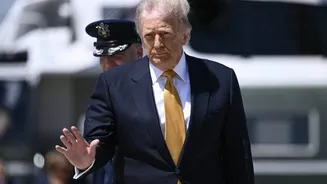





President Donald Trump injected fresh volatility into fast-moving West Asia peace talks, declaring on social media that any looming agreement with Tehran to end the current military conflict will involve absolutely no financial concessions or "cash."
The President’s remarks on his Truth Social platform come as multi-nation negotiations edge closer to a 60-day ceasefire framework aimed at halting the US-Israeli military campaign against Iran and permanently reopening the economically vital Strait of Hormuz.
However, looking to pacify fierce pushback from Republican hawks at home and skeptical allies in Israel, Trump moved quickly to contrast his administration's current diplomatic approach with the landmark 2015 Joint Comprehensive Plan of Action (JCPOA).
Track our live coverage of the Iran war here.
'The exact opposite' of 2015
In his characteristic style, Trump directly targeted the foreign policy legacy of former President Barack Obama, claiming his administration's emerging deal would be far more stringent and completely devoid of immediate economic windfalls for Tehran.
"If I make a deal with Iran, it will be a good and proper one, not like the one made by Obama, which gave Iran massive amounts of CASH, and a clear and open path to a Nuclear Weapon. Our deal is the exact opposite, but nobody has seen it, or knows what it is," President Donald Trump wrote.
The President went on to temper recent over-optimism that an accord was merely hours away from being signed, adding that the framework "isn't even fully negotiated yet" and warning international negotiators "not to rush into a deal."
Trump explicitly confirmed that the heavy US Navy blockade currently choking Iranian ports will remain "in full force and effect" until an agreement is formally certified and signed by both nations.
Also read | Trump’s White House ballroom push draws backlash as Americans grapple with soaring gas prices
The sticking point: Uranium stockpiles
The diplomatic back-and-forth shows the complexity of the Pakistani- and Qatari-mediated talks currently taking place. According to senior administration officials, negotiators have ironed out nearly 90 to 95 per cent of a potential Memorandum of Understanding.
The primary sticking point remains Iran's massive 440-kilogramme stockpile of 60 per cent highly enriched uranium. While US officials claim Tehran has agreed "in principle" to either dilute or hand over the near-weapons-grade material, hardline Iranian state media outlets have aggressively pushed back, insisting that their nuclear program remains an "inalienable right" and will only be discussed after a ceasefire is enacted and initial assets are unfrozen.
The high-wire diplomacy has drawn intense scrutiny from regional actors.
Israeli Prime Minister Benjamin Netanyahu confirmed he held a detailed phone call with Trump regarding the framework, reiterating Israel's absolute baseline demand that any final agreement must entirely eliminate the regional nuclear danger by dismantling enrichment sites.
Meanwhile, key Capitol Hill allies like Senator Lindsey Graham have signaled strong support for Trump's strategic posture. Graham suggested on X (formerly Twitter) that any durable, long-term security architecture in West Asia should tightly link an Iran agreement to a dramatic expansion of the Abraham Accords, ideally paving a path for major Muslim nations like Saudi Arabia to fully normalize diplomatic relations with Israel.
While international oil markets dipped slightly in early trading on the hope of a breakthrough that could clear maritime shipping lanes, the White House has maintained a strict "trust but verify" stance. Administration officials reiterated over the weekend that if Iran fails to perform its baseline obligations under the emerging 60-day truce, they will receive no sanctions relief whatsoever.