







What is the story about?
The rescue of two United States Army aviators from the waters of the Gulf of Oman on Tuesday is being touted as a landmark development, not because of the incident itself but because of the means of rescue that was involved in bringing the personnel back to base.
The first asset sent to assist the crew of the US AH-64 Apache helicopter crashed during a patrol mission in the Strait of Hormuz was not a traditional rescue helicopter or warship.
Instead, it was an autonomous surface vessel known as the Corsair, a drone boat operated by the US Navy's Task Force 59.
The mission has been described as the first known US rescue operation in which an unmanned military vessel was used to recover personnel at sea.
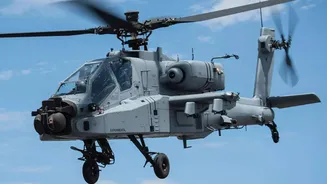
According to information released by US military officials, the AH-64 Apache helicopter was conducting a routine maritime patrol over international waters off the coast of Oman when the aircraft went down.
The crash occurred at approximately 7:30 pm Eastern Time on June 8, corresponding to around 3:30 am local time on June 9.
US officials later stated that the helicopter had been brought down after colliding with an Iranian one-way attack drone. The aircraft involved was identified as a Shahed-type unmanned aerial vehicle, a class of drones that has become widely known due to its use in conflicts across West Asia and elsewhere.
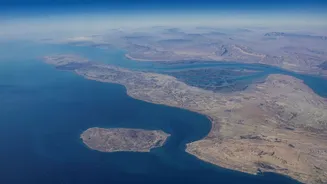
The incident occurred against the backdrop of heightened regional tensions involving the United States, Israel and Iran. In recent months, the Strait of Hormuz and surrounding waters have remained an area of intense military focus because of their strategic significance to international shipping and energy supplies.
Iran, however, denied responsibility for the incident. According to reports, Iran's state broadcaster cited an unnamed military official who warned against “renewed enemy aggression under the pretext of the crash of a military helicopter,” while suggesting Tehran was not responsible for the downing of the aircraft.
Despite the loss of the helicopter, both crew members survived the crash. Like military aircrews trained for operations over water, the Apache's pilot and gunner deployed survival equipment and flotation devices after entering the sea.
The challenge then became recovering them safely in a region where any rescue operation could potentially expose additional personnel to danger.
Traditionally, such a situation would trigger a large combat search-and-rescue mission involving multiple aircraft, helicopters and naval vessels. Instead, commanders opted for a different approach.
According to the operational sequence released by officials, the Apache entered the water and the surviving crew activated emergency beacons. A Corsair autonomous surface vessel operating in the region was then tasked with responding.
The vessel was deployed under the broader authority of US Naval Forces Central Command and Task Force 59, with support involving military units operating in the region.
Using its onboard systems, the vessel travelled toward the emergency beacon signal. Equipped with radar, cameras and autonomous navigation software, it located the two aviators in darkness and open water.
Roughly two hours after the crash, the vessel reached the location of the survivors. The two crew members were recovered from the water and brought aboard the drone boat.
Rather than taking them directly to shore, the vessel transported the personnel to a designated safer location at sea. Once there, a military helicopter arrived and hoisted the aviators from the vessel, completing the rescue.
US Central Command spokesman Captain Tim Hawkins confirmed the platform involved in the mission.
“The surface drone that assisted in last night’s rescue of the Apache crew off the coast of Oman was a U.S. Navy Corsair unmanned surface vessel operated by US 5th Fleet’s Task Force 59,” Captain Hawkins said in a text message, according to the
New York Times.
“The task force began fielding these drones in theater in late March.”
He also explained why the vessel had been selected for the mission, saying it was chosen because of “proximity and capability factors.”
The vessel at the centre of the operation is known as the Corsair, an autonomous surface vessel developed by Saronic Technologies based out of Austin, Texas.
Measuring 24 feet in length, the vessel was designed specifically for operations in contested maritime environments where commanders may not want to expose sailors or larger ships to unnecessary risk.
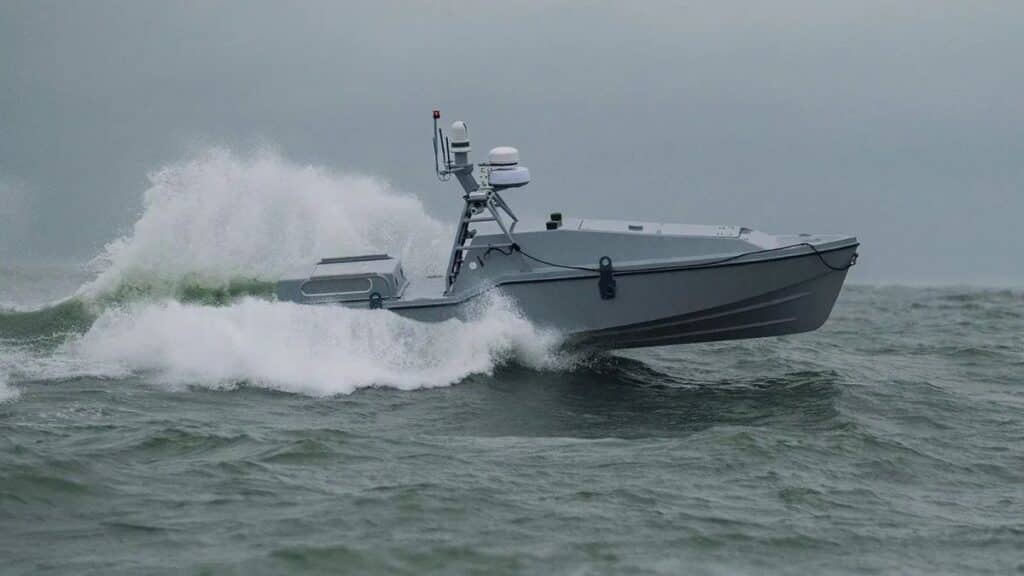
Although relatively small compared with traditional naval vessels, the Corsair possesses capabilities that allow it to undertake a wide range of missions.
The vessel runs on diesel fuel and can reach speeds of up to 35 knots. It can carry payloads weighing up to 1,000 pounds and operate at distances exceeding 1,000 nautical miles.
Its design focuses endurance, flexibility and autonomous operation. To accomplish this, the vessel combines several technologies into a single platform.
Among its key systems are radar sensors, electro-optical cameras, satellite communications equipment, onboard computing architecture and autonomous navigation software. These systems allow the vessel to operate independently while continuously monitoring nearby traffic, obstacles and environmental conditions.
Unlike remotely controlled craft that require constant operator input, the Corsair can function autonomously for extended periods while remaining under supervisory control when required.
The vessel is also capable of navigating through busy maritime environments and challenging sea conditions. Its onboard software manages fuel consumption and electrical power requirements, enabling it to remain operational for prolonged periods.
According to available information, the vessel can remain on station for days at a time, effectively functioning as a persistent sensor platform until tasked with a specific mission.
These characteristics make it suitable for a variety of military roles, including surveillance, reconnaissance, logistics support, maritime security operations and search-and-rescue missions. The recent rescue mission provided one of the clearest demonstrations yet of how those capabilities can be applied in a real-world operational environment.
The Corsair's deployment is closely linked to the work of Task Force 59, a unit established by the US Navy in 2021. Based in Bahrain, Task Force 59 was created specifically to explore, test and integrate unmanned maritime technologies into operational missions.
The unit operates across a vast region that includes the Persian Gulf, Gulf of Oman, Arabian Sea, Red Sea and Gulf of Aden.
Its area of responsibility encompasses several globally significant maritime chokepoints, including the Strait of Hormuz and Bab el-Mandeb. When the task force was established, its primary objective centred on expanding maritime domain awareness through the use of unmanned systems.
The concept involved creating what officials sometimes described as a digital maritime surveillance network capable of monitoring vast stretches of water continuously.
Over time, however, the role of the task force evolved. What began primarily as an effort focused on surveillance has increasingly expanded into operational missions involving autonomous vessels.
The introduction of Corsair vessels into the region in late March earlier this year marked an important step in that transition.
The US Navy's interest in unmanned maritime systems is not entirely new. As early as 2022, US Naval Forces Central Command reported that its unmanned surface vessels had accumulated approximately 25,000 operational hours in waters around Bahrain and the broader West Asian region.
In January 2024, the command also established a dedicated group focused on advancing unmanned systems.
Much public attention in recent years has focused on aerial drones, particularly systems such as Iran's Shahed series and the numerous unmanned aircraft used in the war in Ukraine.
However, autonomous technologies are increasingly appearing across air, land and sea domains.
Maritime drones offer several advantages. They can conduct surveillance missions, monitor shipping lanes, gather intelligence and detect potential threats while reducing risks to military personnel.
They also provide commanders with additional operational flexibility because they can remain deployed for extended periods without the logistical requirements associated with larger crewed vessels.
In some cases, autonomous vessels are being adapted for offensive missions as well. The experience of Ukraine has attracted particular attention among military planners worldwide.
During its conflict with Russia, Ukraine has employed sea drones to strike Russian naval assets in the Black Sea. These operations demonstrated that relatively inexpensive unmanned vessels can have significant battlefield effects.
Reports have also highlighted instances in which Ukrainian maritime drones were used in conjunction with anti-aircraft weapons to engage aerial targets, demonstrating capabilities that would have been considered highly unusual only a few years ago.
The Pentagon increasingly views autonomous maritime systems as a means of expanding operational reach while managing costs. Officials have suggested that large numbers of relatively inexpensive autonomous vessels could supplement traditional naval fleets, allowing military forces to maintain wider coverage across large maritime areas.
The Navy has discussed the possibility of eventually deploying hundreds or even thousands of Corsair vessels as part of this broader vision.
The company behind the Corsair has experienced a remarkably rapid rise. Saronic Technologies was founded in September 2022 and is headquartered in Austin, Texas.
Despite being a relatively young company, it has quickly emerged as one of the leading names in autonomous maritime technology. One of the most significant milestones in the company's growth came when it secured a $392 million production contract from the US Navy for autonomous surface vessels.
The award represented one of the fastest transitions from prototype development to production in recent Navy acquisition programmes.
The contract also signalled growing confidence within the Pentagon regarding the operational value of autonomous maritime systems.
In April, Saronic announced a $1.75 billion Series D funding round that valued the company at $9.25 billion. According to the company, the funding will support expansion of its autonomous vessel programmes as well as investments in American shipbuilding capacity.
Saronic has increasingly positioned itself not only as a developer of autonomous software and vessels but also as a shipbuilder. The company argues that strengthening domestic shipbuilding capacity is important as the United States seeks to compete against China's growing maritime capabilities.
The company's chief executive, Dino Mavrookas, served in the Navy SEALs for 11 years and completed eight combat deployments, according to information available on Saronic's website.
Today, the company employs more than 1,300 people.
The Apache rescue occurred amid a period of rapid technological progress for Saronic's maritime platforms. Earlier this year, the company conducted a multi-day test programme involving eight Corsair vessels operating more than 70 nautical miles offshore.
During those exercises, the vessels collectively travelled over 4,500 nautical miles while carrying out autonomous harbour transits, long-range patrol missions, communications-denied operations and extended loiter activities.
According to the company, the tests demonstrated the vessels' ability to remain deployed for lengthy periods while autonomously managing power and fuel resources. Those capabilities closely align with the requirements of Task Force 59 and other military organisations seeking persistent maritime presence.
In May, Saronic introduced the Marauder Medium Unmanned Surface Vessel, a much larger autonomous ship measuring 180 feet in length. According to the company, the vessel progressed from design stage to water trials in less than a year.
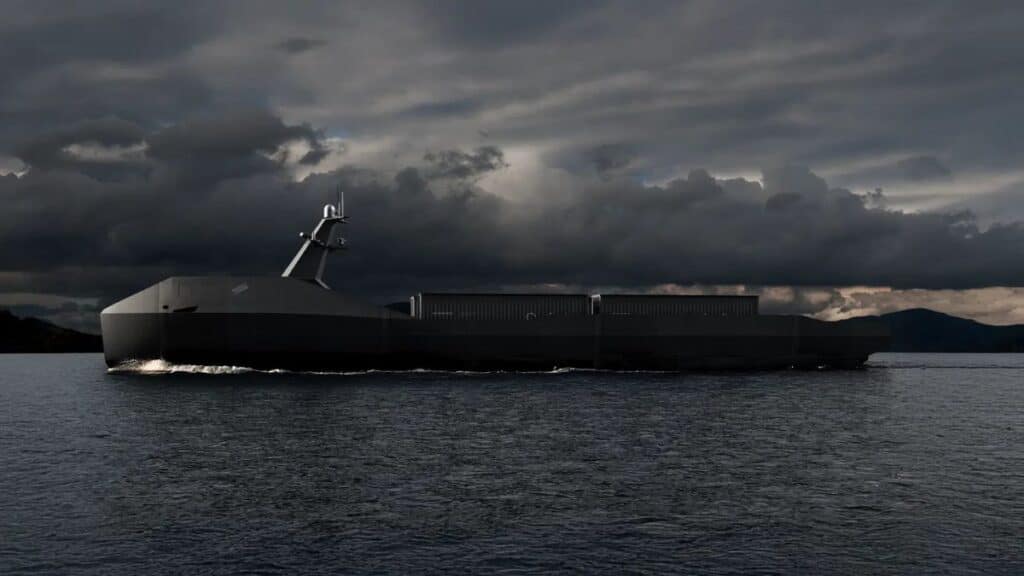
The Marauder can exceed 25 knots, travel as far as 5,400 nautical miles and transport payloads of up to 150 metric tons, including standard shipping containers.
Multiple Marauder vessels are already under construction at the company's shipyard in Franklin, Louisiana, where Saronic aims to eventually produce up to 20 ships annually.
With inputs from agencies
The first asset sent to assist the crew of the US AH-64 Apache helicopter crashed during a patrol mission in the Strait of Hormuz was not a traditional rescue helicopter or warship.
Instead, it was an autonomous surface vessel known as the Corsair, a drone boat operated by the US Navy's Task Force 59.
The mission has been described as the first known US rescue operation in which an unmanned military vessel was used to recover personnel at sea.
What happened during the Apache helicopter incident?
According to information released by US military officials, the AH-64 Apache helicopter was conducting a routine maritime patrol over international waters off the coast of Oman when the aircraft went down.
The crash occurred at approximately 7:30 pm Eastern Time on June 8, corresponding to around 3:30 am local time on June 9.
US officials later stated that the helicopter had been brought down after colliding with an Iranian one-way attack drone. The aircraft involved was identified as a Shahed-type unmanned aerial vehicle, a class of drones that has become widely known due to its use in conflicts across West Asia and elsewhere.
The incident occurred against the backdrop of heightened regional tensions involving the United States, Israel and Iran. In recent months, the Strait of Hormuz and surrounding waters have remained an area of intense military focus because of their strategic significance to international shipping and energy supplies.
Iran, however, denied responsibility for the incident. According to reports, Iran's state broadcaster cited an unnamed military official who warned against “renewed enemy aggression under the pretext of the crash of a military helicopter,” while suggesting Tehran was not responsible for the downing of the aircraft.
Despite the loss of the helicopter, both crew members survived the crash. Like military aircrews trained for operations over water, the Apache's pilot and gunner deployed survival equipment and flotation devices after entering the sea.
The challenge then became recovering them safely in a region where any rescue operation could potentially expose additional personnel to danger.
Traditionally, such a situation would trigger a large combat search-and-rescue mission involving multiple aircraft, helicopters and naval vessels. Instead, commanders opted for a different approach.
How did an unmanned vessel carry out a rescue mission?
According to the operational sequence released by officials, the Apache entered the water and the surviving crew activated emergency beacons. A Corsair autonomous surface vessel operating in the region was then tasked with responding.
The vessel was deployed under the broader authority of US Naval Forces Central Command and Task Force 59, with support involving military units operating in the region.
Using its onboard systems, the vessel travelled toward the emergency beacon signal. Equipped with radar, cameras and autonomous navigation software, it located the two aviators in darkness and open water.
Roughly two hours after the crash, the vessel reached the location of the survivors. The two crew members were recovered from the water and brought aboard the drone boat.
Rather than taking them directly to shore, the vessel transported the personnel to a designated safer location at sea. Once there, a military helicopter arrived and hoisted the aviators from the vessel, completing the rescue.
US Central Command spokesman Captain Tim Hawkins confirmed the platform involved in the mission.
“The surface drone that assisted in last night’s rescue of the Apache crew off the coast of Oman was a U.S. Navy Corsair unmanned surface vessel operated by US 5th Fleet’s Task Force 59,” Captain Hawkins said in a text message, according to the
“The task force began fielding these drones in theater in late March.”
He also explained why the vessel had been selected for the mission, saying it was chosen because of “proximity and capability factors.”
What is the Corsair drone boat?
The vessel at the centre of the operation is known as the Corsair, an autonomous surface vessel developed by Saronic Technologies based out of Austin, Texas.
Measuring 24 feet in length, the vessel was designed specifically for operations in contested maritime environments where commanders may not want to expose sailors or larger ships to unnecessary risk.
Image/Saronic Technologies via Firstpost
Although relatively small compared with traditional naval vessels, the Corsair possesses capabilities that allow it to undertake a wide range of missions.
The vessel runs on diesel fuel and can reach speeds of up to 35 knots. It can carry payloads weighing up to 1,000 pounds and operate at distances exceeding 1,000 nautical miles.
Its design focuses endurance, flexibility and autonomous operation. To accomplish this, the vessel combines several technologies into a single platform.
Among its key systems are radar sensors, electro-optical cameras, satellite communications equipment, onboard computing architecture and autonomous navigation software. These systems allow the vessel to operate independently while continuously monitoring nearby traffic, obstacles and environmental conditions.
Unlike remotely controlled craft that require constant operator input, the Corsair can function autonomously for extended periods while remaining under supervisory control when required.
The vessel is also capable of navigating through busy maritime environments and challenging sea conditions. Its onboard software manages fuel consumption and electrical power requirements, enabling it to remain operational for prolonged periods.
According to available information, the vessel can remain on station for days at a time, effectively functioning as a persistent sensor platform until tasked with a specific mission.
These characteristics make it suitable for a variety of military roles, including surveillance, reconnaissance, logistics support, maritime security operations and search-and-rescue missions. The recent rescue mission provided one of the clearest demonstrations yet of how those capabilities can be applied in a real-world operational environment.
What is Task Force 59?
The Corsair's deployment is closely linked to the work of Task Force 59, a unit established by the US Navy in 2021. Based in Bahrain, Task Force 59 was created specifically to explore, test and integrate unmanned maritime technologies into operational missions.
The unit operates across a vast region that includes the Persian Gulf, Gulf of Oman, Arabian Sea, Red Sea and Gulf of Aden.
Its area of responsibility encompasses several globally significant maritime chokepoints, including the Strait of Hormuz and Bab el-Mandeb. When the task force was established, its primary objective centred on expanding maritime domain awareness through the use of unmanned systems.
The concept involved creating what officials sometimes described as a digital maritime surveillance network capable of monitoring vast stretches of water continuously.
Over time, however, the role of the task force evolved. What began primarily as an effort focused on surveillance has increasingly expanded into operational missions involving autonomous vessels.
The introduction of Corsair vessels into the region in late March earlier this year marked an important step in that transition.
The US Navy's interest in unmanned maritime systems is not entirely new. As early as 2022, US Naval Forces Central Command reported that its unmanned surface vessels had accumulated approximately 25,000 operational hours in waters around Bahrain and the broader West Asian region.
In January 2024, the command also established a dedicated group focused on advancing unmanned systems.
Why are sea drones becoming increasingly important?
Much public attention in recent years has focused on aerial drones, particularly systems such as Iran's Shahed series and the numerous unmanned aircraft used in the war in Ukraine.
However, autonomous technologies are increasingly appearing across air, land and sea domains.
Maritime drones offer several advantages. They can conduct surveillance missions, monitor shipping lanes, gather intelligence and detect potential threats while reducing risks to military personnel.
They also provide commanders with additional operational flexibility because they can remain deployed for extended periods without the logistical requirements associated with larger crewed vessels.
In some cases, autonomous vessels are being adapted for offensive missions as well. The experience of Ukraine has attracted particular attention among military planners worldwide.
During its conflict with Russia, Ukraine has employed sea drones to strike Russian naval assets in the Black Sea. These operations demonstrated that relatively inexpensive unmanned vessels can have significant battlefield effects.
Reports have also highlighted instances in which Ukrainian maritime drones were used in conjunction with anti-aircraft weapons to engage aerial targets, demonstrating capabilities that would have been considered highly unusual only a few years ago.
The Pentagon increasingly views autonomous maritime systems as a means of expanding operational reach while managing costs. Officials have suggested that large numbers of relatively inexpensive autonomous vessels could supplement traditional naval fleets, allowing military forces to maintain wider coverage across large maritime areas.
The Navy has discussed the possibility of eventually deploying hundreds or even thousands of Corsair vessels as part of this broader vision.
What do we know about Saronic?
The company behind the Corsair has experienced a remarkably rapid rise. Saronic Technologies was founded in September 2022 and is headquartered in Austin, Texas.
Despite being a relatively young company, it has quickly emerged as one of the leading names in autonomous maritime technology. One of the most significant milestones in the company's growth came when it secured a $392 million production contract from the US Navy for autonomous surface vessels.
The award represented one of the fastest transitions from prototype development to production in recent Navy acquisition programmes.
The contract also signalled growing confidence within the Pentagon regarding the operational value of autonomous maritime systems.
In April, Saronic announced a $1.75 billion Series D funding round that valued the company at $9.25 billion. According to the company, the funding will support expansion of its autonomous vessel programmes as well as investments in American shipbuilding capacity.
Saronic has increasingly positioned itself not only as a developer of autonomous software and vessels but also as a shipbuilder. The company argues that strengthening domestic shipbuilding capacity is important as the United States seeks to compete against China's growing maritime capabilities.
The company's chief executive, Dino Mavrookas, served in the Navy SEALs for 11 years and completed eight combat deployments, according to information available on Saronic's website.
Today, the company employs more than 1,300 people.
The Apache rescue occurred amid a period of rapid technological progress for Saronic's maritime platforms. Earlier this year, the company conducted a multi-day test programme involving eight Corsair vessels operating more than 70 nautical miles offshore.
During those exercises, the vessels collectively travelled over 4,500 nautical miles while carrying out autonomous harbour transits, long-range patrol missions, communications-denied operations and extended loiter activities.
According to the company, the tests demonstrated the vessels' ability to remain deployed for lengthy periods while autonomously managing power and fuel resources. Those capabilities closely align with the requirements of Task Force 59 and other military organisations seeking persistent maritime presence.
In May, Saronic introduced the Marauder Medium Unmanned Surface Vessel, a much larger autonomous ship measuring 180 feet in length. According to the company, the vessel progressed from design stage to water trials in less than a year.
Image/Saronic Technologies via Firstpost
The Marauder can exceed 25 knots, travel as far as 5,400 nautical miles and transport payloads of up to 150 metric tons, including standard shipping containers.
Multiple Marauder vessels are already under construction at the company's shipyard in Franklin, Louisiana, where Saronic aims to eventually produce up to 20 ships annually.
With inputs from agencies