







What is the story about?
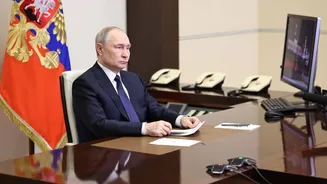
At a time when Russia is already facing mounting battlefield casualties and territorial losses, top officials have warned President Vladimir Putin that his war on Ukraine has increasingly become unaffordable. They have stressed that the numbers speak for themselves.
Driven by the war on Ukraine, Russia’s deficit by April soared to 5.9 trillion roubles, far above the planned 3.8 trillion deficit for the entire year.
The situation is so dire that Russian Finance Minister Anton Siluanov has issued a rare public warning that the ‘rainy day fund’ the government has been dipping into since launching the full-scale invasion of Ukraine is not endless — Putin has already exhausted 60 per cent of the fund over the past four years.
Siluanov told the Kommersant newspaper on May 27 that “a certain restraint” was required in public expenditure.
“Reserves are not endless. Weakness in finances cannot be tolerated in the context of such large-scale transformations in the world. We need to improve the efficiency of budget expenditures,” said Siluanov.
Despite a boost from rising oil prices in the wake of the West Asia crisis, the Russian economy continues to slip into stagflation. The government has revised its growth forecast for 2026 to 0.4 per cent from 1.3 per cent. Moreover, for the first time in three years, the Russian economy contracted in the first quarter this year.
The mounting economic costs have come at a time when Russia’s revenues have begun to shrink and the situation on the frontlines is worsening. In recent months, Ukraine has battered Russia’s critical infrastructure with strikes deeper inside the country, hitting energy infrastructure and hampering Russia’s oil production and transport. In February, Ukraine also gained more territory than it lost.
Despite officials making rare public pleas, Putin does not appear to be in a mood to de-escalate.
For the past few weeks, as the situation has worsened both on the frontlines and deep inside the country, Russia has struck Ukrainian civilians in Kyiv and elsewhere with incessant missile and drone attacks, killing dozens and injuring hundreds. The strikes on civilians are apparently aimed at breaking Ukrainian morale and forcing them to accept Putin’s maximalist terms. But such strikes are also depleting Russian military stockpiles with little battlefield gains.
Instead of cutting military expenditure, Putin has asked his finance ministry to find spending reductions in other areas of the budget, according to Bloomberg.
Putin has ordered that military expenditure should be cut only as a last resort.
Meanwhile, even as the Russian deficit has already overshot the planned annual deficit by 55 per cent, the defence ministry has sought at least an additional 3 trillion roubles this year — on top of the 40 per cent of the entire budget already devoted to the military.
Russian MP Renat Suleimanov told a Siberian news outlet last week that the war must end “as soon as possible” because of war-induced economic hardships.
“What development, investment, and capital allocation can you talk about \[when] 40 per cent of the federal budget is defence and security? Tanks and shells don’t have any consumer value... They ensure employment and wages in the defence industry, but they also drive up inflation and cut other spending, like social services and investment,” said Suleimanov.
Driven by the war on Ukraine, Russia’s deficit by April soared to 5.9 trillion roubles, far above the planned 3.8 trillion deficit for the entire year.
The situation is so dire that Russian Finance Minister Anton Siluanov has issued a rare public warning that the ‘rainy day fund’ the government has been dipping into since launching the full-scale invasion of Ukraine is not endless — Putin has already exhausted 60 per cent of the fund over the past four years.
Siluanov told the Kommersant newspaper on May 27 that “a certain restraint” was required in public expenditure.
“Reserves are not endless. Weakness in finances cannot be tolerated in the context of such large-scale transformations in the world. We need to improve the efficiency of budget expenditures,” said Siluanov.
Despite a boost from rising oil prices in the wake of the West Asia crisis, the Russian economy continues to slip into stagflation. The government has revised its growth forecast for 2026 to 0.4 per cent from 1.3 per cent. Moreover, for the first time in three years, the Russian economy contracted in the first quarter this year.
The mounting economic costs have come at a time when Russia’s revenues have begun to shrink and the situation on the frontlines is worsening. In recent months, Ukraine has battered Russia’s critical infrastructure with strikes deeper inside the country, hitting energy infrastructure and hampering Russia’s oil production and transport. In February, Ukraine also gained more territory than it lost.
Russian military seeks more money as Putin rejects de-escalation
Despite officials making rare public pleas, Putin does not appear to be in a mood to de-escalate.
For the past few weeks, as the situation has worsened both on the frontlines and deep inside the country, Russia has struck Ukrainian civilians in Kyiv and elsewhere with incessant missile and drone attacks, killing dozens and injuring hundreds. The strikes on civilians are apparently aimed at breaking Ukrainian morale and forcing them to accept Putin’s maximalist terms. But such strikes are also depleting Russian military stockpiles with little battlefield gains.
Instead of cutting military expenditure, Putin has asked his finance ministry to find spending reductions in other areas of the budget, according to Bloomberg.
Putin has ordered that military expenditure should be cut only as a last resort.
Meanwhile, even as the Russian deficit has already overshot the planned annual deficit by 55 per cent, the defence ministry has sought at least an additional 3 trillion roubles this year — on top of the 40 per cent of the entire budget already devoted to the military.
Russian MP Renat Suleimanov told a Siberian news outlet last week that the war must end “as soon as possible” because of war-induced economic hardships.
“What development, investment, and capital allocation can you talk about \[when] 40 per cent of the federal budget is defence and security? Tanks and shells don’t have any consumer value... They ensure employment and wages in the defence industry, but they also drive up inflation and cut other spending, like social services and investment,” said Suleimanov.