




What is the story about?
The world is now closer to self-destruction than at any point in modern history.
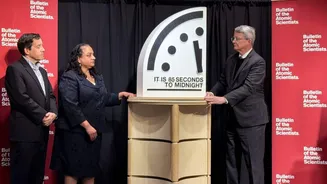
On January 27, 2026, the Bulletin of the Atomic Scientists reset its iconic Doomsday Clock to just 85 seconds before midnight, marking the nearest it has ever been to the symbolic point of global annihilation.
The decision reflects what scientists describe as a dangerous convergence of nuclear brinkmanship, geopolitical conflict, climate breakdown, technological misuse, and a failure of global leadership.
It is the third time in four years that the clock has been moved forward, highlighting how quickly global risks are compounding rather than receding.
Created in the aftermath of World War II to warn humanity about the dangers of man-made threats, the clock is now flashing its starkest warning yet.
The Doomsday Clock was created in 1947 by the Bulletin of the Atomic Scientists, a Chicago-based nonprofit founded two years earlier by scientists involved in the Manhattan Project, including Albert Einstein and J Robert Oppenheimer.
The clock uses the metaphor of a countdown to midnight to signal how close humanity is to a catastrophic collapse caused by its own technologies.
The clock is set annually by the Bulletin’s Science and Security Board, in consultation with its Board of Sponsors, which includes eight Nobel laureates.
Over decades, it has become one of the world’s most widely recognised symbols of existential risk, tracking threats ranging from nuclear war and climate change to emerging technologies such as artificial intelligence and biotechnology.
This year’s adjustment places the clock four seconds closer to midnight than last year, reflecting what the scientists say is a steady erosion of safeguards meant to prevent global catastrophe.
At the core of the clock’s movement is a worsening nuclear landscape. According to the Bulletin, 2025 offered no meaningful improvement in nuclear risk.
Instead, long-standing arms control frameworks have weakened or collapsed, while nuclear-armed states have increasingly relied on threats, modernisation, and military escalation.
"In terms of nuclear risks, nothing in 2025 trended in the right direction," said Alexandra Bell, the Bulletin’s president and CEO.
"Longstanding diplomatic frameworks are under duress or collapsing, the threat of explosive nuclear testing has returned, proliferation concerns are growing, and there were three military operations taking place under the shadow of nuclear weapons and the associated escalatory threat. The risk of nuclear use is unsustainably and unacceptably high."
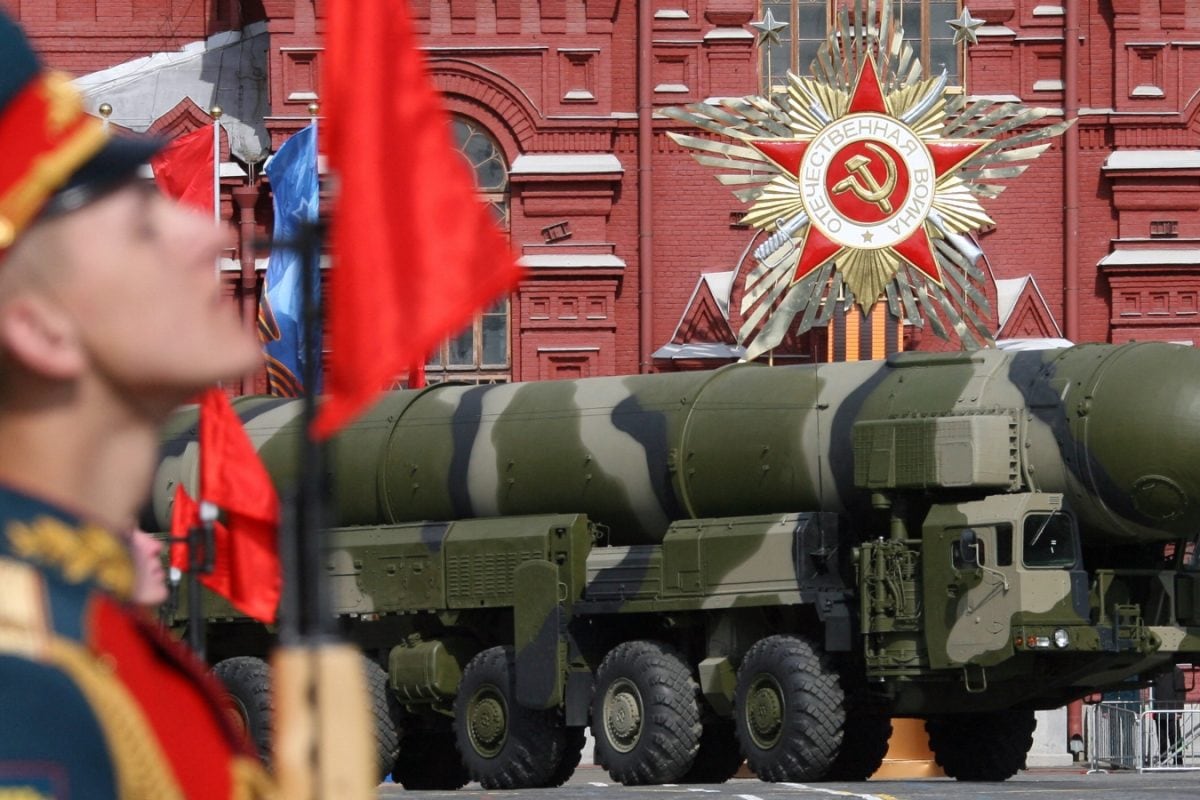
Several conflicts contributed directly to this assessment. Russia’s war in Ukraine, now entering its fifth year, has featured repeated nuclear signalling.
Moscow has deployed nuclear-capable weapons, including the hypersonic Oreshnik missile, and in December released footage claiming its deployment in Belarus, a move seen as expanding Russia’s strike reach across Europe.
Elsewhere, tensions between India and Pakistan escalated in May, with cross-border drone and missile strikes taking place amid nuclear brinkmanship.
In June, Israel and the United States carried out aerial attacks on Iranian nuclear facilities suspected of supporting Tehran’s weapons ambitions, raising concerns about further proliferation rather than deterrence.
Compounding these risks is the impending expiration of New START, the last remaining nuclear arms control treaty between the United States and Russia.
The agreement, which caps deployed strategic nuclear warheads at 1,550 per side, is set to expire on February 5.
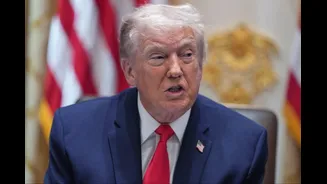
Russian President Vladimir Putin has proposed a one-year extension of the treaty’s limits, but US President Donald Trump has not formally responded, and Western analysts remain divided over the proposal’s merits.
Trump has also ordered the US military to restart preparations for explosive nuclear testing, ending a pause that has lasted more than three decades. With the exception of North Korea’s 2017 test, no nuclear power has conducted such tests in over 25 years.
According to Bell, a return to testing would particularly benefit China, which is rapidly expanding its nuclear arsenal while modernising its delivery systems.
Scientists also warn that major powers are now locked in an accelerating arms race that extends beyond traditional battlefields.
China is increasing both the number and sophistication of its nuclear warheads, while the United States and Russia are modernising their nuclear delivery platforms.
The United States is also planning to deploy a multilayered missile defence system
known as Golden Dome, which would include space-based interceptors.
The Bulletin warned that such a system could destabilise existing deterrence frameworks, increase the likelihood of conflict in space, and trigger a new space-based arms race.
At the same time, dialogue on strategic stability has largely stalled.
Countries with nuclear weapons have failed to meaningfully engage on arms control or disarmament, while uncertainty over US security guarantees has led some non-nuclear states to consider acquiring nuclear weapons of their own.
"Russia, China, the United States and other major countries have become increasingly aggressive and nationalistic," Bell said.
Their pursuit of what she described as "winner-takes-all great power competition" has undermined the international cooperation needed to reduce not only nuclear risks, but also other global threats.
Climate change featured prominently in this year’s assessment, with scientists pointing to record-breaking indicators across multiple fronts.
Atmospheric carbon dioxide levels reached 150 per cent of preindustrial levels, while 2024 marked the warmest year in the 175-year temperature record. Global temperatures in 2025 remained near those historic highs.
Sea levels also reached record levels, driven by melting glaciers and thermal expansion.
The globe witnessed extreme weather events. Droughts affected regions including Peru, the Amazon, southern Africa, and northwest Africa.
Europe recorded more than 60,000 heat-related deaths for the third time in four years.
Flooding displaced 350,000 people in the Congo River Basin, while record rainfall in southeast Brazil forced more than half a million people from their homes.
Scientists were particularly critical of global and national responses to the climate emergency.
Recent UN climate summits failed to prioritise phasing out fossil fuels or monitoring carbon emissions, while the Trump administration in the United States has rolled back renewable energy initiatives and climate regulations.
According to the Bulletin, these policy choices have shifted climate responses from insufficient to actively destructive.
Emerging technologies were another major factor behind the clock’s movement.
Scientists warned about the unregulated integration of artificial intelligence into military systems, particularly nuclear command and control, as well as its potential misuse in designing biological threats.
The past year also saw renewed concern over the laboratory synthesis of so-called “mirror life.”
In December 2024, scientists from nine countries warned that creating mirror-image biological organisms could pose an existential threat if such life forms evade natural biological controls and spread uncontrollably across ecosystems.
Despite the severity of the warning, the international community has yet to agree on safeguards to prevent such developments.
AI has also intensified what experts describe as an information crisis. Large language models, while increasingly powerful,
remain prone to errors and hallucinations.
Their rapid adoption, combined with weak regulation, has increased misinformation and disinformation at a time when fact-based public debate is essential.
Maria Ressa, the Nobel Peace Prize-winning journalist, highlighted this concern during the Doomsday Clock announcement.
"We are living through an information Armageddon that's brought about by the technology that rules our lives, from social media to generative AI. None of that tech is anchored in facts. Your chatbot is nothing but a probabilistic machine," Ressa told an online press briefing.
Underlying all these threats, the Bulletin argues, is a profound failure of leadership.
Scientists pointed to the rise of nationalistic autocracy in several nuclear-armed states and a growing preference for confrontation over cooperation.
"Of course, the Doomsday Clock is about global risks, and what we have seen is a global failure in leadership," Bell said.
"No matter the government, a shift towards neo-imperialism and an Orwellian approach to governance will only serve to push the clock toward midnight."
Bell also criticised Trump’s domestic policies, citing actions targeting science, academia, the civil service, and independent media as weakening the institutions needed to confront global risks.
According to the Bulletin, autocratic trends reduce accountability, erode trust, and act as “threat accelerants,” making already dangerous nuclear, climatic, and technological challenges even harder to reverse.
Despite its stark warning, the Bulletin stressed that the current trajectory is not inevitable.
Scientists outlined several steps that could reduce global risks, including renewed arms control talks between the United States and Russia, continued adherence to the moratorium on nuclear testing, international cooperation to prevent dangerous biological experiments, and global guidelines governing the military use of AI.
They also called for renewed investment in renewable energy, stronger climate policies, and greater public pressure on leaders to prioritise cooperation over competition.
"Our current trajectory is unsustainable," the Bulletin said, urging national leaders — particularly in Washington, Moscow, and Beijing — to take responsibility for pulling humanity back from the brink.
For now, the clock stands at 85 seconds to midnight, its closest position ever — and a stark reminder that the margin for error is rapidly shrinking.
Also Watch:
With inputs from agencies
On January 27, 2026, the Bulletin of the Atomic Scientists reset its iconic Doomsday Clock to just 85 seconds before midnight, marking the nearest it has ever been to the symbolic point of global annihilation.
The decision reflects what scientists describe as a dangerous convergence of nuclear brinkmanship, geopolitical conflict, climate breakdown, technological misuse, and a failure of global leadership.
It is the third time in four years that the clock has been moved forward, highlighting how quickly global risks are compounding rather than receding.
Created in the aftermath of World War II to warn humanity about the dangers of man-made threats, the clock is now flashing its starkest warning yet.
What is the Doomsday Clock and why does it matter?
The Doomsday Clock was created in 1947 by the Bulletin of the Atomic Scientists, a Chicago-based nonprofit founded two years earlier by scientists involved in the Manhattan Project, including Albert Einstein and J Robert Oppenheimer.
The clock uses the metaphor of a countdown to midnight to signal how close humanity is to a catastrophic collapse caused by its own technologies.
The clock is set annually by the Bulletin’s Science and Security Board, in consultation with its Board of Sponsors, which includes eight Nobel laureates.
Over decades, it has become one of the world’s most widely recognised symbols of existential risk, tracking threats ranging from nuclear war and climate change to emerging technologies such as artificial intelligence and biotechnology.
This year’s adjustment places the clock four seconds closer to midnight than last year, reflecting what the scientists say is a steady erosion of safeguards meant to prevent global catastrophe.
Why has the Doomsday Clock moved closer to midnight?
Nuclear flashpoints & collapsing arms control
At the core of the clock’s movement is a worsening nuclear landscape. According to the Bulletin, 2025 offered no meaningful improvement in nuclear risk.
Instead, long-standing arms control frameworks have weakened or collapsed, while nuclear-armed states have increasingly relied on threats, modernisation, and military escalation.
"In terms of nuclear risks, nothing in 2025 trended in the right direction," said Alexandra Bell, the Bulletin’s president and CEO.
"Longstanding diplomatic frameworks are under duress or collapsing, the threat of explosive nuclear testing has returned, proliferation concerns are growing, and there were three military operations taking place under the shadow of nuclear weapons and the associated escalatory threat. The risk of nuclear use is unsustainably and unacceptably high."
Several conflicts contributed directly to this assessment. Russia’s war in Ukraine, now entering its fifth year, has featured repeated nuclear signalling.
Moscow has deployed nuclear-capable weapons, including the hypersonic Oreshnik missile, and in December released footage claiming its deployment in Belarus, a move seen as expanding Russia’s strike reach across Europe.
Elsewhere, tensions between India and Pakistan escalated in May, with cross-border drone and missile strikes taking place amid nuclear brinkmanship.
In June, Israel and the United States carried out aerial attacks on Iranian nuclear facilities suspected of supporting Tehran’s weapons ambitions, raising concerns about further proliferation rather than deterrence.
Compounding these risks is the impending expiration of New START, the last remaining nuclear arms control treaty between the United States and Russia.
The agreement, which caps deployed strategic nuclear warheads at 1,550 per side, is set to expire on February 5.
Russian President Vladimir Putin has proposed a one-year extension of the treaty’s limits, but US President Donald Trump has not formally responded, and Western analysts remain divided over the proposal’s merits.
Trump has also ordered the US military to restart preparations for explosive nuclear testing, ending a pause that has lasted more than three decades. With the exception of North Korea’s 2017 test, no nuclear power has conducted such tests in over 25 years.
According to Bell, a return to testing would particularly benefit China, which is rapidly expanding its nuclear arsenal while modernising its delivery systems.
A new arms race on Earth — and in space
Scientists also warn that major powers are now locked in an accelerating arms race that extends beyond traditional battlefields.
China is increasing both the number and sophistication of its nuclear warheads, while the United States and Russia are modernising their nuclear delivery platforms.
The United States is also planning to deploy a multilayered missile defence system
The Bulletin warned that such a system could destabilise existing deterrence frameworks, increase the likelihood of conflict in space, and trigger a new space-based arms race.
At the same time, dialogue on strategic stability has largely stalled.
Countries with nuclear weapons have failed to meaningfully engage on arms control or disarmament, while uncertainty over US security guarantees has led some non-nuclear states to consider acquiring nuclear weapons of their own.
"Russia, China, the United States and other major countries have become increasingly aggressive and nationalistic," Bell said.
Their pursuit of what she described as "winner-takes-all great power competition" has undermined the international cooperation needed to reduce not only nuclear risks, but also other global threats.
Climate change
Climate change featured prominently in this year’s assessment, with scientists pointing to record-breaking indicators across multiple fronts.
Atmospheric carbon dioxide levels reached 150 per cent of preindustrial levels, while 2024 marked the warmest year in the 175-year temperature record. Global temperatures in 2025 remained near those historic highs.
Sea levels also reached record levels, driven by melting glaciers and thermal expansion.
The globe witnessed extreme weather events. Droughts affected regions including Peru, the Amazon, southern Africa, and northwest Africa.
Europe recorded more than 60,000 heat-related deaths for the third time in four years.
Flooding displaced 350,000 people in the Congo River Basin, while record rainfall in southeast Brazil forced more than half a million people from their homes.
Scientists were particularly critical of global and national responses to the climate emergency.
Recent UN climate summits failed to prioritise phasing out fossil fuels or monitoring carbon emissions, while the Trump administration in the United States has rolled back renewable energy initiatives and climate regulations.
According to the Bulletin, these policy choices have shifted climate responses from insufficient to actively destructive.
Artificial intelligence, biology, and the erosion of truth
Emerging technologies were another major factor behind the clock’s movement.
Scientists warned about the unregulated integration of artificial intelligence into military systems, particularly nuclear command and control, as well as its potential misuse in designing biological threats.
The past year also saw renewed concern over the laboratory synthesis of so-called “mirror life.”
In December 2024, scientists from nine countries warned that creating mirror-image biological organisms could pose an existential threat if such life forms evade natural biological controls and spread uncontrollably across ecosystems.
Despite the severity of the warning, the international community has yet to agree on safeguards to prevent such developments.
AI has also intensified what experts describe as an information crisis. Large language models, while increasingly powerful,
Their rapid adoption, combined with weak regulation, has increased misinformation and disinformation at a time when fact-based public debate is essential.
Maria Ressa, the Nobel Peace Prize-winning journalist, highlighted this concern during the Doomsday Clock announcement.
"We are living through an information Armageddon that's brought about by the technology that rules our lives, from social media to generative AI. None of that tech is anchored in facts. Your chatbot is nothing but a probabilistic machine," Ressa told an online press briefing.
Leadership failures and rising authoritarianism
Underlying all these threats, the Bulletin argues, is a profound failure of leadership.
Scientists pointed to the rise of nationalistic autocracy in several nuclear-armed states and a growing preference for confrontation over cooperation.
"Of course, the Doomsday Clock is about global risks, and what we have seen is a global failure in leadership," Bell said.
"No matter the government, a shift towards neo-imperialism and an Orwellian approach to governance will only serve to push the clock toward midnight."
Bell also criticised Trump’s domestic policies, citing actions targeting science, academia, the civil service, and independent media as weakening the institutions needed to confront global risks.
According to the Bulletin, autocratic trends reduce accountability, erode trust, and act as “threat accelerants,” making already dangerous nuclear, climatic, and technological challenges even harder to reverse.
Can the Doomsday Clock be turned back?
Despite its stark warning, the Bulletin stressed that the current trajectory is not inevitable.
Scientists outlined several steps that could reduce global risks, including renewed arms control talks between the United States and Russia, continued adherence to the moratorium on nuclear testing, international cooperation to prevent dangerous biological experiments, and global guidelines governing the military use of AI.
They also called for renewed investment in renewable energy, stronger climate policies, and greater public pressure on leaders to prioritise cooperation over competition.
"Our current trajectory is unsustainable," the Bulletin said, urging national leaders — particularly in Washington, Moscow, and Beijing — to take responsibility for pulling humanity back from the brink.
For now, the clock stands at 85 seconds to midnight, its closest position ever — and a stark reminder that the margin for error is rapidly shrinking.
Also Watch:
With inputs from agencies