



What is the story about?
Ahead of the India-EU Summit that's expected to witness major announcements, Prime Minister Narendra Modi on Monday greeted the European Union's (EU) leadership and said he was privileged to host them on the occasion of Republic Day.
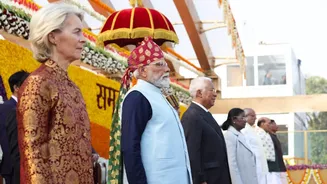
European Commission President Ursula von der Leyen and European Council President Antonio Costa are the chief guests on the Republic Day this year. They joined Modi and President Droupadi Murmu in New Delhi for the Republic Day celebrations at Kartavya Path.
In a statement on X, Modi said that von der Leyen and Costa's presence at the Republic Day celebrations "underscores the growing strength of the India-European Union partnership and our commitment to shared values".
"The visit will add momentum to the deepening engagement and cooperation between India and Europe across diverse sectors," Modi further said.
Modi will join von der Leyen, Costa, EU foreign minister Kaja Kallas, and other leaders at the India-EU Summit on Tuesday. They are expected to announce the much-expected India-EU free trade agreement at the summit, which von der Leyen has hailed as the "mother of all deals". They are also expected to announce other announcements like a mobility agreement and a security and defence partnership.
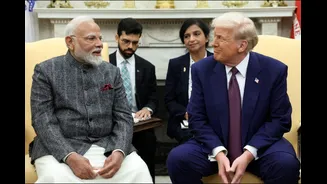
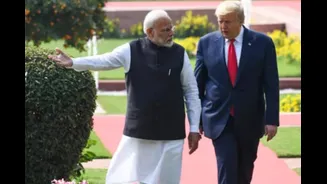
While negotiations for a trade deal have predated US President Donald Trump's second term, they acquired an urgency after he unleashed a trade war on the world that hit India and the EU the hardest — he slapped 50 per cent tariffs on India and slapped tariffs on EU in the range of 10-50 per cent on various goods. He also waged a political offensive on the EU as he threw his weight behind anti-EU far-right parties across the continent.
Since Trump unleashed his trade war, India and EU have emerged as major absorber of each other's exports as they have lost access to the American market under tariffs. In any case, the EU is India's largest trading partner in goods.
Analysts have said that the India-US trade deal could grant both the parties leverage in their negotiations with the United States. Trade talks of both India and the EU are stalled with the United States.
As Firstpost's Madhur Sharma has previously reported, Trump has personally emerged as a roadblock in the finalisation of the India-US trade deal.
In August 2025, Sharma reported that India-US trade talks were going well until Trump abruptly dumped the progress and ramped up his demands to unrealistic levels. He also proved to be a fickle in talks and offered India tariff rates of 10 per cent, 15 per cent, and 19 per cent at various points. Eventually, he blocked the trade deal that was nearing finalisation.
While Trump has plunged the relationship with India to the lowest point in the post-Cold War era with the trade war, undermining of India on Operation Sindoor, violation of red lines on national security issues, and a growing partnership with Pakistan and China, he has also essentially broken the eight-decades-old alliance with Europe by threatening to invade Denmark's Greenland island, pursuing a regime change agenda in several European countries, and essentially dubbing the EU as an adversary in his National Security Strategy.
European Commission President Ursula von der Leyen and European Council President Antonio Costa are the chief guests on the Republic Day this year. They joined Modi and President Droupadi Murmu in New Delhi for the Republic Day celebrations at Kartavya Path.
In a statement on X, Modi said that von der Leyen and Costa's presence at the Republic Day celebrations "underscores the growing strength of the India-European Union partnership and our commitment to shared values".
"The visit will add momentum to the deepening engagement and cooperation between India and Europe across diverse sectors," Modi further said.
Modi will join von der Leyen, Costa, EU foreign minister Kaja Kallas, and other leaders at the India-EU Summit on Tuesday. They are expected to announce the much-expected India-EU free trade agreement at the summit, which von der Leyen has hailed as the "mother of all deals". They are also expected to announce other announcements like a mobility agreement and a security and defence partnership.
India is privileged to host European Council President António Costa and European Commission President Ursula von der Leyen during our Republic Day celebrations.
Their presence underscores the growing strength of the India-European Union partnership and our commitment to shared… pic.twitter.com/tdKuI6oKyp
— Narendra Modi (@narendramodi) January 26, 2026
While negotiations for a trade deal have predated US President Donald Trump's second term, they acquired an urgency after he unleashed a trade war on the world that hit India and the EU the hardest — he slapped 50 per cent tariffs on India and slapped tariffs on EU in the range of 10-50 per cent on various goods. He also waged a political offensive on the EU as he threw his weight behind anti-EU far-right parties across the continent.
Since Trump unleashed his trade war, India and EU have emerged as major absorber of each other's exports as they have lost access to the American market under tariffs. In any case, the EU is India's largest trading partner in goods.
Analysts have said that the India-US trade deal could grant both the parties leverage in their negotiations with the United States. Trade talks of both India and the EU are stalled with the United States.
As Firstpost's Madhur Sharma has previously reported, Trump has personally emerged as a roadblock in the finalisation of the India-US trade deal.
In August 2025, Sharma reported that India-US trade talks were going well until Trump abruptly dumped the progress and ramped up his demands to unrealistic levels. He also proved to be a fickle in talks and offered India tariff rates of 10 per cent, 15 per cent, and 19 per cent at various points. Eventually, he blocked the trade deal that was nearing finalisation.
While Trump has plunged the relationship with India to the lowest point in the post-Cold War era with the trade war, undermining of India on Operation Sindoor, violation of red lines on national security issues, and a growing partnership with Pakistan and China, he has also essentially broken the eight-decades-old alliance with Europe by threatening to invade Denmark's Greenland island, pursuing a regime change agenda in several European countries, and essentially dubbing the EU as an adversary in his National Security Strategy.