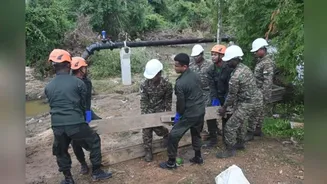

In a show of solidarity following the devastation wreaked by Cyclone Ditwah, engineers from the armies of India and Sri Lanka have launched a joint mission to repair vital infrastructure and restore connectivity for communities in the hardest-hit regions.
Under Operation Sagar Bandhu, a damaged bridge on the Paranthan–Karachchi–Mullaitivu (A35) road in Kilinochchi is being fixed by the joint teams, a key step towards re-opening access for isolated communities.
In a post on X, the Indian High Commission said the Indian and Sri Lankan Army engineers have begun removing the damaged bridge on the Paranthan-Karachchi-Mullaitivu (A35) road in Kilinochchi. The work is moving quickly and is expected to wrap up by December 10, with the first Bailey bridge set to be launched by Saturday afternoon.
#OperationSagarBandhu rebuilding connectivity!@adgpi Engineers, together with @Sri_Lanka_Army Engineers and the Road Development Authority, have begun removing the damaged bridge on the Paranthan–Karachchi–Mullaitivu (A35) road in Kilinochchi. This joint effort marks another… pic.twitter.com/4DixvdKBoe
— India in Sri Lanka (@IndiainSL) December 7, 2025
This engineering push is part of a broader relief operation mounted by India: Tamil Nadu alone has contributed around 1,000 tonnes of essential food items, clothing and relief materials, with some 300 tonnes already delivered to Sri Lanka aboard three Indian naval ships.
VIDEO | Jaffna, Chilaw, Sri Lanka: Indian Army accelerates bridge restoration and medical aid in the Cyclone Ditwah-hit island nation under Operation Sagar Bandhu.#SriLanka #CycloneDitwah
(Source: Third Party)
(Full video available on PTI Videos - https://t.co/n147TvrpG7) pic.twitter.com/ScsoLsz2Tv
— Press Trust of India (@PTI_News) December 9, 2025
Medical assistance is also ramping up. A field hospital set up by the Indian Army near Kandy has treated over 2,200 people since December 5, performing dozens of minor procedures and multiple surgeries to help communities reeling from the cyclone’s aftermath.
The impetus behind these coordinated actions is the escalating humanitarian crisis: with 627 people officially reported dead and hundreds still missing, entire districts have been ravaged, leaving over 2.17 million people from more than 611,000 families affected across Sri Lanka.
India’s throwing everything it has into the effort—engineers, doctors, relief teams—working across land, sea, and air under Operation Sagar Bandhu. It’s a clear sign of New Delhi’s “Neighbourhood First” approach and its belief that you show up for your neighbours when disaster strikes.