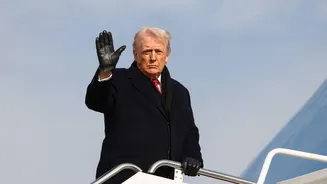

In just twelve months, the Trump administration has executed a radical restructuring of the global order.
The past 365 days have seen the "America First" doctrine and it is looking like the era of the liberal international order appears to have been replaced by a transactional international order, where American power is wielded as a precision tool for economic leverage and regional dominance.
Trump's tariff wall
The hallmark of the first year of Trump 2.0 has been the systemic dismantling of traditional trade norms.
On April 2, 2025, Trump signed an executive order invoking the International Emergency Economic Powers Act to impose a universal baseline tariff on nearly all goods entering the United States.
While the initial rate was set at 10 per cent, by the end of 2025, the average effective tariff rate for the US had surged to an estimated 27 per cent, the highest level in over a century.
The administration has utilised these tariffs as "reciprocal" weapons, specifically targeting nations with large trade surpluses.
China, Mexico and India bore the brunt of these measures.
While the US Treasury reported a surge in tariff revenue from $100 billion in 2024 to approximately $300 billion in 2025, the domestic impact has been a subject of intense debate.
Economic models from the Penn Wharton Budget Model and Goldman Sachs suggest that while the federal deficit has been bolstered by these new revenues, the costs have been passed down to American households, with middle-income families facing significant increases in the cost of consumer electronics, automobiles, and daily essentials.
Trump's 'mass deportation' campaign
Launched on January 23, 2025, just three days after the inauguration, Trump's "Mass Deportation" operation represented the most aggressive immigration enforcement in US history.
Under the direction of "Border Czar" Tom Homan, the US Department of Homeland Security began large-scale raids on sanctuary cities, reversing decades of policy that kept schools, hospitals, and places of worship as sensitive locations.
By the end of 2025, official data indicated that the administration had formally deported 622,000 individuals, while an additional 1.9 million people chose "self-deportation" due to the restrictive environment and the elimination of work authorisations.
To bypass the traditional backlog of the immigration courts, Trump invoked the Alien Enemies Act of 1798 on March 14, 2025, a move that allowed for the expedited removal of non-citizens without full due process.
Although this invocation was met with immediate legal challenges and temporary stays from federal judges, the Supreme Court’s conservative majority has largely allowed the core tenets of the enforcement strategy to proceed.
The Trump administration also signed the Laken Riley Act on January 29, 2025, mandating the detention of immigrants charged with crimes.
The Guantanamo Bay detention camp was also re-opened to house migrants pending deportation, though the move faced immediate legal challenges
Trump's Operation Absolute Resolve
On January 3, 2026, the world awoke to the news that US Special Forces had successfully executed Operation Absolute Resolve, a military extraction in Caracas that captured Nicolas Maduro and his wife, Cilia Flores.
The operation was the culmination of a months-long campaign in the Caribbean, which included a naval blockade intended to intercept drug-running vessels and prevent the evasion of oil sanctions.
Following the raid, Trump declared that the United States would "run" Venezuela until its oil infrastructure could be stabilised and handed over to a transitional government.
This update to the Monroe Doctrine, dubbed the "Donroe Doctrine," was aimed to assert that the Western Hemisphere is the exclusive "backyard" of the United States and that foreign influence from Russia, China, and Iran would no longer be tolerated.
While US Secretary of State Marco Rubio has attempted to frame the intervention as a necessary step toward democratic transition, the move has sent shockwaves through Latin America, prompting nations like Brazil to distance themselves from Washington and seek deeper ties with the Brics bloc.
Trump's pressure on Iran
On February 4, 2025, Trump signed a National Security Presidential Memorandum reimposing pressure with the goal of driving Iranian oil exports to zero.
The administration’s stance had been characterised by a refusal to engage in traditional diplomacy, instead setting a strict two-month deadline for Tehran to accept a new nuclear deal that would also dismantle its ballistic missile programme and regional proxy networks.
When the deadline passed in late 2025, the US moved from economic warfare to targeted military action. In June 2025, Trump praised
The Iranian Rial has since collapsed to record lows, and the country’s economy has entered a period of hyperinflation, with monthly rates exceeding 40 per cent.
Just last week, Trump threatened direct US intervention to support anti-government protesters in Iran, though he later "held off" following military advice regarding carrier positioning
Trump's plan for Ukraine
Trump's Special Envoy Keith Kellogg and Fred Fleitz, the primary architects of the "America First" peace plan, have pushed for a frozen conflict that would see the current battle lines turned into a demilitarised zone.
The 28-point proposal, which gained traction in late 2025, makes future US military aid to Kyiv contingent on President Volodymyr Zelenskyy entering direct negotiations with Moscow.
Simultaneously, the US has warned Vladimir Putin that any refusal to negotiate would result in "arming Ukraine to the teeth" with weapons previously withheld.
The 28-point plan includes:
- A permanent ban on Ukraine joining Nato.
- Recognition of Russian sovereignty over Crimea, Donetsk, and Luhansk.
- The capping of Ukraine’s armed forces.
- The lifting of Western sanctions on Russia and its re-entry into the G8.
While this has drawn sharp criticism from European allies who fear the abandonment of the "rules-based order," the Trump administration has remained steadfast, arguing that the American taxpayer will no longer fund a "forever war" in Europe.
Trump's disengagement from global alliances
The Trump administration also spent 2025 executing a rapid withdrawal from many global governance structures.
On his first day back in office, January 20, 2025, Trump signed executive orders initiating the second US withdrawal from the Paris Climate Agreement — set to become official on January 27, 2026 — and began the year-long process of exiting the World Health Organization (WHO).
This isolationist momentum culminated on January 7, 2026, with a sweeping presidential memorandum directing the US to exit 66 international organisations, including 31 United Nations entities.
Most notably, this included the UN Framework Convention on Climate Change (UNFCCC), the bedrock 1992 treaty underlying all global climate negotiations, and the Intergovernmental Panel on Climate Change (IPCC).
Other casualties of the administration's review of "wasteful and harmful" institutions included UN Women, the UN Population Fund (UNFPA), and the UN Human Rights Council.
This institutional retreat was mirrored by a near-total dismantling of the US Agency for International Development (USAID), which saw its workforce slashed by 95 per cent and the majority of its global health and development programmes terminated.
Trump has also revived discussions regarding the US acquisition of Greenland from Denmark, framing it as a strategic necessity for Arctic defence.
Also Watch:
With inputs from agencies