




What is the story about?
United States President Donald Trump concluded his visit to China on Friday after two days of high-level meetings and claims of new economic agreements that, at least publicly, stopped short of delivering the sweeping breakthroughs many investors and analysts had expected.
The summit between Trump and Chinese President Xi Jinping came as trade tensions between the two powers remain unresolved.
Meanwhile, the Iran conflict has shaken global energy markets, and disputes surrounding advanced technology, semiconductors, Taiwan and sanctions continue to complicate relations between Washington and Beijing.
Trump arrived in Beijing seeking to showcase progress on trade and foreign policy ahead of important US midterm elections, while Xi used the summit to reinforce China’s position as
a central global power capable of engaging the United States on equal terms.
Although the two governments repeatedly described the meetings positively and highlighted the importance of stable ties, the final outcome left lingering questions about how much had actually been achieved beyond symbolism.
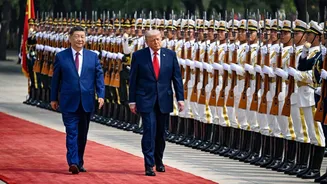
As Trump arrived in Beijing, Chinese authorities organised military honours, formal banquets, cultural displays and private tours that projected both prestige and historical symbolism.
The summit included grand receptions featuring goose-stepping soldiers, carefully orchestrated ceremonies and state dinners attended by senior officials and business leaders.
Trump and Xi also visited prominent historical locations, including Beijing’s Temple of Heaven, which Chinese commentators described as carrying deep cultural significance.
The most notable meetings took place inside Zhongnanhai, the heavily guarded leadership compound in central Beijing that once served as an imperial garden and today houses the offices and residences of China’s senior leadership.
At their final meeting there, Trump praised the visit and said substantial progress had been achieved during the summit.
“It's been an incredible visit. I think a lot of good has come of it,” Trump told Xi before the leaders attended a banquet that reportedly featured dishes including lobster balls and Kung Pao scallops.
Later, while seated beside Xi during the closing phase of the summit, Trump again highlighted what he described as successful negotiations.
“We’ve made some fantastic trade deals for both countries,” he said.
Xi also used the summit to underline the broader importance of US-China ties. During Thursday’s state banquet, the Chinese leader said the relationship between the two countries remained the most consequential bilateral relationship in the world.
“We must make it work and never mess it up,” Xi said.
Chinese academic and former interpreter for late Chinese leader Deng Xiaoping, Victor Gao, strongly praised the summit and described it as historically important.
“Very successful, highly choreographed, but also a lot of spontaneity and also a lot of excitement,” Gao told CNN while rating the summit a “9.99 out of 10.”
According to Gao, China “put its best foot forward” during the visit, while American officials and business leaders also conducted themselves appropriately. He described Trump’s decision to resume presidential visits to China as “an important step in the right direction” for bilateral relations.
Gao also focused on the symbolism of the Temple of Heaven visit, noting that Chinese emperors historically used the site to pray for peace, prosperity and successful harvests. He said he hoped the symbolism would carry lasting significance for global peace and stability.
Trump repeatedly complimented Xi personally during the visit, speaking positively about the Chinese president’s stature and warmth. Chinese state media, meanwhile, portrayed the summit as evidence of China’s growing global influence and diplomatic confidence.
Trade remained one of the biggest themes of the summit, although many of the most important announcements lacked detailed confirmation from either side.
Trump repeatedly claimed that major commercial agreements had been reached during the visit.
Among the headline assertions was his statement that China had agreed to purchase 200 Boeing aircraft — a potentially major deal for the American aerospace sector and one that would represent China’s first major purchase of US-made commercial jets in nearly a decade.
Trump discussed the alleged agreement during an interview with
Fox News, where he also claimed China had committed to buying large volumes of American oil and agricultural products, particularly soybeans.
“China will buy a lot of our farm products,” Trump said.
However, despite the significance of the announcement, neither Boeing nor the Chinese government publicly confirmed the aircraft purchase.
When asked directly during a press briefing whether Beijing had agreed to buy the 200 aircraft mentioned by Trump, Chinese foreign ministry spokesperson Guo Jiakun declined to provide confirmation.
Instead, he pointed generally to the “important consensus” achieved during the summit and stressed that the essence of US-China economic relations remained “mutual benefit and win-win cooperation.”
The lack of clarity surrounding the Boeing deal disappointed investors who had expected a much larger order, reportedly around 500 aircraft. Boeing shares subsequently dropped more than four per cent.
US Trade Representative Jamieson Greer later said Washington expected agreements involving “double-digit billions” of dollars in agricultural exports to China following Trump’s visit.
Greer also stated that Chinese exports of rare earth materials to the United States were improving, although he acknowledged that approvals for some shipments remained slow.
Soybeans appeared likely to remain at the centre of any future agricultural arrangements. China has historically been one of the largest overseas markets for American soybean exports, making the sector politically and economically important for the Trump administration.
Still, Beijing stopped short of publicly endorsing any detailed agricultural commitments.
Chinese officials instead emphasised maintaining “stable economic and trade relations” without specifying the scale or structure of future purchases.
US officials also said both countries had made progress toward identifying approximately $30 billion worth of non-sensitive goods and establishing mechanisms for future trade management.
Yet the summit produced no clear breakthrough on several of the most contentious economic disputes between the two powers.
There were no major announcements regarding sanctions, export restrictions, advanced semiconductors, artificial intelligence cooperation or Chinese electric vehicle access to the American market.
Before the meetings, expectations had grown that discussions involving AI chips and technology restrictions could emerge as a central topic, particularly after Jensen Huang joined the broader delegation at the last moment.
However, no agreements were announced concerning Nvidia’s advanced H200 AI chips or broader semiconductor export restrictions.
US Treasury Secretary Scott Bessent later said discussions had touched on AI “guardrails” and stressed the importance of preserving America’s technological edge over China. Bessent described maintaining US leadership in artificial intelligence as “of utmost importance.”
The issue has gained additional attention following concerns surrounding Anthropic’s Mythos AI model. Officials have reportedly warned that the technology could potentially be exploited by criminal or terrorist organisations, while Chinese state media has also discussed the cybersecurity implications surrounding the model.
Despite these concerns, the summit ended without concrete policy changes related to AI governance, export controls or semiconductor access.
Technology restrictions continue to be one of the most divisive issues in US-China relations. Washington has increasingly limited Chinese access to advanced chips and manufacturing tools, while Beijing has sought to reduce its dependence on foreign technology and strengthen domestic semiconductor production.
At the same time, uncertainty also persisted regarding Chinese electric vehicles.
Earlier this year, Trump had signalled some openness to allowing Chinese EV manufacturers into the US market. Chinese companies have aggressively expanded overseas in recent years with relatively low-cost and technologically advanced vehicles.
However, many American lawmakers remain strongly opposed to such a move, arguing that Chinese EV imports could damage the domestic automobile industry and create national security concerns.
The summit produced no public progress on the issue.
Shortly before Trump’s final meeting with Xi, China’s foreign ministry issued a strongly worded statement criticising the war and warning about its consequences for global stability and energy markets.
“This conflict, which should never have happened, has no reason to continue,” the ministry said. The ministry added that China was supporting efforts aimed at securing a peace agreement and reducing the economic damage caused by the conflict.
The war has severely affected global energy supplies and increased concerns surrounding the Strait of Hormuz, one of the world’s most strategically important maritime chokepoints through which a significant portion of global oil and gas shipments normally pass.
Trump later said he and Xi shared similar positions regarding Iran.
“We did discuss Iran. We feel very similar about [how] we want it to end. We don’t want them to have a nuclear weapon. We want the strait open,” Trump said.
A brief White House summary of Thursday’s discussions also highlighted what it described as a shared desire to reopen the Strait of Hormuz and ensure the uninterrupted movement of energy supplies.
Trump additionally suggested China could increase purchases of American oil as part of broader efforts to reduce dependence on West Asian energy sources.
Global crude oil benchmarks rose following Trump’s comments regarding possible Chinese purchases of US oil amid continuing disruptions in the Gulf region.
However, Chinese officials again refrained from publicly confirming specific agreements.
The summit also took place against the backdrop of ongoing tensions surrounding sanctions connected to Iran. Less than a week before Trump arrived in Beijing, the United States imposed sanctions on three Chinese satellite companies accused of assisting Iran’s military.
Earlier this month, China reportedly instructed several firms not to comply with US sanctions targeting oil refineries accused of facilitating Iranian crude exports.
Analysts remained sceptical that Beijing would significantly pressure Tehran despite Washington’s hopes for Chinese assistance.
According to reports, Xi warned Trump that mishandling Taiwan could lead to conflict — a reminder that despite the cordial tone of the summit, the island remains one of the most dangerous issues in US-China relations.
Taiwan sits roughly 80 kilometres from the Chinese mainland and has long represented a major source of friction between Beijing and Washington.
China claims Taiwan as part of its territory and has repeatedly refused to rule out the use of military force to bring the island under its control. The United States, meanwhile, is legally obligated to provide Taiwan with defensive support.
US Secretary of State Marco Rubio said American policy regarding Taiwan had not changed following the summit. “US policy on the issue of Taiwan is unchanged as of today,” Rubio told NBC News.
Rubio added that Chinese leaders “always raise it ... we always make clear our position and we move on.”
Taiwan Foreign Minister Lin Chia-lung later thanked the United States for continuing to express support for Taiwan during the meetings.
Trump also raised the case of jailed Hong Kong media businessman and democracy activist Jimmy Lai during talks with Xi. Rubio confirmed that the matter had been discussed during the summit.
Lai, one of Hong Kong’s most prominent critics of Beijing, was sentenced earlier this year to 20 years in prison in the territory’s largest national security case.
Chinese officials have consistently maintained that Hong Kong-related matters are internal affairs and have previously rejected outside criticism concerning the case.
No progress regarding Lai’s situation was publicly announced following the summit.
Despite Trump’s repeated claims of successful negotiations, financial markets reacted cautiously to the summit’s conclusion. Chinese stocks fell on Friday as investors expressed disappointment over the absence of major concrete agreements.
The CSI300 Index and Shanghai Composite Index both declined by more than one percent, while Hong Kong’s Hang Seng Index fell around 1.6 per cent.
Analysts suggested that investors had expected more substantial progress on trade and technology issues.
Many analysts ultimately concluded that the most important outcome may simply have been preserving dialogue between the two countries and maintaining the fragile trade truce established during talks in Busan last October.
That earlier understanding involved Trump suspending steep tariffs on Chinese goods while China stepped back from restricting exports of critical rare earth materials.
However, US officials acknowledged that it had not yet been decided whether the trade truce would be extended beyond its expiration later this year.
Greer said discussions on a possible extension remained ongoing.
By the end of Trump’s visit, both governments had succeeded in projecting an image of engagement and diplomatic stability.
The summit featured warm public exchanges, elaborate state ceremonies and repeated assurances about the importance of cooperation between the world’s two largest economies.
At the same time, many of the most difficult disputes remained unresolved.
No major breakthroughs emerged on semiconductors, sanctions, export controls, electric vehicles, artificial intelligence or Taiwan.
Several of Trump’s headline trade claims also remained unconfirmed by Beijing. Yet for both leaders, the optics of the summit carried significance.
For Trump, the trip provided an opportunity to present himself as an international negotiator capable of engaging America’s primary geopolitical rival directly while claiming economic victories for US industries and farmers.
For Xi, the summit reinforced China’s image as a confident global power increasingly central to discussions involving trade, technology and energy security.
Meanwhile, Trump has invited Xi to the White House for a reciprocal visit on September 24 later this year.
But more recently, Russian President Vladimir Putin will reportedly be heading to meet Xi in China next week.
With inputs from agencies
The summit between Trump and Chinese President Xi Jinping came as trade tensions between the two powers remain unresolved.
Meanwhile, the Iran conflict has shaken global energy markets, and disputes surrounding advanced technology, semiconductors, Taiwan and sanctions continue to complicate relations between Washington and Beijing.
Trump arrived in Beijing seeking to showcase progress on trade and foreign policy ahead of important US midterm elections, while Xi used the summit to reinforce China’s position as
Although the two governments repeatedly described the meetings positively and highlighted the importance of stable ties, the final outcome left lingering questions about how much had actually been achieved beyond symbolism.
Was it all just pomp & pageantry?
As Trump arrived in Beijing, Chinese authorities organised military honours, formal banquets, cultural displays and private tours that projected both prestige and historical symbolism.
The summit included grand receptions featuring goose-stepping soldiers, carefully orchestrated ceremonies and state dinners attended by senior officials and business leaders.
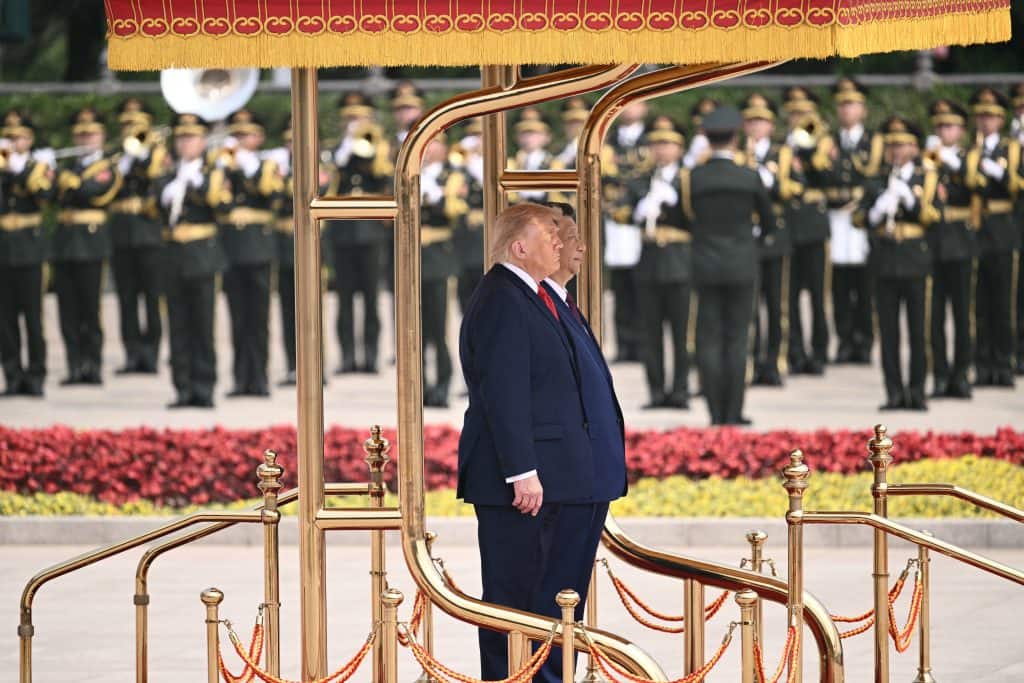
US President Donald Trump (L) and China's President Xi Jinping stand for their counties' national anthems during a welcome ceremony at the Great Hall of the People in Beijing on May 14, 2026. File Image/AFP
Trump and Xi also visited prominent historical locations, including Beijing’s Temple of Heaven, which Chinese commentators described as carrying deep cultural significance.
The most notable meetings took place inside Zhongnanhai, the heavily guarded leadership compound in central Beijing that once served as an imperial garden and today houses the offices and residences of China’s senior leadership.
At their final meeting there, Trump praised the visit and said substantial progress had been achieved during the summit.
“It's been an incredible visit. I think a lot of good has come of it,” Trump told Xi before the leaders attended a banquet that reportedly featured dishes including lobster balls and Kung Pao scallops.
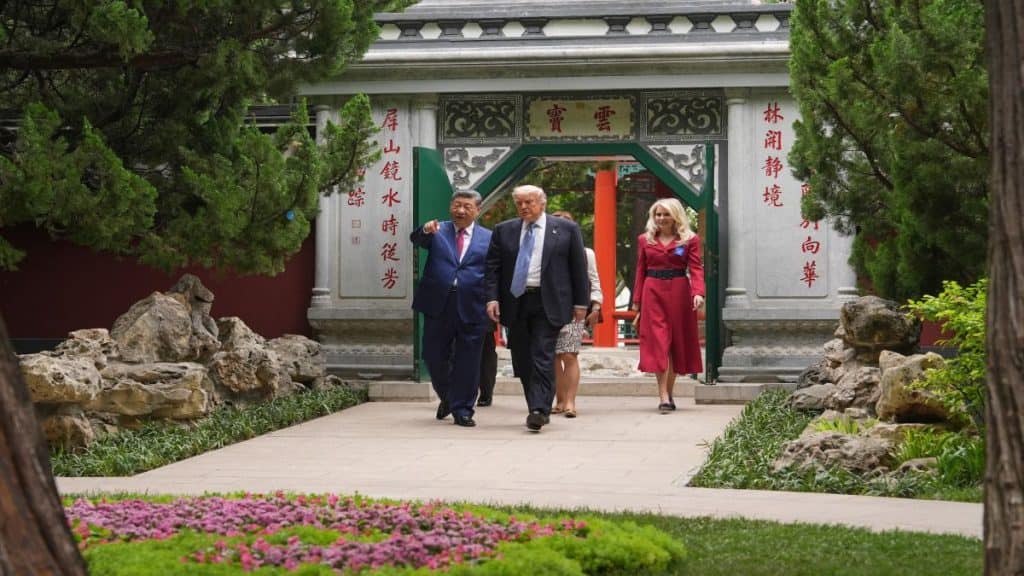
China’s President Xi Jinping shows US President Donald Trum around the Zhongnanhai leadership compound. File Image/Reuters
Later, while seated beside Xi during the closing phase of the summit, Trump again highlighted what he described as successful negotiations.
“We’ve made some fantastic trade deals for both countries,” he said.
Xi also used the summit to underline the broader importance of US-China ties. During Thursday’s state banquet, the Chinese leader said the relationship between the two countries remained the most consequential bilateral relationship in the world.
“We must make it work and never mess it up,” Xi said.
Chinese academic and former interpreter for late Chinese leader Deng Xiaoping, Victor Gao, strongly praised the summit and described it as historically important.
“Very successful, highly choreographed, but also a lot of spontaneity and also a lot of excitement,” Gao told CNN while rating the summit a “9.99 out of 10.”
According to Gao, China “put its best foot forward” during the visit, while American officials and business leaders also conducted themselves appropriately. He described Trump’s decision to resume presidential visits to China as “an important step in the right direction” for bilateral relations.
Gao also focused on the symbolism of the Temple of Heaven visit, noting that Chinese emperors historically used the site to pray for peace, prosperity and successful harvests. He said he hoped the symbolism would carry lasting significance for global peace and stability.
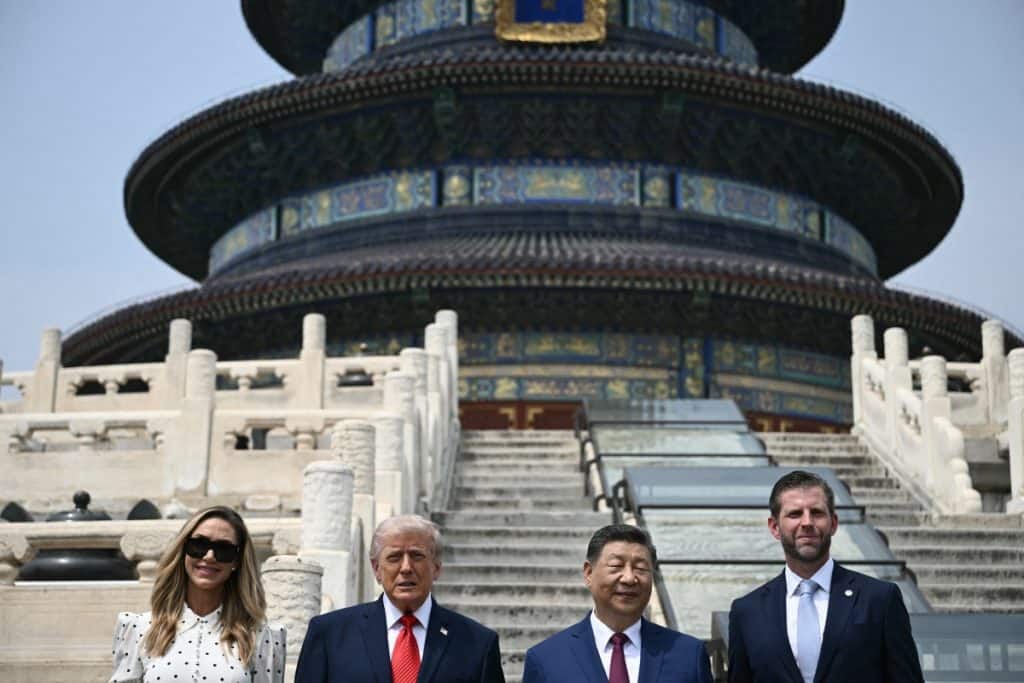
China's President Xi Jinping and US President Donald Trump pose for a photo with Eric Trump and his spouse Lara Trump at the Temple of Heaven in Beijing on May 14, 2026. File Image/Reuters
Trump repeatedly complimented Xi personally during the visit, speaking positively about the Chinese president’s stature and warmth. Chinese state media, meanwhile, portrayed the summit as evidence of China’s growing global influence and diplomatic confidence.
What are these 'trade agreements' claimed by Trump?
Trade remained one of the biggest themes of the summit, although many of the most important announcements lacked detailed confirmation from either side.
Trump repeatedly claimed that major commercial agreements had been reached during the visit.
Among the headline assertions was his statement that China had agreed to purchase 200 Boeing aircraft — a potentially major deal for the American aerospace sector and one that would represent China’s first major purchase of US-made commercial jets in nearly a decade.
Trump discussed the alleged agreement during an interview with
“China will buy a lot of our farm products,” Trump said.
However, despite the significance of the announcement, neither Boeing nor the Chinese government publicly confirmed the aircraft purchase.
When asked directly during a press briefing whether Beijing had agreed to buy the 200 aircraft mentioned by Trump, Chinese foreign ministry spokesperson Guo Jiakun declined to provide confirmation.
Instead, he pointed generally to the “important consensus” achieved during the summit and stressed that the essence of US-China economic relations remained “mutual benefit and win-win cooperation.”
The lack of clarity surrounding the Boeing deal disappointed investors who had expected a much larger order, reportedly around 500 aircraft. Boeing shares subsequently dropped more than four per cent.
US Trade Representative Jamieson Greer later said Washington expected agreements involving “double-digit billions” of dollars in agricultural exports to China following Trump’s visit.
Greer also stated that Chinese exports of rare earth materials to the United States were improving, although he acknowledged that approvals for some shipments remained slow.
Soybeans appeared likely to remain at the centre of any future agricultural arrangements. China has historically been one of the largest overseas markets for American soybean exports, making the sector politically and economically important for the Trump administration.
Still, Beijing stopped short of publicly endorsing any detailed agricultural commitments.
Chinese officials instead emphasised maintaining “stable economic and trade relations” without specifying the scale or structure of future purchases.
US officials also said both countries had made progress toward identifying approximately $30 billion worth of non-sensitive goods and establishing mechanisms for future trade management.
Yet the summit produced no clear breakthrough on several of the most contentious economic disputes between the two powers.
There were no major announcements regarding sanctions, export restrictions, advanced semiconductors, artificial intelligence cooperation or Chinese electric vehicle access to the American market.
What about US-China tech deals?
Before the meetings, expectations had grown that discussions involving AI chips and technology restrictions could emerge as a central topic, particularly after Jensen Huang joined the broader delegation at the last moment.
However, no agreements were announced concerning Nvidia’s advanced H200 AI chips or broader semiconductor export restrictions.
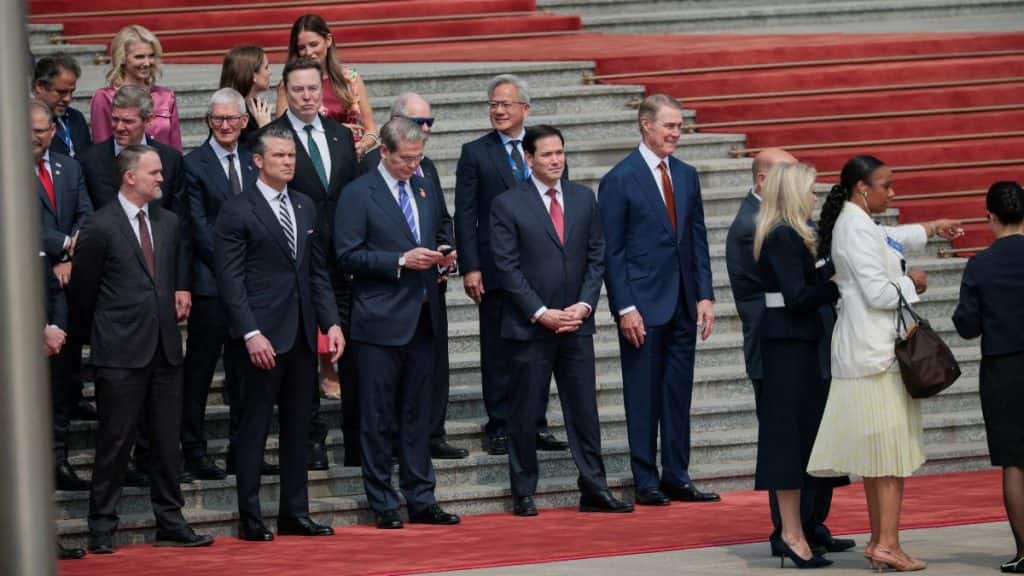
US Secretary of State Marco Rubio, US Treasury Secretary Scott Bessent, US Secretary of Defense Pete Hegseth, US Trade Representative Jamieson Greer, Jensen Huang, Founder, President and CEO of Nvidia, Elon Musk, Apple CEO Tim Cook and others stand together ahead of the arrival of US President Donald Trump for a welcome ceremony at the Great Hall of the People in Beijing, China, May 14, 2026. File Image/Reuters
US Treasury Secretary Scott Bessent later said discussions had touched on AI “guardrails” and stressed the importance of preserving America’s technological edge over China. Bessent described maintaining US leadership in artificial intelligence as “of utmost importance.”
The issue has gained additional attention following concerns surrounding Anthropic’s Mythos AI model. Officials have reportedly warned that the technology could potentially be exploited by criminal or terrorist organisations, while Chinese state media has also discussed the cybersecurity implications surrounding the model.
Despite these concerns, the summit ended without concrete policy changes related to AI governance, export controls or semiconductor access.
Technology restrictions continue to be one of the most divisive issues in US-China relations. Washington has increasingly limited Chinese access to advanced chips and manufacturing tools, while Beijing has sought to reduce its dependence on foreign technology and strengthen domestic semiconductor production.
At the same time, uncertainty also persisted regarding Chinese electric vehicles.
Earlier this year, Trump had signalled some openness to allowing Chinese EV manufacturers into the US market. Chinese companies have aggressively expanded overseas in recent years with relatively low-cost and technologically advanced vehicles.
However, many American lawmakers remain strongly opposed to such a move, arguing that Chinese EV imports could damage the domestic automobile industry and create national security concerns.
The summit produced no public progress on the issue.
What was discussed on Iran?
Shortly before Trump’s final meeting with Xi, China’s foreign ministry issued a strongly worded statement criticising the war and warning about its consequences for global stability and energy markets.
“This conflict, which should never have happened, has no reason to continue,” the ministry said. The ministry added that China was supporting efforts aimed at securing a peace agreement and reducing the economic damage caused by the conflict.
The war has severely affected global energy supplies and increased concerns surrounding the Strait of Hormuz, one of the world’s most strategically important maritime chokepoints through which a significant portion of global oil and gas shipments normally pass.
Trump later said he and Xi shared similar positions regarding Iran.
“We did discuss Iran. We feel very similar about [how] we want it to end. We don’t want them to have a nuclear weapon. We want the strait open,” Trump said.
A brief White House summary of Thursday’s discussions also highlighted what it described as a shared desire to reopen the Strait of Hormuz and ensure the uninterrupted movement of energy supplies.
Trump additionally suggested China could increase purchases of American oil as part of broader efforts to reduce dependence on West Asian energy sources.
Global crude oil benchmarks rose following Trump’s comments regarding possible Chinese purchases of US oil amid continuing disruptions in the Gulf region.
However, Chinese officials again refrained from publicly confirming specific agreements.
The summit also took place against the backdrop of ongoing tensions surrounding sanctions connected to Iran. Less than a week before Trump arrived in Beijing, the United States imposed sanctions on three Chinese satellite companies accused of assisting Iran’s military.
Earlier this month, China reportedly instructed several firms not to comply with US sanctions targeting oil refineries accused of facilitating Iranian crude exports.
Analysts remained sceptical that Beijing would significantly pressure Tehran despite Washington’s hopes for Chinese assistance.
How has Taiwan emerged as a red line?
According to reports, Xi warned Trump that mishandling Taiwan could lead to conflict — a reminder that despite the cordial tone of the summit, the island remains one of the most dangerous issues in US-China relations.
Taiwan sits roughly 80 kilometres from the Chinese mainland and has long represented a major source of friction between Beijing and Washington.
China claims Taiwan as part of its territory and has repeatedly refused to rule out the use of military force to bring the island under its control. The United States, meanwhile, is legally obligated to provide Taiwan with defensive support.
US Secretary of State Marco Rubio said American policy regarding Taiwan had not changed following the summit. “US policy on the issue of Taiwan is unchanged as of today,” Rubio told NBC News.
Rubio added that Chinese leaders “always raise it ... we always make clear our position and we move on.”
Taiwan Foreign Minister Lin Chia-lung later thanked the United States for continuing to express support for Taiwan during the meetings.
What about Jimmy Lai?
Trump also raised the case of jailed Hong Kong media businessman and democracy activist Jimmy Lai during talks with Xi. Rubio confirmed that the matter had been discussed during the summit.
Lai, one of Hong Kong’s most prominent critics of Beijing, was sentenced earlier this year to 20 years in prison in the territory’s largest national security case.
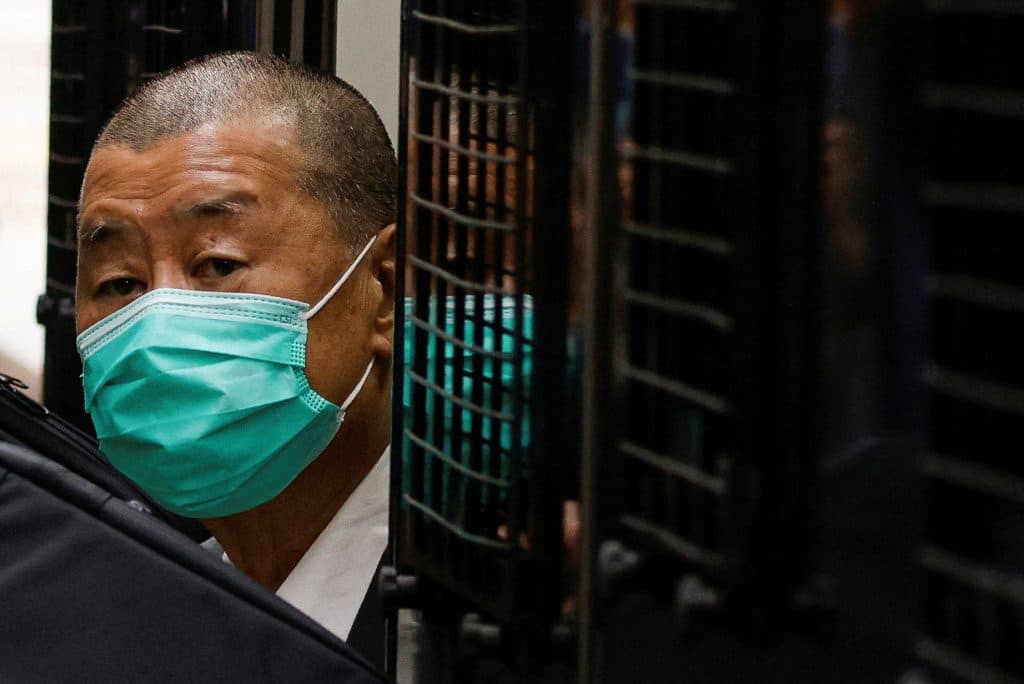
Media mogul Jimmy Lai, founder of Apple Daily, arrives the Court of Final Appeal by prison van in Hong Kong, China, February 1, 2021. File Image/Reuters
Chinese officials have consistently maintained that Hong Kong-related matters are internal affairs and have previously rejected outside criticism concerning the case.
No progress regarding Lai’s situation was publicly announced following the summit.
How did markets react?
Despite Trump’s repeated claims of successful negotiations, financial markets reacted cautiously to the summit’s conclusion. Chinese stocks fell on Friday as investors expressed disappointment over the absence of major concrete agreements.
The CSI300 Index and Shanghai Composite Index both declined by more than one percent, while Hong Kong’s Hang Seng Index fell around 1.6 per cent.
Analysts suggested that investors had expected more substantial progress on trade and technology issues.
Many analysts ultimately concluded that the most important outcome may simply have been preserving dialogue between the two countries and maintaining the fragile trade truce established during talks in Busan last October.
That earlier understanding involved Trump suspending steep tariffs on Chinese goods while China stepped back from restricting exports of critical rare earth materials.
However, US officials acknowledged that it had not yet been decided whether the trade truce would be extended beyond its expiration later this year.
Greer said discussions on a possible extension remained ongoing.
What next?
By the end of Trump’s visit, both governments had succeeded in projecting an image of engagement and diplomatic stability.
The summit featured warm public exchanges, elaborate state ceremonies and repeated assurances about the importance of cooperation between the world’s two largest economies.
At the same time, many of the most difficult disputes remained unresolved.
No major breakthroughs emerged on semiconductors, sanctions, export controls, electric vehicles, artificial intelligence or Taiwan.
Several of Trump’s headline trade claims also remained unconfirmed by Beijing. Yet for both leaders, the optics of the summit carried significance.
For Trump, the trip provided an opportunity to present himself as an international negotiator capable of engaging America’s primary geopolitical rival directly while claiming economic victories for US industries and farmers.
For Xi, the summit reinforced China’s image as a confident global power increasingly central to discussions involving trade, technology and energy security.
Meanwhile, Trump has invited Xi to the White House for a reciprocal visit on September 24 later this year.
But more recently, Russian President Vladimir Putin will reportedly be heading to meet Xi in China next week.
With inputs from agencies