
Earlier this week, the Indian Embassy urged Indian citizens in Iran to leave the country. The advisory, along with the closure of Iranian airspace on Thursday (January 15) for nearly five hours, has stirred anxiety among parents in India, particularly in Kashmir, whose wards are studying in the Islamic Republic.
There are about 10,000 Indians in Iran, including students and pilgrims. But why do so many students go to the West Asian country?
We take a look.
Indian students in Iran
As many as 10,765 Indian nationals are present in Iran. Of these 10,320 are Non-Resident Indians (NRIs) and the remaining are Persons of Indian Origin (PIOs), according to the MEA.
Thousands of Indian students, especially from Kashmir, are also studying in the West Asian country. As per a Moneycontrol analysis of data from the Lok Sabha and Rajya Sabha, roughly 2,000 Indian students chose Iran for higher education in 2024.
MEA’s data in 2022 estimated that about 2,050 Indian students were enrolled in Iran, mostly for medical studies, at Tehran University of Medical Sciences, Shahid Beheshti University and Islamic Azad University. Many of these were from Kashmir.
About 3,000 to 5,000 Indian students are enrolled in various universities and medical colleges in Iran, according to
A significant number of Kashmiris pursue medical education in Tehran, while others study Islamic theology in the holy cities of Qom and Mashhad, reported Indian Express.
Parents in India worry about safety
Iran’s brutal crackdown on anti-government protesters has killed over 2,000 people and injured several others. The Donald Trump administration has repeatedly threatened to intervene if the West Asian nation continues to use force against protesters.
The US has not ruled out the possibility of striking Iran. Amid the ongoing tensions, several countries have asked their nationals to avoid travel to or leave Iran. India’s embassy in Tehran has urged Indian citizens to leave Iran “by available means.” The government has also “strongly advised” Indian nationals to avoid travelling to the West Asian country.
— India in Iran (@India_in_Iran) January 14, 2026
Iran’s internet blackout and severing of telephone lines abroad have made it difficult for families in India to contact their kin in the West Asian country.
Many anxious parents in Srinagar took to the streets on Thursday as their children went incommunicado following the internet shutdown in Iran. They called on the Centre to run special flights to help students leave the Islamic Republic.
Altaf Ahmad, a Kashmiri resident whose sister Sobia is an MBBS student at Tehran University, told Indian Express that it has become difficult to contact her due to the communication blockade. “There is no internet, and we have been unable to reach them on direct calls when we dial from here. When she calls, we manage to talk for barely a minute or two. It’s been an anxious time,” he said.
Altaf said that his sister moved to Tehran just a month ago and was still settling in when the situation turned volatile in the Islamic Republic. “When I last spoke to her, she said some of the girls from her hostel went out for groceries and came back injured. Since then, no one has gone out. The girls bought a kilo of rice for Rs 2,200. How long will they survive on it?”
“I have not spoken to my daughter for many days now. The Government of India’s advisory to leave the country is futile without providing a window to return. Reports of closure of airspace have panicked us all,” Fahmeeda Jan, mother of a student, in Srinagar said, as per
Major airlines, including Air India, had to reroute flights on Thursday as Iran closed its airspace to all flights for about five hours amid concerns about possible US military action.
Speaking to Hindustan Times (HT), Riyaz Ahmad of Sopore said, “I couldn’t contact my daughter, who is studying in Tehran. The good news is that some students who reached Kashmir have conveyed [to] us every thing is fine in their colleges. Still due to current situation we are very much perturbed.”
Meanwhile, Jammu and Kashmir Chief Minister Omar Abdullah said Thursday that he spoke to External Affairs Minister (EAM) S Jaishankar about the situation in Iran and was assured of government action to safeguard the interests of people stranded there from the Union Territory. ”Just spoke to EAM @DrSJaishankar ji about the evolving situation in Iran. He shared his assessment of the ground situation & the plans that the External Affairs Ministry is working on,” he wrote in a post on X.
The J&K government has nominated a senior officer to coordinate and liaise with concerned agencies to ensure the welfare of residents and students from the UT living in Iran. The officer has been instructed to “coordinate with the Ministry of External Affairs, Government of India, concerned embassy and consular authorities, and other relevant agencies as required”, The Hindu reported.
J&K Students Association national convener Nasir Khuehami earlier said that the first evacuation flight carrying Indian students will depart from Tehran to Delhi on Friday morning.
However, as per some media reports, the evacuation process was later put on hold as the situation eased in Iran.
"The evacuation process initiated by the Indian Embassy has been kept on hold until further notice. The earlier evacuation decision was taken purely as a precautionary measure in view of war-related concerns. However, following official confirmation that no war-like situation or further escalation is expected, it is now clear that there is no requirement for evacuation at this time", Khuehami told
He said that the Indian embassy officials are in direct contact with the students and if an evacuation were needed, they will visit the students and inform them through official channels.
Kashmir’s connection to Iran
Thousands of students from Kashmir go to Iran for higher education. The majority of them choose the West Asian nation for medical studies.
Even though the number of medical seats in India has increased — from around 51,000 MBBS seats in 2014 to 1.18 lakh in 2024, tens of thousands of students still go abroad for medical education.
The number of candidates taking the Foreign Medical Graduate Examination (FMGE), which is mandatory to practice medicine in India after studying overseas, has jumped from 52,000 and 61,616 in 2022 and 2023, respectively, to 79,000 in 2024, as per an Indian Express report.
“While the number of MBBS seats has increased in the country, the field continues to remain competitive. Students have to get a very good rank to get into government colleges,” Dr Pawanindra Lal, former executive director of the National Board of Examinations in Medical Sciences, which conducts the FMGE, told the newspaper.
Moreover, government seats are limited in India and fees at private institutes can "run into crores", Dr Lal said. This is another factor that is making other countries, where the costs are far less, attractive for Indians seeking to study medicine.
While Indian students choose different destinations abroad to pursue medical studies, Iran continues to draw people from the Kashmir Valley.
Kashmir enjoys cultural and historical ties with Iran.
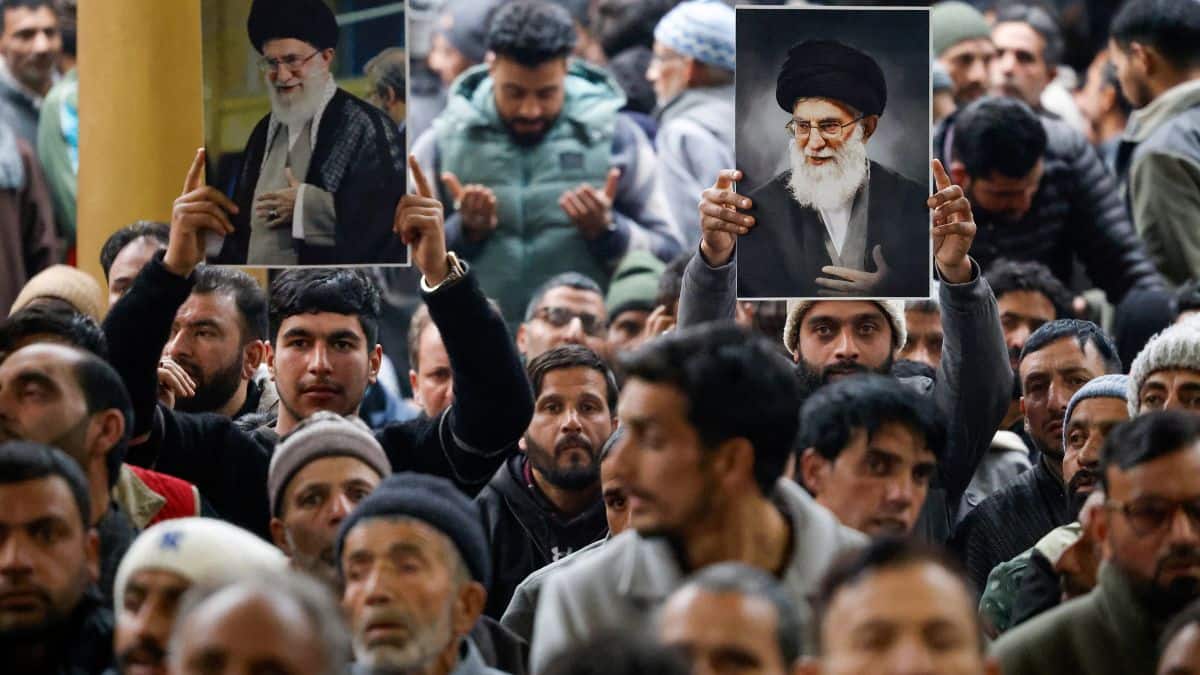
Kashmiri Shi'ite Muslims hold pictures of Iran's Supreme Leader Ayatollah Ali Khamenei inside a mosque during a religious gathering on the death anniversary of the seventh Shia Twelver Imam, Imam Musa al-Kazim, in Budgam district, central Kashmir, January 15, 2026. Reuters
“Kashmir for a very long time has been called Iran-e-Sagheer or Iran Minor. The topography of Kashmir and the culture of Kashmir are similar to that of Iran. In the old times, they always thought Kashmir was a part of Iran in a way. In the 13th century, Meer Sayyed Ahmed Ali Hamadani came to Kashmir from Iran. He brought about 200 Syeds along with him, and those people brought crafts and industry from Iran to Kashmir. They brought carpet, papier-mâché, dry fruits and saffron too. Historically, this is the link,” Professor Syed Akhtar Hussain, a Persian scholar at Jawaharlal Nehru University, said to
Religious affinity also drives the bond. “Because there is a Shia element in Kashmir, and Shia presence in Iran, there is that affinity. Iran also feels happy that it has that special space in the heart of Kashmir,” he said.
Professor Hussain said that Iran has introduced a “pargees quota” to help Kashmiri students get admission in the country. “Iran gives some concessions to Kashmiri students to study there. By virtue of being Shia, they get admission very quickly and easily… for Kashmiris in Iran, it’s less expensive.”
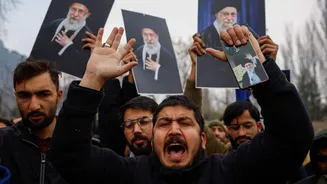
These religious ties were visible when members of the Shia community on Wednesday organised massive protests in the Shia-majority Kargil district of Ladakh, expressing support for Iran's Supreme Leader Ayatollah Ali Khamenei and solidarity with the Iranian regime, reported India Today.
They also raised slogans against US President Donald Trump and Israeli PM Benjamin Netanyahu, accusing them of being hostile toward Iran and the broader Muslim world.
With inputs from agencies