






On March 4, 2026, the Indian Ocean witnessed the sinking of the Iranian frigate IRIS Dena by a United States submarine. The Wednesday strike was the first time an American submarine had used a torpedo to sink an enemy vessel since World War II in 1945.
Questions are being asked on whether the strike was in compliance with international law and naval warfare norms as the confrontation in West Asia widens.
So on the sidelines of the Raisina Dialogue on Saturday, Brent Sadler, a retired United States Navy Captain and nuclear submarine officer with 26 years of service, now a Senior Research Fellow at the Heritage Foundation, sat down with Firstpost's Anmol Singla to dissect the legality and strategy behind the strike.
The "Quiet Death" off the coast of Galle
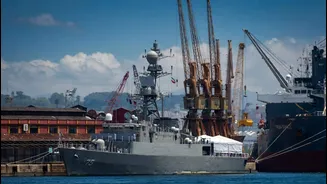
The IRIS Dena, the pride of the Iranian Navy’s domestically produced fleet, was in the middle of a routine transit. It had just completed its participation in India’s International Fleet Review 2026 in Visakhapatnam — a 74-nation maritime display aimed at fostering "bridges of friendship."
On its way home, while sailing approximately 40 nautical miles off the coast of Galle, Sri Lanka, the vessel was struck by a single Mark 48 heavyweight torpedo.
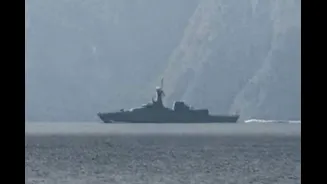
The Pentagon later released infrared footage of the event, which US Secretary of Defence Pete Hegseth described as a "quiet death."
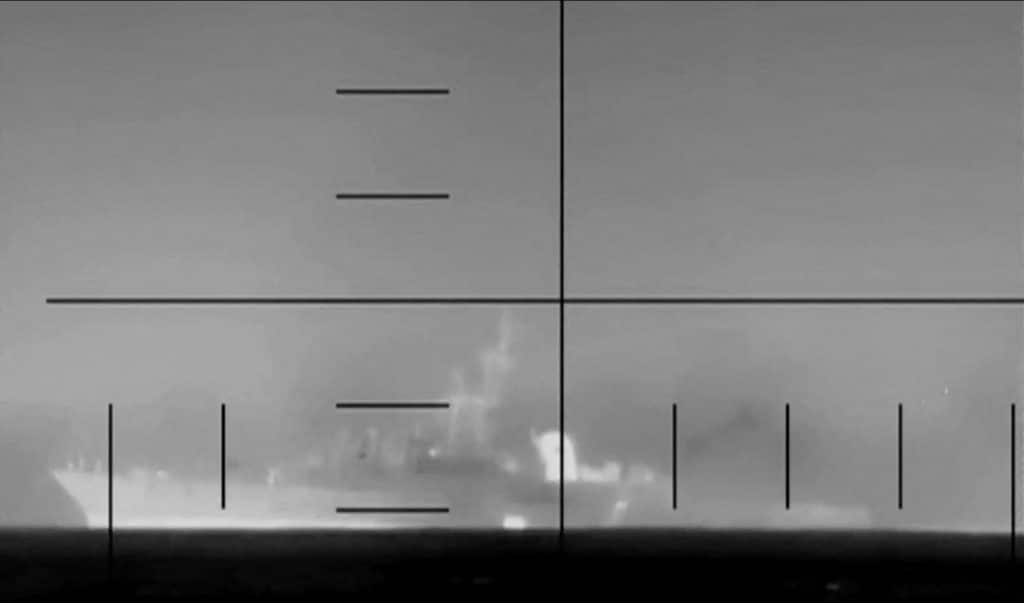
An explosion on what the US Department of Defense says is an Iranian warship, at the sea, in this screengrab obtained from a handout video released on March 4, 2026. US Department of Defence
The explosion fractured the frigate's keel, sending a geyser of seawater hundreds of feet into the air. Of the estimated 180 crew members on board, early reports from the Sri Lankan Navy suggested at least 87 sailors perished.
The incident has sent shockwaves, especially in New Delhi, as the Dena had been a "guest" of the Indian Navy only days earlier.
Was the strike legal?
“The military has very clear rules of engagement,” Sadler began, addressing the widely reported comments from the White House suggesting a total absence of military restraint.
“One of the objectives that were given from the Pentagon, which came from the White House and President Trump, is to sink the Iranian Navy. Make sure it is not a threat to the transit of commerce through the Strait of Hormuz. So, the Iranian Navy in its entirety is targeted,” he told Firstpost.
Roughly one-fifth of the world’s seaborne oil exports pass through the narrow waterway connecting the Persian Gulf with the Arabian Sea.
The strike took place within Sri Lanka’s Exclusive Economic Zone (EEZ) but outside its 12-mile territorial waters. This distinction is at the heart of the international outcry. Critics argue that targeting a ship transiting through a third party’s EEZ violates the spirit of the United Nations Convention on the Law of the Sea (UNCLOS).
When pressed on whether such a global green-light to sink an entire nation's navy aligns with international law, Sadler offered a pragmatic distinction.
“It’s national policy,” Sadler said. “There is international law and there’s domestic law. A lot of times people start to conflate the two, but they are very different. In international law that is the UN Conventions and the Charter, there is no stipulation that says a nation cannot pursue its national interest for defensive purposes.”
Sadler’s argument rests on a specific interpretation of Article 51 of the UN Charter, which recognises the inherent right of individual or collective self-defence.
“You can argue against it, but that is the position, and the UN law, the Charter, supports the US position,” Sadler continued.
“You can disagree, but that’s the law. It’s really hard to make an argument that sticks on a legal basis, based just on the words of the Charter.”
In the eyes of the Trump administration and its "Department of War" (renamed from the Department of Defense last year), the IRIS Dena was not just a ship in transit; it was a mobile piece of an enemy state's infrastructure.
"Sink me now or sink me later"
A point of major contention is the timing. Why strike the Dena in the Indian Ocean, far from the flashpoints of the Persian Gulf?
Sadler dismisses the idea that the ship’s lack of immediate "offensive posture" rendered it a non-threat.
“The conflict started the morning of Saturday, a week ago today [February 28, 2026],” Sadler explained.
“The ship had finished its fleet review, its exercises, which, by the way, when it was doing exercises with the Indian Navy, one of the exercises was anti-submarine warfare and live fire. But it was finished. The war starts three days later.”
In the cold mathematics of naval warfare, the Dena was a "fair target" the moment hostilities commenced. Sadler pointed out that the ship was in international waters — outside the 12-mile limit — meaning its presence in an EEZ provided no legal sanctuary from a belligerent power.
The ship’s path would have eventually brought it into the proximity of the aircraft carrier USS Abraham Lincoln, currently operating in the region.
“It was a sink me now or sink me later,” Sadler remarked.
“You don't want to take the risk of an Iranian warship getting close to an aircraft carrier that's engaged in combat... you don’t take that risk in war. If you see an enemy, you sink it.”
The reference to the USS Abraham Lincoln, currently operating in the Arabian Sea, does put a spotlight on the strategic anxiety.
A lone frigate, even if outclassed, could provide intelligence or launch a "suicide" strike if allowed to get too close to a carrier. For the US Navy, the directive is clear: eliminate the variable before it enters the equation.
The human toll & ethics of the deep
Perhaps the most harrowing aspect of the Dena’s sinking is the aftermath. Submarine warfare is notoriously impersonal and unforgiving. Unlike a surface battle where victors might linger to pick up survivors, a submarine’s primary defence is its invisibility.
Surfacing to conduct a rescue in a combat zone is often considered a suicidal move for a sub commander.
“There’s a rich historical record on submarine warfare. It goes back all the way to the First World War,” Sadler noted. “Submarines do not have the capacity to actually provide care or feeding. And the other part of it is it puts the submarine at undue risk.”
He drew a sharp distinction between the different branches of service, stating that “In the Navy, and to an extent also the Air Force, it's platform or ship versus ship. It’s not personal... The common enemy is the ocean at the end of the day.”
“I would say everyone did the right thing. And those sailors were rescued fairly quickly,” Sadler said, praising the response of the Sri Lanka Coast Guard. Acting on a dawn distress call, Sri Lankan vessels managed to rescue 32 sailors so far.
However, the onus for the tragedy, according to Sadler, does not rest on the neutral parties who are now cleaning up the oil slicks and recovering bodies. "There's no onus. The onus is on the Iranians. There's no obligation for Sri Lanka or India to do anything."
What happens to the second Iranian ship?
The sinking of the Dena has left another Iranian vessel — a logistics ship — in a diplomatic and tactical limbo.
Sadler points to the Hague Convention of 1907 as the rulebook for what happens when a "warship of a belligerent" enters a neutral port.
He referenced the famous 1939 case of the German pocket battleship Admiral Graf Spee, which was cornered in Montevideo, Uruguay, during the early days of World War II.
“In accordance with the Geneva Convention [Hague XIII] in 1907, neutral powers can allow a ship belligerent to come into its port for no more than 24 hours. Then it has to send it out,” Sadler explained.
However, there is a second option — one that might save the lives of the remaining Iranian sailors while satisfying US objectives.
“There’s another loophole. And probably the Sri Lankans and the Iranians, I think and I hope they take this, is that they basically embargo the ship. It stays in port. It becomes property of Sri Lanka. The Iranian sailors are now... basically kept in custody by the authorities.”
If the ship chooses to leave and "hop" between ports in the Maldives or Sri Lanka to reset the 24-hour clock, Sadler warns that the outcome is almost certain.
“Every time they do that, they're a potential target. And there's a US submarine out there. And that ship is not going to have a chance against a submarine... If she does go to sea, I think everyone understands that she runs the risk of being targeted. The President’s [US President Donald Trump] objectives remain the same: Sink the Iranian Navy so that it’s never a threat.”
Sri Lanka has indeed escorted the second Iranian vessel, the IRIS Bushehr, to harbour and transferred more than 200 Iranian sailors to a naval base near Colombo.
At the same time, India allowed another Iranian warship, the IRIS Lavan, to dock in Kochi for humanitarian reasons, housing its crew at naval facilities.
Also Watch:
The 11th edition of the Raisina Dialogue was held from March 5, 2026 to March 7, 2026 in New Delhi. Firstpost has partnered with the Raisina Dialogue to bring exclusive conversations with global leaders to you.
The Raisina Dialogue is India’s flagship conference on geopolitics and geo-economics, hosted by the Observer Research Foundation in collaboration with India’s Ministry of External Affairs.