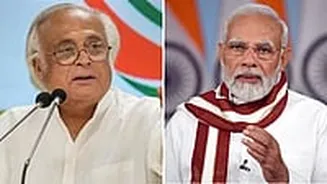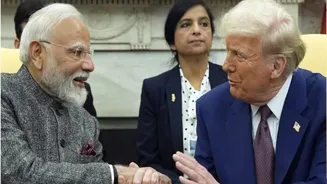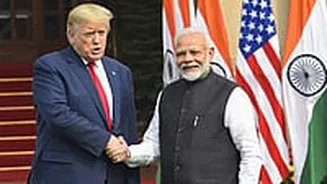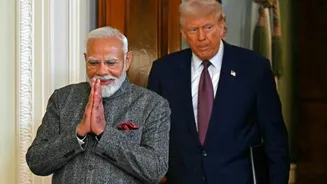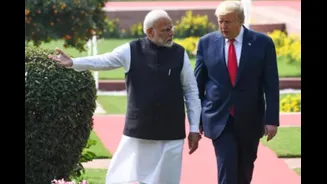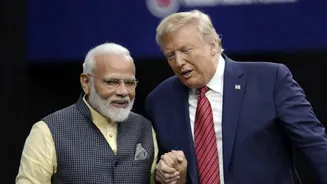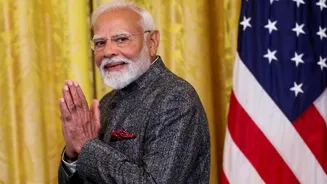

Trump held a phone call with Prime Minister Narendra Modi. This phone call was followed by Potus’ major announcement. While reciprocal tariffs (25 per cent) have been reduced to 18 per cent, the penal levies that Trump imposed on India for buying Russian oil (another 25 per cent) have been cut to zero.
The announcement pointed to a warming of India–US relations, which had been strained by tariffs imposed under the Trump administration. The United States is India’s largest export market, absorbing around 20 per cent of the country’s merchandise exports.
The US has become the latest country to reach a trade deal with India. Here are some other countries that concluded trade discussions with New Delhi in the recent past:
EU
The EU and India concluded negotiations last week for a historic free trade agreement (FTA), the largest such deal ever concluded by either side.
It will strengthen economic and political ties between the world's second and fourth largest economies, at a time of rising geopolitical tensions and global economic challenges.
European Commission President, Ursula von der Leyen, said: “The EU and India make history today, deepening the partnership between the world's biggest democracies. We have created a free trade zone of 2 billion people, with both sides set to gain economically.”
Mauritius
India signed a Comprehensive Economic Cooperation and Partnership Agreement (CECPA) with Mauritius in 2021. CECPA became the first trade agreement signed between the two countries.
CECPA provides for an institutional mechanism to encourage and improve trade between the two countries. The CECPA between India and Mauritius covers 310 export items for India, including food stuff and beverages, agricultural products, textile and textile articles, base metals and articles thereof (32 lines), electricals and electronic item, among other things.
Under the deal, Indian service providers have access to around 115 sub-sectors from the 11 broad service sectors, such as professional services, computer-related services, research & development, and other business services.
UK
India and the United Kingdom signed a landmark Free Trade Agreement (FTA) last year that aimed to deepen economic ties and boost bilateral trade. Under the deal, the UK will give duty-free access to about 99% of Indian exports, covering key sectors like textiles, leather, gems and jewellery, engineering goods, and footwear, which should make Indian products more competitive in the UK market.
In return, India will progressively reduce tariffs on around 90% of UK imports, including on products like whisky, cars, cosmetics, and medical devices, lowering costs for Indian consumers and businesses.
Beyond tariffs, the agreement includes provisions to ease trade in services and support the temporary movement of professionals, as well as access for UK firms to India’s public procurement market. Both governments expect the trade deal to significantly increase bilateral commerce, strengthen investment flows, and create new opportunities for exporters, consumers, and workers on both sides.
Oman
Just last month, India signed a Comprehensive Economic Partnership Agreement (CEPA) with Oman. The India–Oman CEPA provides a comprehensive framework covering trade in goods and services, investment, professional mobility, and regulatory cooperation.
Under the deal, India secured 100 per cent duty-free market access in Oman across 98.08% of tariff lines, covering 99.38 per cent of export value.
The agreement opened export opportunities across engineering goods, pharmaceuticals, agriculture and processed food, marine products, textiles, chemicals, electronics, plastics, and gems & jewellery.
Australia
India and Australia signed the Economic Cooperation and Trade Agreement (ECTA), a free-trade framework that came into force on 29 December 2022, marking India’s first major FTA with a developed economy in over a decade.
Under this pact, Australia now exports around 85 per cent of its goods to India duty-free, rising to about 90 per cent by 2026, while 96 per cent of Indian exports to Australia enter tariff-free, increasing to 100 per cent by the same year. This reduction in tariffs covers a wide range of goods, from coal, sheep meat and wool to textiles, engineering products and agricultural items, helping reduce costs and boost competitiveness on both sides.