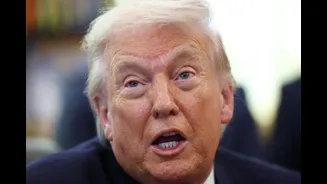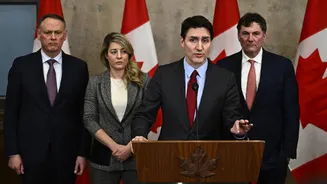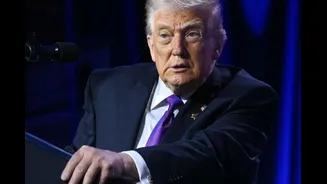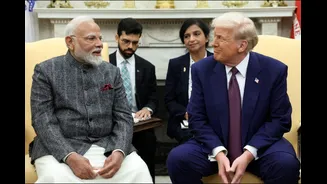

US President Donald Trump’s announcement of a “framework of a future deal” on Greenland has been met with deep scepticism in the Arctic territory, even as financial markets rebounded and European leaders welcomed a pause in escalating tensions and threatened tariffs.
Hours after telling the World Economic Forum in Davos that he wanted Greenland “including right, title and ownership,” while backing away from threats of military action, Trump announced on social media a “framework of a future deal with respect to Greenland” and withdrew tariff threats against eight European countries.
He later described it as “a concept of a deal” in an interview with CNBC.
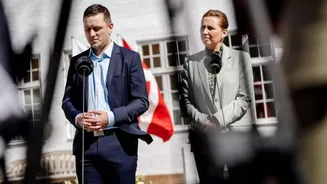
Danish Prime Minister Mette Frederiksen welcomed talks between Trump and Nato secretary-general Mark Rutte that led to the "framework for a future deal" but stressed that Greenland’s sovereignty was not negotiable.
“Nato is fully aware of the Kingdom of Denmark’s position. We can negotiate about everything politically — security, investments, the economy. But we cannot negotiate about our sovereignty,” Politico quoted Frederiksen as saying.
“Only Denmark and Greenland themselves can make decisions on matters concerning Denmark and Greenland," she added.
Danish Foreign Minister Lars Løkke Rasmussen struck a cautious note, saying, “The day ended better than it started,” while calling for talks that respect Denmark’s “red lines.”
Italy’s Prime Minister Giorgia Meloni also welcomed the move, though Rutte warned that there was still “a lot of work to be done.”
Rutte later said Greenland’s status had not come up in talks, and a Nato spokesperson clarified that no compromise on sovereignty had been proposed, reported The Guardian.
The announcement sparked anger among some Danish lawmakers.
“It’s not real negotiations; it’s two men who have had a conversation,” MP Sascha Faxe told Sky News, adding, “There can’t be a deal without having Greenland as part of the negotiations.”
Media reports suggested the US could seek control over limited areas hosting military bases and access to rare earth minerals, though Greenlandic MP Aaja Chemnitz Larsen said such ideas were “completely out of the question.”
Tariff rollback de-escalation, say European leaders
European leaders described Trump’s tariff rollback as de-escalation.
UK Prime Minister Keir Starmer said “British pragmatism” helped defuse the crisis and urged focus on Arctic security.
Sweden’s minister for foreign affairs, Maria Stenergard, said the work of Europe’s allies has “had an effect” and she reiterated that they would not be “blackmailed”.
"I think you will have noticed that the last few days have been incredibly serious in relation to big things happening on the world stage.
"And you may have seen but it is a good thing that yesterday the threat of tariffs against the United Kingdom was lifted, and now we can start hard yards and finding a way forward on security in the Arctic, which may seem a long way away, pretty remote, but actually it does matter to all of us in terms of the safety and security of our country," The Guardian quoted Starmer as saying in his first public remarks since Trump’s climbdown last night.
"And we’ve got through the last few days with a mix of British pragmatism, common sense, but also that British sense of sticking to our values and our principles," he added.
Markets, rattled earlier by Trump’s rhetoric, rebounded after the announcement. “The market bounced when he said we wouldn’t use force,” said strategist Mark Hackett, while analyst Matthew Smart said “uncertainty just got priced out.”
In Greenland, however, reaction was starkly different. “He’s lying,” one resident in Nuuk told AFP, while care worker Anak said, “Greenland belongs to the Greenlanders.”
With inputs from agencies