






When a filmmaker like Prakash Jha returns to the political arena, expectations come preloaded. The director built an entire cinematic identity around dissecting power structures with films like Raajneeti and Gangaajal. With Sankalp, his latest web series, he once again ventures into the labyrinth of ideology, influence and institutional power, this time anchored by the formidable presence of Nana Patekar .
The plot of Sankalp
The premise is promising- a mentor shaping the minds that will eventually control the system. But while Sankalp begins like a careful game of political chess, it eventually finds itself circling the board a little too long before making a decisive move.
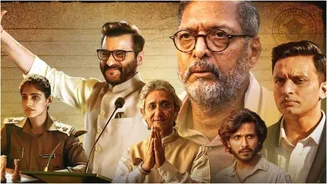
The series frames the journey of Ma’at Saab (Nana Patekar) as a modern reinterpretation of the Chanakya-Chandragupta relationship. His mission is simple in theory- train bright young minds who will infiltrate the administrative system and eventually reshape it. By running the most powerful UPSC coaching centre in Bihar, he also makes sure that he is the one who is shaping the army of future bureaucrats, all holding powerful positions and all of whom have their loyalty pledged towards him.
The most compelling thread emerges from his relationship with his protégé Aditya (Mohammad Zeeshan Ayyub). What begins as admiration slowly evolves into ideological tension as ambition and power start altering loyalties.
It is in these moments, where mentorship collides with ambition,that Sankalp briefly achieves the dramatic weight it aims for.
The performances
If Sankalp has a gravitational centre, it is Nana Patekar. As Kanhaiya Lal, also known as Ma’at Saab, the veteran actor plays a respected teacher who runs a gurukul-like institution designed to groom future bureaucrats and political leaders.
Patekar performs the role with a restraint that feels almost old-school in today’s OTT landscape. He does not shout to command attention; he simply occupies the frame with quiet authority. A pause, a measured line delivery, even a glance, Patekar reminds you how much power lies in understatement. It’s the kind of performance that elevates material even when the writing begins to wander.
Ayyub, who always delivers an effortless performance, stays steady in Sankalp. His character Aditya is one of the key players in the game of chess, who would always keep you guessing whose side he is really on. He has his moments of self-doubt, questions and vulnerability, all of which Ayyub plays with an ease that's rare to see on screen.
Kubbra Sait plays the troubled but brilliant IPS Praveen Sheikh. Her character needed to be fleshed out better and Sait was dedicated to her character. However, it felt so superficial that audience might have a hard-time connecting to her and her pain.
Then, there's also Neeraj Kabi as the mastermind Waqar. Kabi is a great actor in general, but a few particular scene in episode 6, and his wink looked so out of place that it jolted me out of the narrative. What happened, and why was the scene not cut is a huge question mark.
Sanjay Kapoor also gets limited scope, as does other actors like Meghna Malik, Kranti Prakash Jha and Sourabh Goel.
The good and the bad
The problem with Sankalp is not its ideas but its pacing. The show clearly wants to be a layered political study, but the storytelling often feels stretched.
At nearly ten episodes, the narrative frequently meanders through subplots that neither deepen the central conflict nor move it forward. The tension builds slowly but the eventual payoff lacks the sharpness the setup demands.
In political dramas, the thrill lies in watching strategy unfold. Here, the strategies are often discussed rather than experienced.
Fans of Prakash Jha will recognise the DNA immediately. Institutions are fragile, power is transactional, and idealism always walks a tightrope.
The world of Sankalp is filled with bureaucrats, strategists and ideological warriors who believe they are shaping the nation’s future. Jha clearly wants the series to function as a meditation on influence, how real power is rarely loud but almost always strategic.
Yet the execution occasionally feels like a diluted echo of the urgency that defined his earlier political dramas. It has also been quite simplified. The entire world-building is expected to achieve something that most series don't get to - the Tier 3 audience.
The verdict
Sankalp is a show with ambition, ideas and a commanding central performance. But a sprawling narrative and uneven pacing dilute what could have been a far sharper political drama.
Still, for viewers who enjoy dialogue-driven stories about power and ideology, the series offers enough intrigue to stay invested.
Rating: 2.5 out of 5 stars.
Watch the trailer of Sankalp here:
The series is streaming on Amazon MX Player and can be watched for free.