









What is the story about?
The West Bengal government has decided to hand over seven strategically important stretches of national highways to central agencies, a move expected to strengthen connectivity, defence logistics and infrastructure development in the sensitive Siliguri Corridor, popularly known as the “Chicken’s Neck”.
The decision, approved in principle by the state government, ends a long-standing deadlock over several highway projects that had reportedly remained stalled for nearly a year. The stretches will now be managed by the National Highways Authority of India (NHAI) and the National Highways & Infrastructure Development Corporation Limited (NHIDCL).
The move carries major strategic significance because five of the seven highway stretches pass through the Siliguri Corridor — a narrow strip of land in northern West Bengal that serves as the only land link between mainland India and the eight northeastern states. The corridor is barely 20-22 kilometres wide at its narrowest point and is surrounded by Nepal, Bhutan and Bangladesh, while China lies further north beyond Sikkim.
The Siliguri Corridor is considered one of India’s most critical military and logistical chokepoints. Any disruption in this narrow passage can affect road, rail and military connectivity with Assam, Arunachal Pradesh, Meghalaya, Mizoram, Manipur, Nagaland, Tripura and Sikkim.
Security concerns around the corridor have increased over the years, particularly after the 2017 Doklam standoff between India and China near the India-Bhutan-China trijunction. Frequent landslides and monsoon damage in the hills of north Bengal and Sikkim have also repeatedly disrupted transport and military movement in the region.
The transfer of these highways to central agencies will help speed up widening, strengthening and repair work on roads considered vital for defence preparedness, trade, tourism and regional connectivity.
According to a News18 report, under the new arrangement, NHAI will take charge of key stretches including NH-31, NH-33 and NH-312. NHIDCL will oversee projects such as the Sevok-Coronation Bridge stretch, the Hasimara-Jaigaon route and the Changrabandha corridor.
The projects had remained pending despite repeated requests from central agencies. With formal approval now granted, construction and expansion work is expected to move forward at a faster pace.
The decision is also expected to improve connectivity to border regions near Bangladesh and Bhutan, while strengthening transport networks across the Darjeeling hills, Dooars and north Bengal.
The Centre views the corridor as critical for rapid troop deployment and movement of military equipment to India’s northeastern frontier. Better highways are expected to improve strategic readiness in case of emergencies or border tensions.
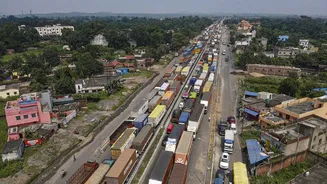
NH10, which connects Sikkim, has remained especially vulnerable to monsoon damage and landslides, often disrupting supply lines. NH110, linking Darjeeling, has also faced chronic issues related to subsidence and traffic bottlenecks for years.
Now when these seven highway stretches have been transferred to the Centre, it will likely lead to integrating north Bengal more closely with the national highway network.
The decision, approved in principle by the state government, ends a long-standing deadlock over several highway projects that had reportedly remained stalled for nearly a year. The stretches will now be managed by the National Highways Authority of India (NHAI) and the National Highways & Infrastructure Development Corporation Limited (NHIDCL).
The move carries major strategic significance because five of the seven highway stretches pass through the Siliguri Corridor — a narrow strip of land in northern West Bengal that serves as the only land link between mainland India and the eight northeastern states. The corridor is barely 20-22 kilometres wide at its narrowest point and is surrounded by Nepal, Bhutan and Bangladesh, while China lies further north beyond Sikkim.
Strategic importance of Chicken’s Neck
The Siliguri Corridor is considered one of India’s most critical military and logistical chokepoints. Any disruption in this narrow passage can affect road, rail and military connectivity with Assam, Arunachal Pradesh, Meghalaya, Mizoram, Manipur, Nagaland, Tripura and Sikkim.
Security concerns around the corridor have increased over the years, particularly after the 2017 Doklam standoff between India and China near the India-Bhutan-China trijunction. Frequent landslides and monsoon damage in the hills of north Bengal and Sikkim have also repeatedly disrupted transport and military movement in the region.
The transfer of these highways to central agencies will help speed up widening, strengthening and repair work on roads considered vital for defence preparedness, trade, tourism and regional connectivity.
Highways to come under central control
According to a News18 report, under the new arrangement, NHAI will take charge of key stretches including NH-31, NH-33 and NH-312. NHIDCL will oversee projects such as the Sevok-Coronation Bridge stretch, the Hasimara-Jaigaon route and the Changrabandha corridor.
The projects had remained pending despite repeated requests from central agencies. With formal approval now granted, construction and expansion work is expected to move forward at a faster pace.
The decision is also expected to improve connectivity to border regions near Bangladesh and Bhutan, while strengthening transport networks across the Darjeeling hills, Dooars and north Bengal.
Defence and connectivity boost
The Centre views the corridor as critical for rapid troop deployment and movement of military equipment to India’s northeastern frontier. Better highways are expected to improve strategic readiness in case of emergencies or border tensions.
NH10, which connects Sikkim, has remained especially vulnerable to monsoon damage and landslides, often disrupting supply lines. NH110, linking Darjeeling, has also faced chronic issues related to subsidence and traffic bottlenecks for years.
Now when these seven highway stretches have been transferred to the Centre, it will likely lead to integrating north Bengal more closely with the national highway network.