
Karl Marx famously said that history repeats itself, first as tragedy and second as farce. The way US President Donald Trump and his cronies have cobbled together what they advertised as the Board of Peace (BoP) at the World Economic Forum (WEF) 2026 shows their real intent: economic opportunities in political tragedies.
Gaza, with a death toll of over 60,000 and the displacement of more than two million others, is a huge tragedy. But it has morphed into a political farce — and a massive business opportunity.
Manufacturing conflicts, marketing weapons, and rebuilding war-ravaged countries are all big global businesses. Period.
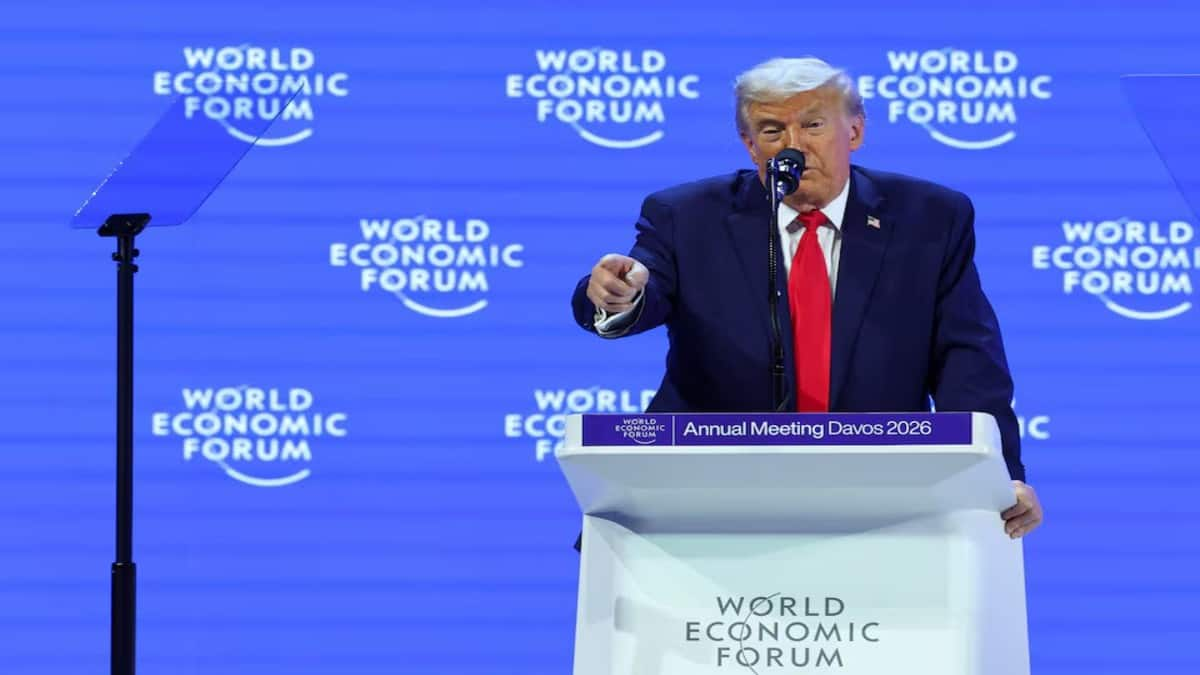
President Trump unveiled the BoP at the WEF’s Annual Summit in Davos, Switzerland — hardly a political platform. Had he any political solutions to offer on Gaza or other crises, he would have probably launched the board at United Nations platforms in New York or Geneva—or in Washington.
He did not.
Instead, he formally unveiled, signed, and got others to sign the Charter of the US-friendly international organisation in Europe. Assembled, ostensibly, for resolving not just the stalemated Gaza war but also other conflicts, it carries an entry fee of $1 billion for permanent membership; other guests will have three-year terms. And, of course, Trump will lead this League of Nations 2.0 as its lifetime Chairman.
In September 2025, the BoP was originally conceived to oversee the rebuilding of war-torn Gaza and rehabilitate its more than two million displaced people. However, there is no Palestinian representative on the BoP.
But then its larger master plan evolved to embrace the entire planet; the Gazans/Palestinians have simply ceased to exist—almost.
Why?
Gaza, or for that matter Ukraine, is a lever to be leveraged — by a US President who admits he is a businessman and deal-maker.
If we piece together diverse strands, a bigger picture emerges.
Come November 2026
Democratic-Socialist Zohran Mamdani’s November 2025 election as the next Mayor of New York City likely made the Republicans rethink the very fate of the capitalist world’s financial and geopolitical capital: is New York now an asset or a liability for America as a unipolar superpower?
And has California, especially San Francisco, grown too big for its high-tech boots?
Spot these straws in the wind:
A day after the first Muslim was sworn in as the 111th Mayor of New York City on January 1, 2026, Trump’s crypto adviser and venture capitalist David Sacks predicted that Miami would dethrone New York City as the USA’s financial capital. He also argued that ‘progressive policies’ in San Francisco would push talent and investment to Austin, Texas, making it the new technology capital.
In other words, just as some nations relocate their capitals for different reasons, the Republicans may also shift the USA’s financial and technology capitals to get even with the Democrats.
Ahead of the crucial mid-term elections to the US Congress in November 2026, the Republicans are likely cleansing New York and San Francisco as the Democrats’ nurseries; the two bastions have traditionally funded and fertilised liberal, democratic, and secular ecosystems not only in America but overseas as well. With Trump’s return to the White House for a second term in January 2025, many Republicans have fiercely and openly targeted ‘Democrat-infested’ academia and media, and pushed through aggressive anti-immigration policies. More than a dozen leading US universities and millions of immigrants have been targeted like never before.
If the Republicans win, New York may lose its sheen as a global city, and even the United Nations may be phased out. In January 2026, Trump set this objective in motion when the US withdrew from 66 UN-linked global bodies; and just a day after he signed the BoP in Davos, Washington formally pulled out of the WHO as well.
Overall, the US foots nearly 20 per cent of the UN’s bills; starved of funds, the UN has already reduced its staff.
Of course, age-related health issues — complacency and dependence on others —also afflict this first truly global organisation.
Trump and UNO@80
Then US President Franklin D. Roosevelt coined the term “United Nations” in 1942 to describe the Allied nations fighting the Axis powers during the ongoing Second World War (1939-45). As a key founder of the United Nations Organisation (UNO), he initiated the planning for the international body. Shortly after his untimely death, the UN Charter was signed on June 26, 1945, in San Francisco; his administration had laid the groundwork.
His successor, Harry S. Truman, oversaw the finalisation of the UN Charter; the US Senate approved it on July 28, 1945, making the United States the first nation to complete the ratification process. In 1946, Truman welcomed the first sessions of the UN General Assembly in New York, which became the organisation’s permanent headquarters.
But that was the age of West-led geopolitics. Now is the era of geo-economics.
The Republicans have since had a problem with Roosevelt and Truman: both were Democrats who fought real wars against Japan and European fascists.
The UN is now 80 years old; Trump, the oldest person in American history to become President (for a second term), will also turn 80 in July 2026. And his ambition is, if not to make history, at least to leave a mark on it.
What better way to achieve this than to undermine — or maybe even kick out — the UN itself?
Even during Trump 1.0, the US had temporarily withdrawn from seven UN organisations.
America after UN?
Post-Mamdani, this likely Republican strategy — call it the Deep State’s global vision — is no longer America-centric but expands to the entire planet, even space (that’s why the US must acquire Greenland, the emerging spot for the best space forays). In this 21st-century quest for untrammelled US ascendance, not only the UN but even NATO are redundant. For example, because of four non-American vetoes in the UN Security Council, the US cannot always have its way. Within NATO also, the US controls the UK’s nuclear warheads but not France’s.
Clearly, America has its limits in both the UN and NATO.
Trump, who has already warned Europe against illegal immigrants, elaborated on what he plans for NATO. In a January 23 social media post, he wrote: “Maybe we should have put NATO to the test: invoked Article 5 and forced NATO to come here and protect our Southern Border from further invasions of illegal immigrants, thus freeing up large numbers of Border Patrol Agents for other tasks.”
National sovereignty? It’s the post-nation and post-UN era.
The Third BoP!
Until recently, the world was familiar with two BoPs: balance of payments and balance of power. Trump is leveraging both with his own BoP — the Board of Peace — for geodynamic objectives.
It is in this context that the White House, bypassing the UN, invited more than 60 countries to join the Trump-headed BoP in Davos. Nearly 25 agreed to join, nine European nations declined, and Trump disinvited Canada. America’s key NATO allies — the UK, Germany, Canada and France — are notable absentees. Others, such as Russia, China, India and Japan, are yet to decide.
Ironically, while Trump’s BoP was initially conceived as a mechanism to oversee the reconstruction of Gaza, its 11-page Charter does not directly mention the war-torn Palestinian territory — not even once. Instead, the Charter describes a broad international organisation with an open-ended mandate to “promote stability, restore dependable and lawful governance, and secure enduring peace in areas affected or threatened by conflict”.
Observers noted that the Charter allows for a much wider global scope, feeding speculation that it is intended as a rival to the United Nations. Moreover, it designates Trump as Chairman with wide-ranging powers, including the ability to veto decisions and control the agenda. Like an exclusive Trump Club, its membership is invitation-only.
While the UNSC previously endorsed the board for Gaza-specific work (under Resolution 2803), the Charter itself appears to have evolved into a more ‘imperial’ or wide-ranging agenda.
“Once this board is completely formed, we can do pretty much whatever we want to do,” Trump claimed before signing the documents. He was joined on stage by cheering leaders, foreign ministers and top officials representing 19 other countries, such as Argentina, Qatar, Azerbaijan, Indonesia, Hungary, Morocco, Bahrain, Pakistan and Saudi Arabia. Even Islamic countries signing the Charter did not object to the omission of Gaza.
To be politically correct, for now, Trump said his BoP would “work with many others, including the United Nations”. “I’ve always said the United Nations has tremendous potential; it has not used it.”
He praised the work of US officials involved in the project for their efforts in establishing a ceasefire in Gaza. “We have peace in the Middle East. Nobody thought that was possible.”
He added that the board was going to be “very successful in Gaza” and that “we can spread out to other things as we succeed with Gaza”.
But many suspect Trump’s real intentions.
Brazilian President Luiz Inácio “Lula” da Silva has accused his US counterpart of wanting to create “a new UN”. “Instead of fixing” the UN, he said, “Trump is proposing to create a new UN where only he is the owner”.
‘Board of Action’
US Secretary of State Marco Rubio said: “This is not just a Board of Peace. This is a board of action, just like President Trump is a president of action.”
Trump’s Jewish son-in-law Jared Kushner, a senior White House adviser and real-estate developer, outlined details of the BoP’s development plans in Gaza without mentioning any pathway towards a Palestinian state. The board wants to use “free market principles” to shift Gaza away from dependence on foreign aid, he said, showing a map of the Gaza Strip divided into “residential” and “coastal tourism mixed” zones.
The plan includes building 100,000 housing units in Rafah as well as “New Gaza”, Kushner said, showing a rendering of high-rise coastal towers.
On February 4, 2025, Trump stated in a joint press conference with Israeli Prime Minister Benjamin Netanyahu that the US would “take over” and “own” the Gaza Strip, levelling and reconstructing the territory, which would provide “unlimited amounts of jobs and housing for the people of the area”.
Trust Trump!
(The author is a senior journalist. Views expressed in the above piece are personal and solely those of the author. They do not necessarily reflect Firstpost’s views.)