







What is the story about?
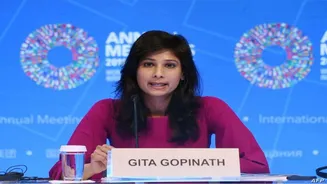
Former IMF chief economist Gita Gopinath has said India has bigger problems than US President Donald Trump's tariffs, naming pollution as having the capacity to threaten the Indian economy much more than tariffs.
"Pollution is a challenge in India, and its impact on the economy is far more consequential than any impact of tariffs imposed so far," Gopinath said at the World Economic Forum in Davos.
She explained that the effects of pollution have direct consequences on productivity, healthcare costs and overall economic activity, making it an underlying cause of slowed economic growth.
"The real costs of pollution are not merely environmental ... They are deeply intertwined with economic growth, productivity, and the health of citizens," she added.
Gopinath argued that environmental factors deserve more attention than tariffs in economic debates, citing their more permanent and extensive impact on the global economy.
She argued that India should prioritise mitigating the effects of pollution to safeguard its economy. "India has made progress in expanding its economy and improving infrastructure, but pollution remains a persistent challenge, particularly in major urban centers," she said.
"From an international investor’s point of view, if you are thinking of setting up operations in India and living there, the environment matters," she added.
The former IMF chief economist highlighted a 2022 World Bank study revealing that pollution claims nearly 1.7 million lives in India annually. This figure represents approximately 18 per cent of all deaths in the country.
Meanwhile, the Commission for Air Quality Management (CAQM)told the Supreme Court on Wednesday that vehicular pollution is the highest contributor to air pollution in Delhi-NCR and recommended 15 long-term measures to improve the worsening Air Quality Index (AQI).
Appearing for CAQM, Additional Solicitor General Aishwarya Bhati told a bench comprising Chief Justice of India Surya Kant and Justices Joymalya Bagchi and Vipul M Pancholi that a meta-analysis of studies from 2015 to 2025 attributes PM2.5 in Delhi to a mix of primary emissions and secondary particulate formation from sources within the National Capital Region (NCR).
"Pollution is a challenge in India, and its impact on the economy is far more consequential than any impact of tariffs imposed so far," Gopinath said at the World Economic Forum in Davos.
She explained that the effects of pollution have direct consequences on productivity, healthcare costs and overall economic activity, making it an underlying cause of slowed economic growth.
"The real costs of pollution are not merely environmental ... They are deeply intertwined with economic growth, productivity, and the health of citizens," she added.
Gopinath argued that environmental factors deserve more attention than tariffs in economic debates, citing their more permanent and extensive impact on the global economy.
She argued that India should prioritise mitigating the effects of pollution to safeguard its economy. "India has made progress in expanding its economy and improving infrastructure, but pollution remains a persistent challenge, particularly in major urban centers," she said.
"From an international investor’s point of view, if you are thinking of setting up operations in India and living there, the environment matters," she added.
The former IMF chief economist highlighted a 2022 World Bank study revealing that pollution claims nearly 1.7 million lives in India annually. This figure represents approximately 18 per cent of all deaths in the country.
Meanwhile, the Commission for Air Quality Management (CAQM)told the Supreme Court on Wednesday that vehicular pollution is the highest contributor to air pollution in Delhi-NCR and recommended 15 long-term measures to improve the worsening Air Quality Index (AQI).
Appearing for CAQM, Additional Solicitor General Aishwarya Bhati told a bench comprising Chief Justice of India Surya Kant and Justices Joymalya Bagchi and Vipul M Pancholi that a meta-analysis of studies from 2015 to 2025 attributes PM2.5 in Delhi to a mix of primary emissions and secondary particulate formation from sources within the National Capital Region (NCR).