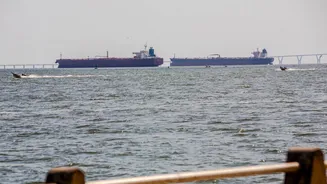

This development meant to economically cripple Moscow comes at a time when the US already seized a Russian-flagged oil tanker, named the Marinera, and simultaneously, continues to negotiate a deal to end the war that began with Russia’s invasion of Ukraine.
What exactly is the Sanctioning Russia Act of 2025, as the bill is formally known? What does India have to do with it? We explain.
The Sanctioning Russia Act of 2025, explained
The bill, titled as Sanctioning Russia Act of 2025, has mainly been written by US Senator Lindsey Graham from South Carolina (a Republican) and Senator Richard Blumenthal from Connecticut (a Democrat).
This legislation empowers Donald Trump to impose tariffs and secondary sanctions on countries that purchase Russia’s oil, gas, uranium and other exports. This will help cut off the source of financing for much of Russia’s military actions.
As per the bill, strict penalties can be imposed if the US president determines that Russia, or someone acting on Russia’s behalf, refuses to negotiate peace with Ukraine, breaks a peace agreement, invades Ukraine again or attempts to overthrow or undermine the Ukrainian government.
Moreover, the legislation allows for the US president to take actions, including visa bans and freeze US property of key Russian individuals, including the Russian president.
The bill further reads: “The President must increase the rate of duty on all goods and services imported from Russia into the United States to at least 500 per cent relative to the value of such goods and services.
“The President must increase the rate of duty on all goods and services imported into the United States from countries that knowingly engage in the exchange of Russian-origin uranium and petroleum products to at least 500 per cent relative to the value of such goods and services.
“The Department of the Treasury must impose property-blocking sanctions on any financial institution organised under Russian law and owned wholly or partly by Russia, and any financial institution that engages in transactions with those entities.”
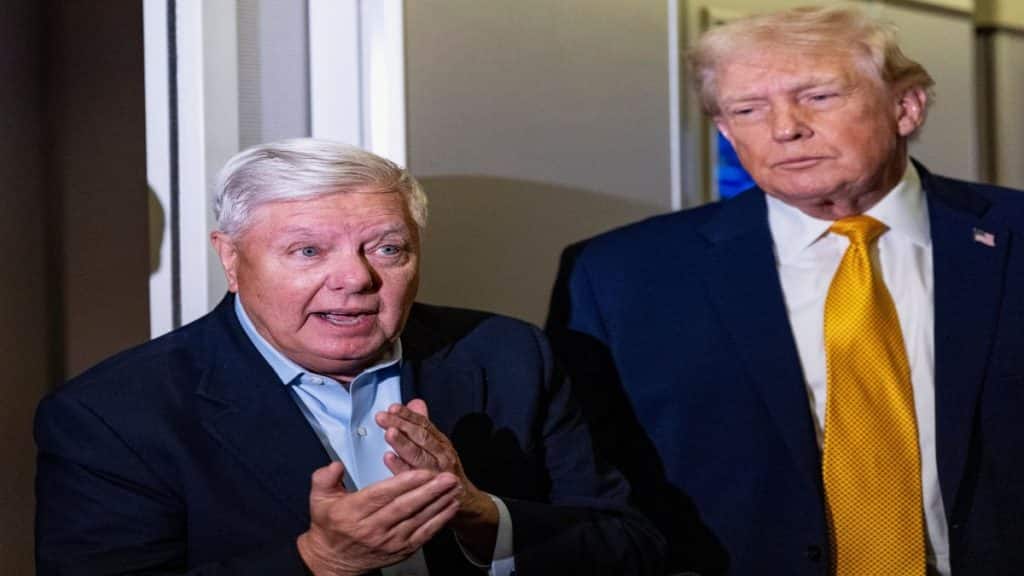
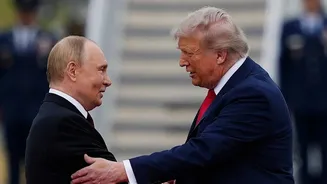
President Donald Trump stands near Senator Lindsey Graham on Air Force One. Trump has now “greenlit” the Russia sanctions bill that Senator Graham has been working on for months. AP
Passing of the Sanctions Bill
Senator Graham said that he met with US President Donald Trump earlier on Wednesday and that the American leader “greenlit” the bill, which has been in the works for months. He wrote on X, “After a very productive meeting today with President Trump on a variety of issues, he greenlit the bipartisan Russia sanctions bill that I have been working on for months with Senator Blumenthal and many others.”
Graham added that there could be a vote as early as next week, although it’s unclear how likely that will be.
The Senate is poised to take up a scaled-back government funding package next week that the House is currently considering, if the House passes it. The following week is a Senate recess timed to Martin Luther King Jr Day.
The sanctions bill and India
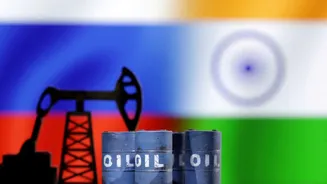
Graham’s legislation would allow for the US to impose tariffs as high as 500 per cent on countries doing business with Russia’s energy sector. This means it would impact India and China, both nations that continue to import oil from Russia.
“This bill will allow President Trump to punish those countries who buy cheap Russian oil fueling Putin’s war machine,” Graham said in a statement, referring to Russian President Vladimir Putin.
“This bill would give President Trump tremendous leverage against countries like China, India and Brazil to incentivise them to stop buying the cheap Russian oil that provides the financing for Putin’s bloodbath against Ukraine.”
India and China have been major buyers of Russia’s oil despite US and European sanctions — in fact, Trump imposed an additional 25 per cent of tariff on India for its purchase of Russian crude last August, taking the total tax levied to a whopping 50 per cent.
If this sanctions bill was to pass, it would mean that India could face sharply higher US import duties. Already, India has been hit hard by the tariffs; labour-intensive sectors were particularly affected, resulting in New Delhi announcing a rollout of a new labour laws.
Now, a steep 500 per cent tariff would mean Indian exports to the US would face enhanced challenges. It could result in export losses and factory slowdowns.
Moreover, the legislation is bound to strain India-US ties even further. US President Trump on January 4 reiterated that the
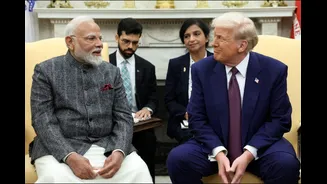
“They (India) wanted to make me happy, basically. (Prime Minister Narendra) Modi is a very good man; he is a good guy. He knew I was not happy, and it was important to make me happy. They do trade and we can raise tariffs on them very quickly. It would be very bad for them,” Trump told reporters aboard Air Force One, referring to India’s recent reduction in purchases of Russian crude oil.
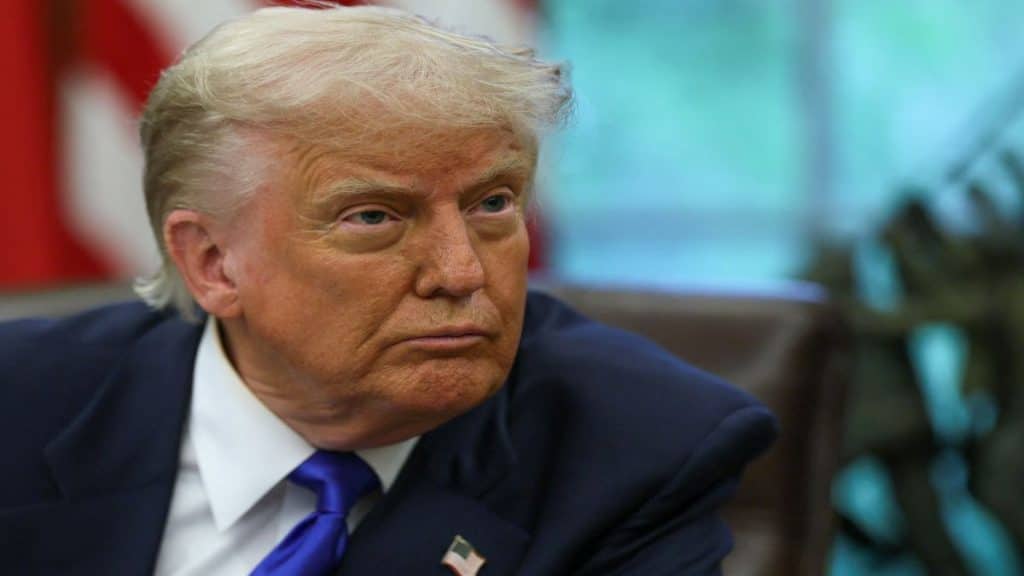
US President Donald Trump has been pressuring India to stop purchasing oil from Russia. Last August, he also imposed an additional 25 per cent tariff on New Delhi for its purchase of Russian crude. File image/Reuters
The timing of Russia sanctions bill
Notably, Trump’s “greenlighting” of Graham’s bill comes while the Trump administration is currently trying to finalise a
“This will be well-timed, as Ukraine is making concessions for peace and Putin is all talk, continuing to kill the innocent,” Graham said in a statement, referring to the Russian President Vladimir Putin.
The irony of it all though is that while the US wants to punish India for its purchase of Russian crude, the European Union continues to remain heavily reliant on Russian liquefied natural gas (LNG).
EU purchases from a single oil project in northwest Siberia, a strategically important development known as the Yamal project, netted €7.2 billion ($8.4 billion) of revenue for the Kremlin in 2025 alone. Around 15 million of the 19.7 million tonnes (76.1 per cent) of LNG exported from Yamal was shipped to the EU, according to analysis of data published by trading intelligence website Kpler.
With inputs from agencies