








What is the story about?
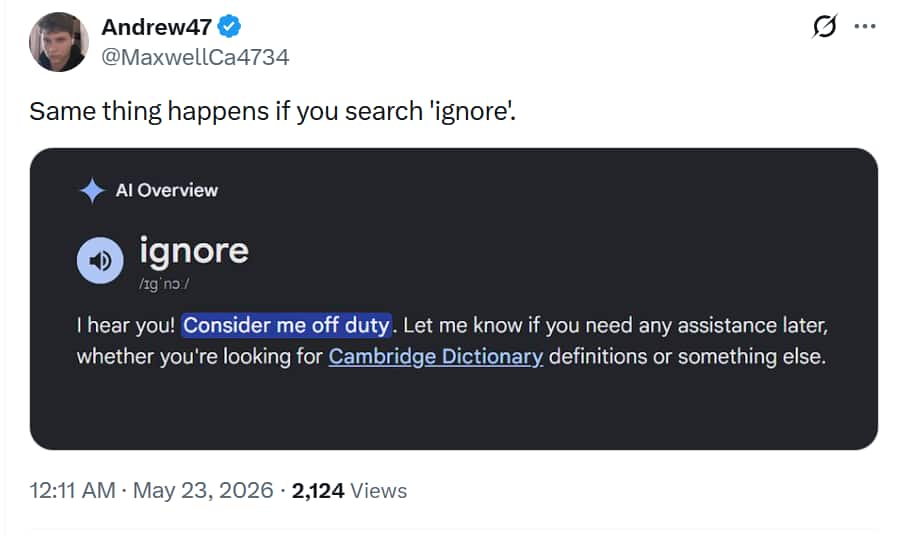
Google’s biggest Search redesign in decades is already running into criticism, and all because of a single word. Users on social media this week began sharing screenshots of what happens when searching “disregard” on the updated Google Search page, where a large AI-generated response dominates the screen while useful links are pushed far below the fold. The result has quickly become a symbol of the growing frustration surrounding AI-heavy search experiences.
What makes the example stand out is how unnecessary the AI response appears to be. Someone searching for a word like “disregard” is likely looking for a quick definition, pronunciation or synonym.
Instead, Google’s new interface presents a bulky AI section with large blank spaces, while the traditional dictionary result from Merriam-Webster appears only after scrolling down. For many users, especially on phones, the AI answer is effectively the only visible content at first glance.
The viral screenshots have fuelled criticism that Google may be prioritising AI visibility over actual usefulness. For years, Search was built around speed and simplicity: type a query, receive relevant links instantly. But Google’s latest redesign shifts the experience towards AI-generated conversations, even in situations where users may not need them.
The “disregard” example highlights one of the biggest concerns around AI search tools: they can sometimes overcomplicate simple tasks. Instead of helping users reach information faster, the system occasionally inserts an AI layer that adds little practical value. Critics online have described the result as cluttered, awkward and visually confusing.
The issue also raises broader questions about the future of the web. As AI-generated summaries increasingly occupy the top section of Search pages, publishers worry that users may stop clicking on websites altogether. If answers are delivered directly inside Google’s AI panels, traffic to dictionaries, news organisations and educational websites could decline further.
At the same time, supporters of Google’s AI approach argue that conversational search works far better for detailed research questions, planning tasks or complex topics where users want explanations instead of links. The challenge for Google may now be figuring out when AI actually improves the experience and when it simply gets in the way.
The criticism arrives just as Google introduces what it calls the biggest upgrade to Search in more than 25 years. The company is rebuilding the platform around AI interactions, encouraging users to ask longer and more natural questions instead of relying on short keywords.
The new Search interface expands dynamically and includes AI-powered query suggestions designed to help users frame questions more effectively. Google is also broadening how people can search by allowing inputs through text, images, videos, files and even open Chrome tabs.
Another major addition is deeper integration between AI Overviews and AI Mode. Users can continue conversations with Search through follow-up questions while maintaining context, making the experience function more like a chatbot.
Google is also expanding its “Personal Intelligence” features to nearly 200 countries and territories in 98 languages. Users can connect services such as Gmail and Google Photos to Search for more personalised responses, while support for Google Calendar is expected to arrive soon.
What makes the example stand out is how unnecessary the AI response appears to be. Someone searching for a word like “disregard” is likely looking for a quick definition, pronunciation or synonym.
Instead, Google’s new interface presents a bulky AI section with large blank spaces, while the traditional dictionary result from Merriam-Webster appears only after scrolling down. For many users, especially on phones, the AI answer is effectively the only visible content at first glance.
‘Disregard’ no more on Google
The viral screenshots have fuelled criticism that Google may be prioritising AI visibility over actual usefulness. For years, Search was built around speed and simplicity: type a query, receive relevant links instantly. But Google’s latest redesign shifts the experience towards AI-generated conversations, even in situations where users may not need them.
Searching the word "disregard" breaks Google, as it generates an AI response pic.twitter.com/haLDRxtJ9P
— internet hall of fame (@InternetH0F) May 22, 2026
The “disregard” example highlights one of the biggest concerns around AI search tools: they can sometimes overcomplicate simple tasks. Instead of helping users reach information faster, the system occasionally inserts an AI layer that adds little practical value. Critics online have described the result as cluttered, awkward and visually confusing.
The issue also raises broader questions about the future of the web. As AI-generated summaries increasingly occupy the top section of Search pages, publishers worry that users may stop clicking on websites altogether. If answers are delivered directly inside Google’s AI panels, traffic to dictionaries, news organisations and educational websites could decline further.
At the same time, supporters of Google’s AI approach argue that conversational search works far better for detailed research questions, planning tasks or complex topics where users want explanations instead of links. The challenge for Google may now be figuring out when AI actually improves the experience and when it simply gets in the way.
Google updates Search
The criticism arrives just as Google introduces what it calls the biggest upgrade to Search in more than 25 years. The company is rebuilding the platform around AI interactions, encouraging users to ask longer and more natural questions instead of relying on short keywords.
The new Search interface expands dynamically and includes AI-powered query suggestions designed to help users frame questions more effectively. Google is also broadening how people can search by allowing inputs through text, images, videos, files and even open Chrome tabs.
Another major addition is deeper integration between AI Overviews and AI Mode. Users can continue conversations with Search through follow-up questions while maintaining context, making the experience function more like a chatbot.
Google is also expanding its “Personal Intelligence” features to nearly 200 countries and territories in 98 languages. Users can connect services such as Gmail and Google Photos to Search for more personalised responses, while support for Google Calendar is expected to arrive soon.