





What is the story about?
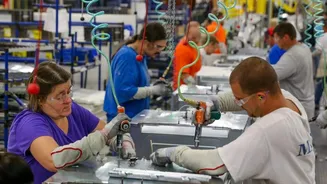
Even as unemployment claims have fallen in the United States, the manufacturing boom that President Donald Trump promised has remained elusive.
Ever since Trump imposed 'Liberation Day' tariffs in April 2025, the manufacturing sector has been in a steady decline. The situation is so bad that American factories now employ fewer people than during Trump's first term.
Trump's tariffs are a major driver of the crisis in the manufacturing sector. While tariffs have protected some manufacturers like steel mills from foreign competition, they have raised costs for many others, particularly small- and medium-scale factories, and that has resulted in a loss of manufacturing activity.
For example, employment in automobile and auto part factories has fallen by around 20,000 since April 2025, according to Washington Post.
In the week ending January 10, unemployment claims were down by 9,000 to 198,000 from 207,000 the previous week. But the fall in unemployment has clearly not reflected into growth in manufacturing jobs.
At the time of announcing tariffs, Trump said that "jobs and factories will come roaring back into our country".
But the reality is that American factories have lost 72,000 jobs —instead of adding any jobs— since the imposition of tariffs, according to The Post.
One of the reasons for the decline are tariffs as nearly half of US imports that are now subjected to tariffs are intermediate goods that American factories use to produce finished products, such as metals that go into the making of food and beverage cans and circuits boards that are used in electronics.
Similarly, auto parts are used in automobiles made in the United States.
Tariffs on such goods has raised or fluctuated frequently input costs for factories that has affected demand as costs were eventually passed on the customers. The jobs were also affected as uncertainty around input prices meant factories tend to moderate their production.
As a result, 57 per cent of midsize manufacturers and 40 per cent of small producers said in a November survey by the Federal Reserve Bank of Richmond that they had no certainty about their input costs, according to The Post.
For large manufacturers, the figure was just 23 per cent, showing that smaller factories were overwhelmingly affected by Trump's tariffs.
The survey found that smaller companies also were more than twice as likely to respond to tariffs by delaying investments in new plants and equipment.
But the effect is also felt by companies making technologically complex goods like aircraft and chips. For example, The Post reported that makers of semiconductors lost more than 13,000 jobs since Trump imposed tariffs.
Ever since Trump imposed 'Liberation Day' tariffs in April 2025, the manufacturing sector has been in a steady decline. The situation is so bad that American factories now employ fewer people than during Trump's first term.
Trump's tariffs are a major driver of the crisis in the manufacturing sector. While tariffs have protected some manufacturers like steel mills from foreign competition, they have raised costs for many others, particularly small- and medium-scale factories, and that has resulted in a loss of manufacturing activity.
For example, employment in automobile and auto part factories has fallen by around 20,000 since April 2025, according to Washington Post.
In the week ending January 10, unemployment claims were down by 9,000 to 198,000 from 207,000 the previous week. But the fall in unemployment has clearly not reflected into growth in manufacturing jobs.
Why factory jobs have fallen under Trump 2.0
At the time of announcing tariffs, Trump said that "jobs and factories will come roaring back into our country".
But the reality is that American factories have lost 72,000 jobs —instead of adding any jobs— since the imposition of tariffs, according to The Post.
One of the reasons for the decline are tariffs as nearly half of US imports that are now subjected to tariffs are intermediate goods that American factories use to produce finished products, such as metals that go into the making of food and beverage cans and circuits boards that are used in electronics.
Similarly, auto parts are used in automobiles made in the United States.
Tariffs on such goods has raised or fluctuated frequently input costs for factories that has affected demand as costs were eventually passed on the customers. The jobs were also affected as uncertainty around input prices meant factories tend to moderate their production.
As a result, 57 per cent of midsize manufacturers and 40 per cent of small producers said in a November survey by the Federal Reserve Bank of Richmond that they had no certainty about their input costs, according to The Post.
For large manufacturers, the figure was just 23 per cent, showing that smaller factories were overwhelmingly affected by Trump's tariffs.
The survey found that smaller companies also were more than twice as likely to respond to tariffs by delaying investments in new plants and equipment.
But the effect is also felt by companies making technologically complex goods like aircraft and chips. For example, The Post reported that makers of semiconductors lost more than 13,000 jobs since Trump imposed tariffs.