
Late last week, the former Soviet republic hosted an international conference aimed at amplifying the Khalistan narrative, having big implications for India.
So, what’s exactly happening? Is this a threat to India? Here’s all we know about the conference that was held in Baku and how it plays into the anti-India narrative being peddled by Pakistan.
Conference on India’s treatment of Sikhs held in Baku
On January 16, the Azerbaijani government-linked Baku Initiative Group held its first international conference focused on India’s treatment of Sikhs and other ethnic minorities, highlighting concerns over alleged state-led repression, discrimination, and human rights violations.
The event, titled ‘Racism and Violence Against Sikhs and Other National Minorities in India: The Reality on the Ground’ was attended by Ramesh Singh Arora, Punjab’s minister for human rights and minorities, alongside Sikh representatives from Canada, the United Kingdom, and the United States.
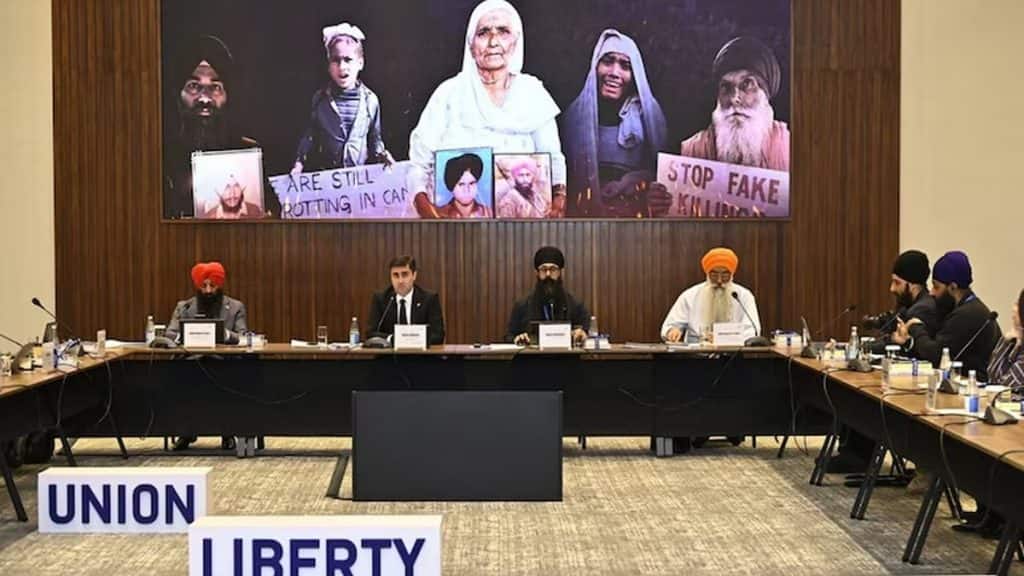
Attendees at the Khalistan conference titled 'Racism and Violence Against Sikhs and Other National Minorities in India: The Reality on the Ground' was held in Baku, Azerbaijan. Image Courtesy: Allen Hampton/X
Among the attendees, the most notable ones was Moninder Singh from Canada, who was friends with known Khalistani Hardeep Singh Nijjar. There was also UK’s Dabinderjit Singh Sidhu, a known Khalistan supporter whose nomination to the UK’s House of Lords was dropped.
What has raised eyebrows about the event in Azerbaijan is the minute of silence that was accorded in memory of Khalistani Hardeep Singh Nijjar, who was assassinated in Canada in 2023. It was then followed up with videos and statements highlighting alleged violations and crimes committed against Sikhs by the Indian government, as well as systemic discrimination faced by other ethnic minorities in India.
Speakers highlighted that activists continue to face arrests under accusations of “separatism” or “espionage,” while international authorities have linked some attacks on Sikh diaspora activists to Indian intelligence services.
During the discussions, words such as genocide and systemic racism were used time and again to characterise India’s action and it’s so-called mistreatment of Sikhs.
A concern for India
At the conference in Azerbaijan’s capital, there was a concerted effort to lend the Khalistan movement legitimacy. As News18 reports, the strategy of the meeting was to move beyond regional rhetoric and engage the United Nations.
At one point during the conference, participants demanded for an investigation of extrajudicial executions by the UN Human Rights Committee and the documentation of rights violations by UN Special Rapporteurs for international monitoring. Moreover, the joint statement after the conference framed Sikh activism as being unjustly labelled “extremism”, echoing a core Khalistani discourse.
But it goes well beyond this. Azerbaijan’s decision to host such an event indicates its steady alignment to an anti-India narrative, being pushed by Pakistan and Turkey. Defence experts note that Pakistan is using Azerbaijan as a neutral-looking ground to facilitate disinformation and provide a platform for elements that are inherently anti-India. They note that by outsourcing the narrative push to Baku, Islamabad gains plausible deniability while keeping the Khalistan issue alive internationally.
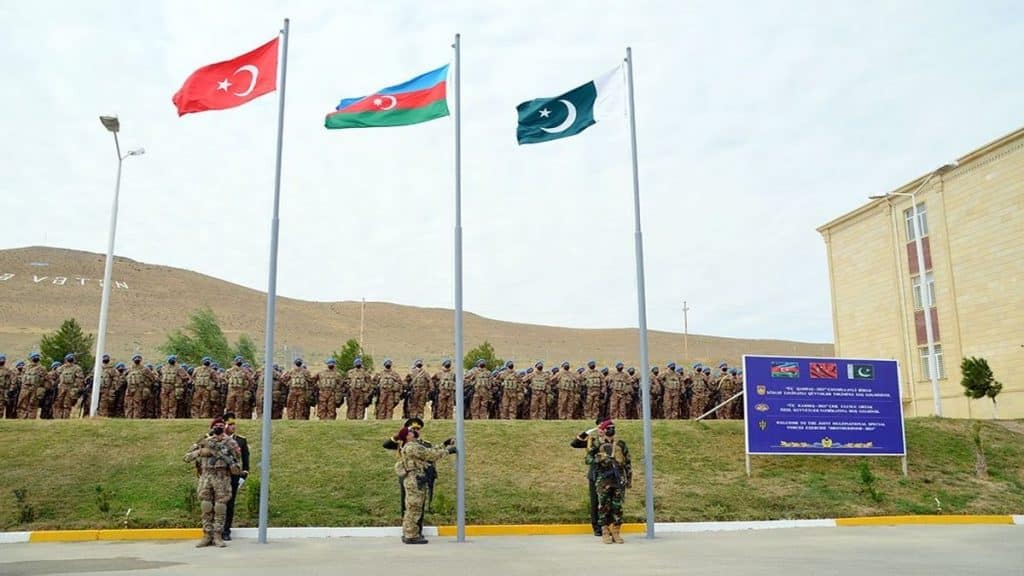
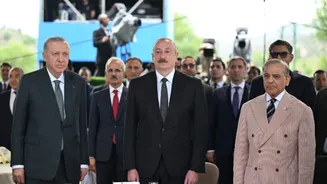
Turkish, Pakistani and Azerbaijani troops at a ceremony together. Image Courtesy: X
Growing nexus between Pakistan-Turkey-Azerbaijan
The Khalistan conference in Baku is just another indicator of the nexus between Pakistan, Turkey and Azerbaijan. Interestingly, Azerbaijan has been siding with Pakistan in recent times — the most recent instance was last year’s Operation Sindoor. Last May, Azerbaijan echoed Pakistan’s stance on the conflict, saying: “We condemn the military attacks on the Islamic Republic of Pakistan, which have resulted in the deaths and injuries of several civilians. In solidarity with the people of Pakistan, we extend our condolences to the families of the innocent victims and wish a speedy recovery to the injured.”
Many note that Azerbaijan’s backing for Pakistan stems from New Delhi’s support to Armenia, Azerbaijan’s arch-rival. New Delhi has ramped up its arms sales to Armenia since 2020, which includes the sale of Swathi weapon locating radars as well as Pinaka multi-barrel rocket launchers and the Akash-1S missile defence system.
Notably, in 2024, Azerbaijan’s President, Ilham Aliyev, asked India to stay away from supplying defence equipment to Armenia. Citing concerns over Azerbaijan’s national security, Aliyev said, “It is a matter of our national security. We cannot sit and wait, seeing how France, India, and Greece are weaponising Armenia against us and doing it openly, demonstratively.”
Another way that Azerbaijan extends support to Pakistan is in the way it reports on Kashmir. Despite the Union territory being an integral part of India, the state media as well as think tanks in Azerbaijan, refer to the area as Indian Occupied Jammu & Kashmir (IOJK), a term that Pakistan uses.
Even during Operation Sindoor, Azerbaijan media parroted Pakistan’s claims, peddling fake news about the conflict. For instance, one article described Indian strikes as causing civilian casualties, damaging mosques, and injuring children. Another focused on the alleged damage to the
Meanwhile Turkey has continuously supported Islamabad’s demand for an international investigation into the Pahalgam attack. Turkey also supplied weapons to Pakistan, which were used during the military confrontation that lasted for five days.
Moreover, Turkey’s President Recep Tayyip Erdogan has repeatedly raised the issue of Kashmir at international events. At last year’s United Nations General Assembly, he mentioned India’s Union territory, “The issue of Kashmir should be resolved on the basis of resolutions of the UN for the best for our brothers and sisters in Kashmir, through dialogue, we hope.”
Such conditions make it prudent for India to be wary of the growing ties between the ‘three brothers’ as they call themselves.
With inputs from agencies