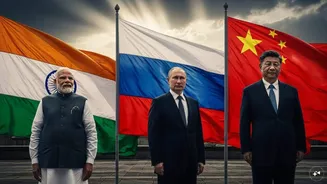

The consequences of this transition from defence dependence to broader economic interdependence go much beyond the bilateral realm. The India-Russia ties underscore the evolving Asian power landscape and, in particular, compel regional and global powers like China to reassess the emerging strategic environment near their periphery. This pivot is shaped by wider regional and global contexts. The long-term policy trajectory has been clear and well defined: enhancing its strategic autonomy by diversifying the supply chains, broadening economic partnerships, and minimising fragility due to one-source reliance.
While historically being heavily inclined towards Russia, India had to consider the contemporary dominant geopolitical model that is defined in terms of technological innovations, energy insecurity, and contested access to critical minerals. India’s own economic ambitions that depend on industrial modernisation and electric-mobility transitions require deeper, more varied and more resilient partnerships.
Similarly, Russia’s intention to seek more balanced global economic linkages is due to Western sanctions and over-dependence on China. These converging motivations have set the grounds for a renewed, reinvigorated and multi-sectoral partnership for both India and Russia.
The Delhi Summit’s New Playbook
The set of agreements endorsed by the two governments in the recent summit meeting set the tone for this tactical shift, covering mutual cooperation on nuclear energy, mechanisms for critical-minerals trade, enhanced relations in shipbuilding, new frameworks for labour mobility, and strengthened coordination on fertilisers and agricultural goods.
Prime Minister Narendra Modi described the new “Economic Cooperation Programme till 2030” as central for diversifying the country’s trade and investment linkages. India not only looks to buy more from Russia but also intends to build sustained long-term industrial, logistical, and regulatory mechanisms to mitigate swings in its core economic sectors.
The message from President Vladimir Putin was just as unmistakable. He reiterated that Moscow remains a “reliable supplier” and pledged “uninterrupted” fuel shipments to India. He further emphasised Moscow’s intentions to broaden cooperation beyond hydrocarbons, extending into pharmaceuticals, nuclear technologies, joint manufacturing ventures, and resource-based partnerships.
The mutual commitments are reflective of economic necessity and geopolitical signalling. This high-stakes visit broadens Moscow’s strategic options not to slide into exclusive dependence on Chinese markets and technology and gives room to manoeuvre a measure of agency in its Asian diplomatic engagements.
The visit is a paradigm shift from the traditional transactional model of the past and marks a shift towards co-development. The cooperation in the field of nuclear energy and agreement by Russia on setting up new reactors and small modular reactors (SMR) gives India a crucial boost in its long-term energy security and diversification strategy.
Apart from the civil-nuclear deals, labour mobility agreements, which will ease the movement of Indian workers into specific Russian sectors, add to a long-run socio-economic aspect of this partnership. And most important is the cooperation on critical minerals that could strengthen multi-decadal supply-chain linkages. In the midst of global energy transitions, these engagements between Delhi and Moscow could shape industries and the geopolitical landscape well beyond defence.
The China Angle: Three Regions of Strategic Impact
In the midst of Russia’s search for agency and India’s pursuit of strategic balance, China’s angle becomes relevant. The India–Russia new economic axis introduces a new variable in Beijing’s long game, characterised by its control over supply-chain chokepoints, infrastructure (like BRI), technological self-reliance, and subtle military expansion in the region. When Russia-India relations evolve economically and not just militarily, it potentially pushes China back in three key regions: Central Asia, South Asia, and the Indian Ocean.
In Central Asia, the Russia-India coordination offers an alternative to China’s expansion through road and rail corridors, mining partnerships, and energy projects. Western sanctions on Russia might have weakened its historic economic leverage in the region, but a strengthened Russia-India partnership spanning across critical minerals, transport networks, and energy could offer Central Asian states a credible alternative to a China-centric economic landscape.
Similarly in South Asia and the Indian Ocean, implications are notable. Chinese footprints in Hambantota, Gwadar, Chattogram, and maritime logistics are evidence of an asymmetric regional environment. But a strengthened and ambitious Russia-India partnership enhancing India’s shipbuilding capacity, energy logistics, nuclear power expansion and port cooperation would potentially strengthen its southern maritime profile in ways that would indirectly counterbalance Beijing’s naval and commercial strategies.
What more does this renewed friendship hold for Russia? It offers diversification and alternative economic pathways by subtly constraining Beijing’s strategic leverage and bargaining power. Due to war and sanctions, Moscow had few economic and strategic alternatives, and this gave China a near-monopoly position vis-à-vis Russia.
In this background, the India-Russia economic partnership, though modest in size and having structural limitations, dilutes China’s monopolistic leverage. Russia that is not wholly tethered to China and India that is resilient to vulnerabilities are what renewed India-Russia friendship brings to the table.
A New Template for Asian Power
Everything said and done, this India-Russia 2.0 partnership is not constructed as a China-containment framework. New Delhi remains committed to managing competition with Beijing while avoiding any unwarranted escalation. Similarly, Moscow, for its part, continues to be “closest friends” with both India and China but at the same time values its strategic alignment with China against Western pressure.
A more economically intertwined India-Russia 2.0 creates new patterns of connectivity, resource flows, and industrial collaboration that reshape the broader Asian landscape, which is cautious and diversified and one where economic dominance is no longer taken for granted.
As put forward by Jaishankar, India’s approach is driven by “long-term consistency” and strategic autonomy. For Asia, the evolving trajectory of the India-Russia partnership underscores that power in the 21st century will not be defined solely by military strength or bilateral alignments. Rather deep and more resilient economic structures will knit the region closely. The Delhi summit positions India and Russia in testing this logic of resilience and prompts China to recalibrate accordingly.