








What is the story about?
What do Pakistan, China and North Korea have in common? According to US Director of National Intelligence Tulsi Gabbard, all three countries pose the most significant nuclear threats to America.
In a testimony before the Senate Intelligence Committee, Gabbard said, “The intelligence community assesses that Russia, China, North Korea, Iran, and Pakistan have been researching and developing an array of novel, advanced, or traditional missile delivery systems, with nuclear and conventional payloads, that put our homeland within range.”
While Gabbard’s statement exposes the risk that Pakistan, who has been cosying up to the US in recent times, poses to America, it also emphasises the dangers to India.
In our explainer, we unpack what the US director of National Intelligence revealed and why India should be on guard.
The US intelligence chief, Tulsi Gabbard, presented the 2026 Annual Threat Assessment, which noted that Pakistan was one of the most significant nuclear threats facing the United States, placing it alongside major powers such as Russia and China.
“China, Russia, North Korea, Iran, and Pakistan have been researching and developing an array of novel, advanced, or traditional missile delivery systems with nuclear and conventional payloads, that can strike the homeland,” read the report, adding that threats to the US will expand to more than 16,000 missiles by 2035, from the current figure of more than 3,000 missiles.
Gabbard’s reports further added that China, North Korea, Pakistan, and Russia will probably continue to research, develop, and field delivery systems that will increase their ranges and accuracy, challenge US missile defences, and provide new weapons of mass destruction-use options.

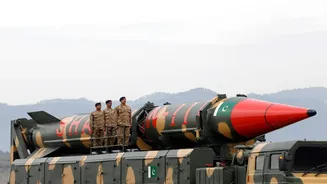
On Pakistan, Gabbard stated that the country continues to develop increasingly sophisticated missile technology that provides its military the means to develop missile systems with the capability to strike targets beyond South Asia, and if these trends continue, ICBMs that would threaten the US.
The US intelligence chief identified Al-Qaeda and the Islamic State as significant and enduring threats to US interests abroad, with both groups maintaining a dangerous presence across parts of Africa, the Middle East, and South Asia.
In the 34-page report, Gabbard also said, “Countries such as Egypt, Israel, Pakistan, Turkey, and the UAE are using a mix of lethal aid, proxy forces, or their own military assets to provoke or undermine their rivals or to tilt nearby conflicts in their favour.”
It said that many countries are now more willing to use deniable, coercive, or violent approaches below the threshold of war. “These include acts of sabotage, assassinations, detentions, non-lethal attacks, and the use of migration as a weapon,” the document said.
Gabbard’s inclusion of Pakistan as a significant threat to Pakistan is noteworthy. It comes at a time when Islamabad has been cosying up to Washington, notably President Donald Trump.
Pakistan Prime Minister Shehbaz Sharif has termed the American leader as a
“saviour of South Asia”,
claiming that it was Trump who helped broker peace between India and Pakistan last year amid Operation Sindoor hostilities. Sharif even nominated Trump for a Nobel Peace prize.
Moreover, in efforts to appease Trump, Pakistan has even enlisted as a member of the controversial Board of Peace.
Many experts note that Gabbard’s risk assessment report is important for India for a number of reasons. Long-simmering hostilities between the two countries came to the forefront last year amid Operation Sindoor, when India struck terror camps and infrastructure deep within Pakistan and Pakistan-occupied Kashmir, prompting Islamabad to counter with attacks on civilian infrastructure in India. Both nations were engaged in a series of tit-for-tat moves.
However, with Gabbard’s assessment of Pakistan’s continued development of missile systems should be a concern for India. That’s because Islamabad has never officially released a comprehensive policy statement on its nuclear weapons use, giving it the flexibility to potentially deploy nuclear weapons at any stage of a conflict, as it has threatened to do in the past. Experts widely believe that from the outset, Islamabad’s non-transparency is strategic and meant to act as a deterrence to India’s superior conventional military strength, rather than to India’s nuclear power alone.
This is in stark contrast to India that abides by the no first use policy. This principle means that India will not be the first to launch nuclear attacks on its enemies. It will only retaliate with nuclear weapons if it is first hit in a nuclear attack. India’s doctrine says it can launch retaliation against attacks committed on Indian soil or if nuclear weapons are used against its forces on foreign territory. India also commits to not using nuclear weapons against non-nuclear states.
Moreover, Pakistan has long been engaged in
nuclear sabre-rattling. For instance, Pakistan’s Field Marshal Asim Munir, while on a US visit, said: “We are a nuclear nation. If we think we are going down, we’ll take half the world down with us.”
At the time, India responded by saying that nuclear sabre-rattling is Pakistan’s stock-in-trade, and expressed regret that such remarks were made from the soil of a friendly third country.
Even Pakistan Peoples Party chairman Bilawal Bhutto Zardari issued similar war threats to India last year.
But the threat to India is not just rhetorical but also tangible. Pakistan continues to develop its
missile programme. According to an Al Jazeera report, Islamabad has over 170 warheads in its arsenal. An Arms Control report further states that Pakistan has short- and medium-range ballistic missiles, but does not have a long-range ballistic missile system.
Of all its missiles, the Shaheen-III has the longest range — of 2,750 kilometres. This means that the Shaheen III can reach every part of India, including Mumbai and Delhi.
Apart from the Shaheen, Pakistan also has the Babur cruise missile. This weapon system has a range of 700 kilometres. It flies low to avoid radar and is pinpoint accurate. There’s also the
Fatah-II, which is a rocket guided small-range ballistic missile that can hit its targets with precision.
According to a Times of India report, Pakistan also has the nuclear-capable Abdali weapon system. This ballistic missile has a range of 450 kilometres.
In fact, Pakistan’s missile programme has raised concern in the US in the past as well. Jon Finer, serving in the Biden administration, described Pakistan’s pursuit of advanced missile technology as an “emerging threat” to the United States.
We shall wait and watch to see what comes next. However, India is and should continue to keep its guard up against Pakistan.
With inputs from agencies
In a testimony before the Senate Intelligence Committee, Gabbard said, “The intelligence community assesses that Russia, China, North Korea, Iran, and Pakistan have been researching and developing an array of novel, advanced, or traditional missile delivery systems, with nuclear and conventional payloads, that put our homeland within range.”
While Gabbard’s statement exposes the risk that Pakistan, who has been cosying up to the US in recent times, poses to America, it also emphasises the dangers to India.
In our explainer, we unpack what the US director of National Intelligence revealed and why India should be on guard.
What did Gabbard say about Pakistan?
The US intelligence chief, Tulsi Gabbard, presented the 2026 Annual Threat Assessment, which noted that Pakistan was one of the most significant nuclear threats facing the United States, placing it alongside major powers such as Russia and China.
“China, Russia, North Korea, Iran, and Pakistan have been researching and developing an array of novel, advanced, or traditional missile delivery systems with nuclear and conventional payloads, that can strike the homeland,” read the report, adding that threats to the US will expand to more than 16,000 missiles by 2035, from the current figure of more than 3,000 missiles.
Gabbard’s reports further added that China, North Korea, Pakistan, and Russia will probably continue to research, develop, and field delivery systems that will increase their ranges and accuracy, challenge US missile defences, and provide new weapons of mass destruction-use options.
Director of National Intelligence (DNI) Tulsi Gabbard delivers opening remarks during a Senate Intelligence Committee hearing on Capitol Hill in Washington, DC. She stated that Pakistan was a significant nuclear threat to America. Reuters
On Pakistan, Gabbard stated that the country continues to develop increasingly sophisticated missile technology that provides its military the means to develop missile systems with the capability to strike targets beyond South Asia, and if these trends continue, ICBMs that would threaten the US.
The US intelligence chief identified Al-Qaeda and the Islamic State as significant and enduring threats to US interests abroad, with both groups maintaining a dangerous presence across parts of Africa, the Middle East, and South Asia.
In the 34-page report, Gabbard also said, “Countries such as Egypt, Israel, Pakistan, Turkey, and the UAE are using a mix of lethal aid, proxy forces, or their own military assets to provoke or undermine their rivals or to tilt nearby conflicts in their favour.”
It said that many countries are now more willing to use deniable, coercive, or violent approaches below the threshold of war. “These include acts of sabotage, assassinations, detentions, non-lethal attacks, and the use of migration as a weapon,” the document said.
Why is Pakistan’s inclusion as a threat significant?
Gabbard’s inclusion of Pakistan as a significant threat to Pakistan is noteworthy. It comes at a time when Islamabad has been cosying up to Washington, notably President Donald Trump.
Pakistan Prime Minister Shehbaz Sharif has termed the American leader as a
Moreover, in efforts to appease Trump, Pakistan has even enlisted as a member of the controversial Board of Peace.
Why should India pay heed to Gabbard’s risk assessment?
Many experts note that Gabbard’s risk assessment report is important for India for a number of reasons. Long-simmering hostilities between the two countries came to the forefront last year amid Operation Sindoor, when India struck terror camps and infrastructure deep within Pakistan and Pakistan-occupied Kashmir, prompting Islamabad to counter with attacks on civilian infrastructure in India. Both nations were engaged in a series of tit-for-tat moves.
However, with Gabbard’s assessment of Pakistan’s continued development of missile systems should be a concern for India. That’s because Islamabad has never officially released a comprehensive policy statement on its nuclear weapons use, giving it the flexibility to potentially deploy nuclear weapons at any stage of a conflict, as it has threatened to do in the past. Experts widely believe that from the outset, Islamabad’s non-transparency is strategic and meant to act as a deterrence to India’s superior conventional military strength, rather than to India’s nuclear power alone.
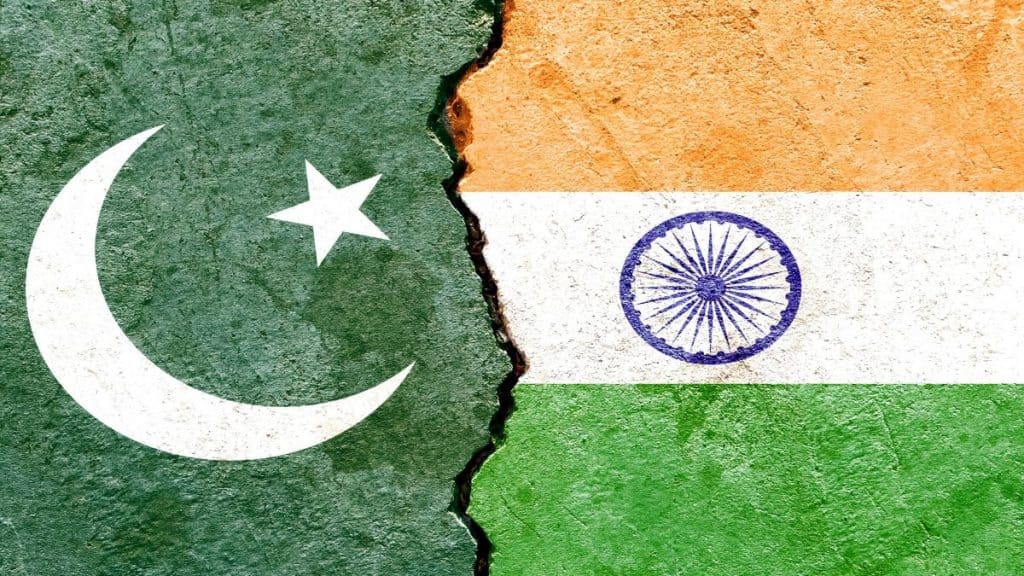
Pakistan's nuclear doctrine is ambiguous and in stark contrast to India's No First Use policy. Representational image/PTI
This is in stark contrast to India that abides by the no first use policy. This principle means that India will not be the first to launch nuclear attacks on its enemies. It will only retaliate with nuclear weapons if it is first hit in a nuclear attack. India’s doctrine says it can launch retaliation against attacks committed on Indian soil or if nuclear weapons are used against its forces on foreign territory. India also commits to not using nuclear weapons against non-nuclear states.
Moreover, Pakistan has long been engaged in
At the time, India responded by saying that nuclear sabre-rattling is Pakistan’s stock-in-trade, and expressed regret that such remarks were made from the soil of a friendly third country.
Even Pakistan Peoples Party chairman Bilawal Bhutto Zardari issued similar war threats to India last year.
But the threat to India is not just rhetorical but also tangible. Pakistan continues to develop its
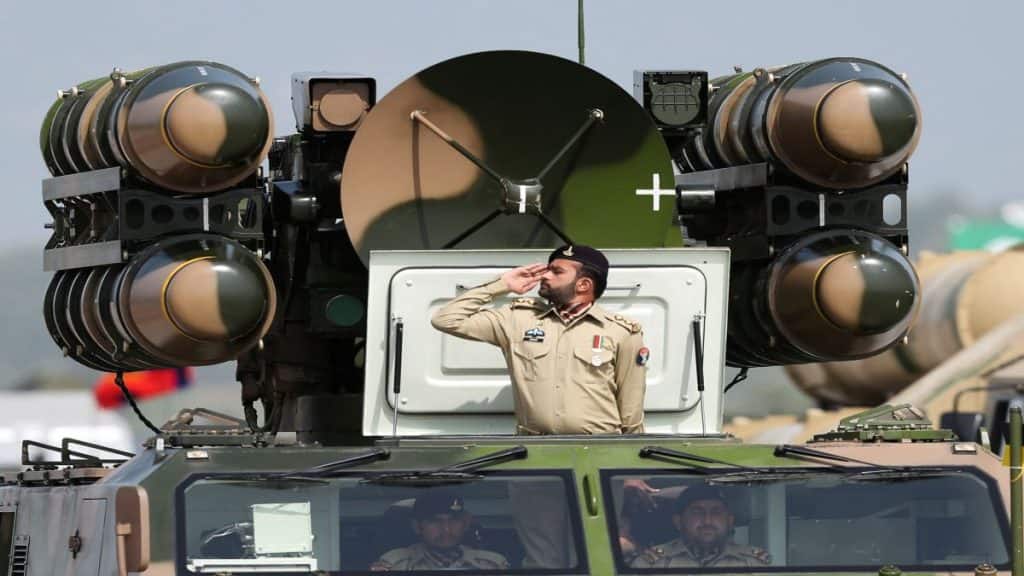
Pakistani army soldier salutes while standing on an air defence missile system during a military parade in Islamabad. File image/Reuters
Of all its missiles, the Shaheen-III has the longest range — of 2,750 kilometres. This means that the Shaheen III can reach every part of India, including Mumbai and Delhi.
Apart from the Shaheen, Pakistan also has the Babur cruise missile. This weapon system has a range of 700 kilometres. It flies low to avoid radar and is pinpoint accurate. There’s also the
According to a Times of India report, Pakistan also has the nuclear-capable Abdali weapon system. This ballistic missile has a range of 450 kilometres.
In fact, Pakistan’s missile programme has raised concern in the US in the past as well. Jon Finer, serving in the Biden administration, described Pakistan’s pursuit of advanced missile technology as an “emerging threat” to the United States.
We shall wait and watch to see what comes next. However, India is and should continue to keep its guard up against Pakistan.
With inputs from agencies