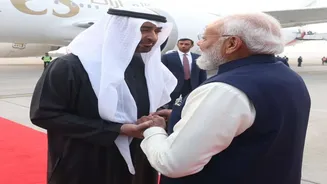

However, that wasn’t the case for UAE President Sheikh Mohamed bin Zayed Al Nahyan. The UAE leader visited India on Monday (January 19) and met Prime Minister Narendra Modi in the nation’s capital for a brief period — the entire visit lasted about three hours. But it was a significant visit with the two leaders announcing their intention to conclude a “framework agreement” for a strategic defence partnership.
But why did the UAE’s MBZ, as he is popularly known, visit India for such a short duration? We tell you why.
UAE’s MBZ visits India for just 3 hours
The UAE leader’s visit to India has become quite a talking point because of its timing and duration. Firstly, the visit — this is MBZ’s fifth travel to India in the last 10 years and his third official visit as the president of the UAE — came as quite a surprise. The Ministry of External Affairs only announced it a day prior to the UAE president’s arrival, on January 18.
Moreover, UAE President Sheikh Mohamed bin Zayed Al Nahyan spent just three hours in India. He arrived at New Delhi’s Air Force Station (AFS) Palam at 4.20 pm, where he was welcomed by Prime Minister Narendra Modi himself. From there, the two leaders rode together in a car and attended a meeting that was officially slated for 4.45 pm. And at 6.05 pm, the UAE leader departed for his country after his meeting with PM Modi.
What’s even more notable is that MBZ travelled for more time than the meeting with PM Modi — a flight from Abu Dhabi to New Delhi takes a little more than three hours. This means that MBZ flew for more than six hours for a three-hour meeting.
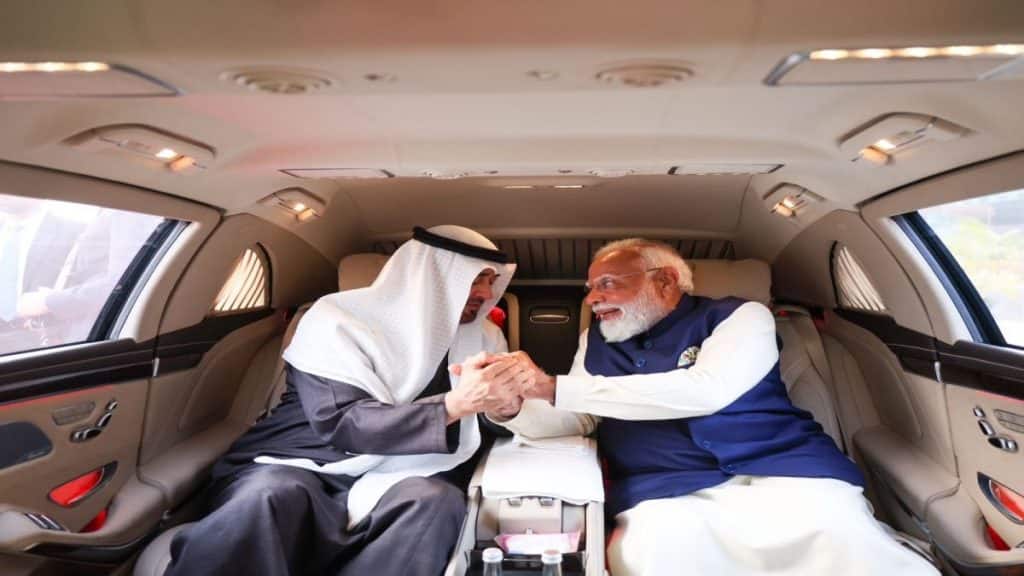
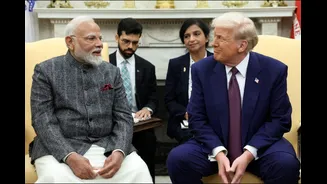
PM Modi welcomed the UAE's President Sheikh Mohamed bin Zayed Al Nahyan in Delhi on Monday, and travelled together in the same car from the airport. Image Courtesy: @narendramodi/X
Modi-MBZ’s short but significant meeting
So, what came out of the meeting between Modi and MBZ?
The two leaders reviewed the full scope of bilateral cooperation between the two countries and agreed on a range of bilateral agreements and outcomes — from defence to space and LNG.
Of most significance was the “letter of intent” that India and the UAE signed to conclude negotiations for the framework of a strategic defence partnership.
The defence pact with the UAE comes months after Saudi Arabia signed a strategic mutual defence agreement with Pakistan. “Our involvement in the defence and security front with a country from the region does not then necessarily lead to the conclusion that we will get involved in particular ways in the conflicts of the region. There is already a great deal of content in defence cooperation and engagement in the defence front between India and the UAE,” said Misri at a special briefing on the visit, highlighting that the framework does not indicate New Delhi’s change in posture in West Asia.
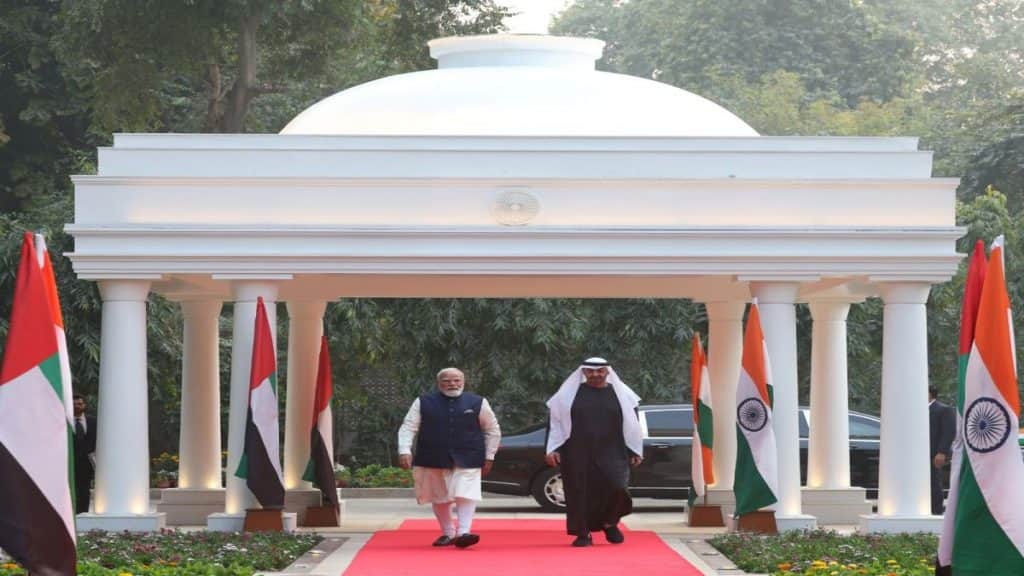
After arriving at Delhi, the UAE President Sheikh Mohamed bin Zayed Al Nahyan and PM Modi held discussions at the latter's residence, 7 Lok Kalyan Marg. Image Courtesy: @narendramodi/X
Besides the defence deal, India and the UAE also signed a “10-year LNG Supply Agreement between Hindustan Petroleum Corporation Limited (HPCL) and ADNOC Gas for the delivery of 0.5 million tonnes per year of liquefied natural gas, beginning in 2028”. The agreement makes the UAE India’s second-largest LNG supplier.
UAE also signed a letter of intent to participate in the development of Dholera, the special investment region in Gujarat. Emirati businesses will be allowed to bid for and construct infrastructure in the region, including energy, airport, pilot training facilities, railway connectivity and ports.
Moreover, the two leaders announced the establishment of a ‘House of India’ in Abu Dhabi; setting up offices and operations of UAE companies First Abu Dhabi Bank (FAB) and DP World at GIFT City in Gujarat.
During the course of their interaction, Modi and MBZ agreed to deepen cooperation in the space sector through a joint initiative aimed at commercialising space science and technology, including launch facilities and satellite fabrication.
A statement from the Ministry of External Affairs said that the two decided cooperation in advanced nuclear technologies, welcoming “the enactment of the Sustainable Harnessing and Advancement of Nuclear Energy for Transforming India (SHANTI) law, noting that it creates new opportunities for enhanced civil nuclear cooperation”.
“The two sides agreed to explore partnership in advanced nuclear technologies, including development and deployment of large nuclear reactors and Small Modular Reactors (SMRs), as well as cooperation in advanced reactor systems, nuclear power plant operations and maintenance and nuclear safety,” the statement said.
The two leaders also reiterated their unequivocal condemnation of terrorism in all its forms and manifestations and emphasised that no country should provide safe haven to those who finance, plan, support or commit terrorist acts. They agreed to continue cooperation within the framework of the Financial Action Task Force (FATF) to counter terror financing and strengthen anti-money laundering efforts.
Modi also presented the UAE leader with traditional gifts. One of the gifts was a beautifully carved wooden swing from Gujarat. In Gujarati culture, the swing, called jhula, symbolises togetherness, conversation and bonding across generations. The gift also resonates deeply with the UAE’s declaration of 2026 as the ‘Year of Family’.
Modi also gifted Al Nahyan a Pashmina shawl from Kashmir in an ornate silver box made in Telangana, representing India’s rich tradition of handloom and handicraft. Moreover, PM Modi gifted a Pashmina shawl in an ornate silver box to Sheikha Fatima bint Mubarak Al Ketbi, Al Nahyan's mother. “She was also gifted Kashmiri saffron in an ornate silver box. Grown in the Kashmir Valley, saffron is revered for its deep crimson strands and intense aroma,” officials said.
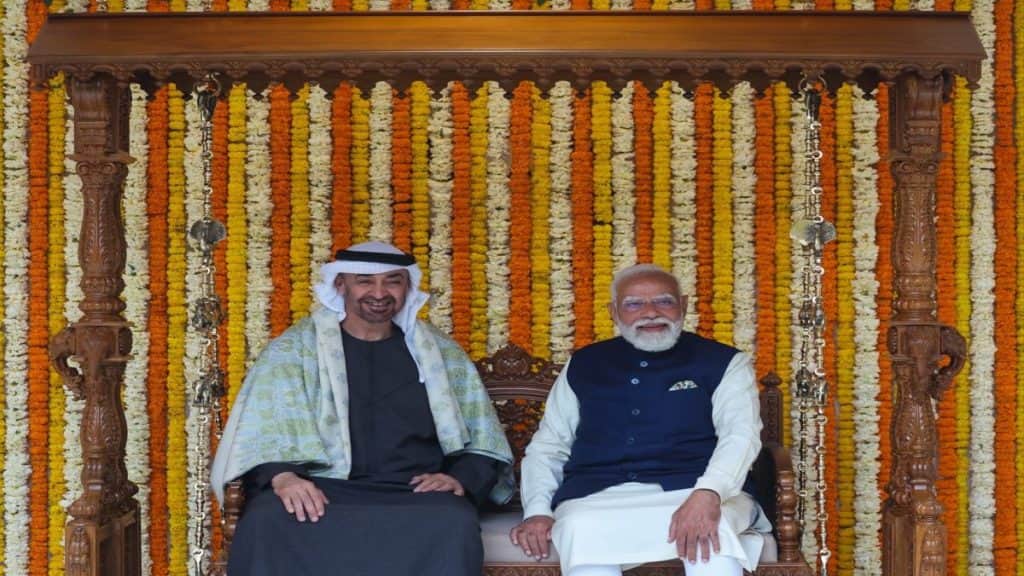
PM Narendra Modi and UAE President Sheikh Mohamed bin Zayed Al Nahyan held wide-ranging discussions on bilateral, regional and global issues. Discussions focused on imparting further strength in areas across trade, investment, defense, technology and people-to-people ties, shaping a brighter future for both nations. Image Courtesy: @narendramodi/X
Timing really matters
Despite the positive outcomes of MBZ’s visit, many are still wondering what led to the UAE leader’s surprise travel to India.
And if one looks closer, the existing geopolitical conditions explain it all. Firstly, it comes in the backdrop of the sharp escalation in tensions between the UAE and Saudi Arabia over Yemen. Late last December, simmering tensions exploded into the open when Saudi officials accused the UAE of backing separatist groups in Yemen and carried out an airstrike in the southern Yemeni city of Mukalla targeting an alleged shipment of weapons from the UAE to the Southern Transitional Council, one such separatist group. The UAE backed off, saying it would withdraw troops from Yemen.
The speculation of a new Islamic Nato comprising Saudi Arabia and Pakistan, along with Turkey, is also of great concern to the UAE. This has left the UAE scrambling to look for an independent security partner in India. According to a News18 report, Indian security cooperation because India provides a professional military framework without the complications of “army ideology”.
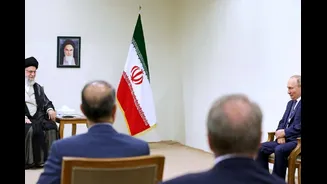
Another factor behind MBZ’s succinct visit to India is the tensions in Iran. While US President Donald Trump hasn’t attacked Iran so far, despite his many threats, a military action can’t be ruled out completely. So far, Gulf states such as Saudi Arabia, Qatar, Turkey and Oman have been able to persuade the US president from launching strikes.
The UAE hopes that India’s goodwill with Trump will stop any possibility of a strike in Iran, which could imperil the entire region, including the Arab Emirates.
Last but not least, is Trump’s invitation to India to join the “Board of Peace”, the body formed and led by the US to oversee peace and reconstruction in Gaza. On Monday, came the news that Trump had sent a letter to PM Modi inviting him to join the administration. “It is my great honour to invite you, as Prime Minister of the Republic of India, to join me in a critically historic and magnificent effort to solidify peace in the Middle East and, at the same time, to embark on a bold new approach to resolving global conflict,” wrote Trump.
The UAE has already found its place on Trump’s Board of Peace. And many see MBZ’s visit as a way to convince New Delhi to join suit. Notably, India has yet to accept the invite.
Overall, it seemed that MBZ’s visit to India was full of intent — short on time, but high on impact.
With inputs from agencies