







What is the story about?
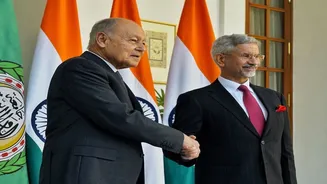
India has had civilisational and commercial linkages with the League of Arab States (LAS) for centuries, and the region has been dubbed as India’s ‘extended neighbourhood’ in view of the convergence of interests on a wide range of issues and perspectives. In this context, India’s holding the second edition of the India-Arab Foreign Ministers meeting in Delhi on January 31, 2026, bears special significance.
With just seven countries in the Arab League from its inception in 1945, LAS has grown to a group of 22 nations arising out of countries in the Gulf, West Asia, and North Africa and also undertaking maritime trade through the Suez Canal, Red Sea, and Gulf of Aden. Syria: with the new regime of Ahmed al-Sharaa in place, the country has been reinstated as a member of the Arab League. LAS maintains robust relationships with major powers of the globe, including Russia, France and Brazil, and has missions in over 20 countries, including India and the US.
India too maintains an observer state status in the Arab League. Since the LAS takes decisions on a majority basis, the organisation has faced criticisms as it has failed in achieving collective, unanimous decisions, including in the LAS response to the Gaza conflict, the Abraham Accords, etc. Nevertheless, LAS has, over the years, been an important institutional vehicle in strengthening and coordinating the political, economic, social and cultural fabrics of the Gulf, West Asia and North Africa.
Defence Cooperation
A number of countries within the Arab League have had increasing defence cooperation with India, particularly the UAE, Oman, Saudi Arabia, and Egypt, through strategic partnerships, joint military exercises, military industrial networks and maritime security. Key initiatives include Security and Growth for All in the Region (Sagar) for maritime security, including curbing acts of piracy, the Duqm port agreement with Oman and potential exports of Tejas fighters, BrahMos missiles and Aakash missiles from India.
During UAE President Mohammed bin Zayed Al-Nahyan’s visit to Delhi recently, a strategic defence partnership was established to streamline the defence cooperation mechanism. With Saudi Arabia, a structured ministerial committee has been formed for regular interaction.
Operation Sankalp (2019) demonstrated India’s active role in ensuring security in the Strait of Hormuz, the Red Sea and the Gulf of Oman. Defence cooperation is also extended to other areas such as intelligence sharing, counter-terrorism, and critical and emerging technologies, including cyber, space, and drone capabilities.
As part of the institutional framework, the India-Arab partnership is ably supplemented by the Arab-India Cooperation Forum that was established in 2008 by focusing on reinforcing strategic ties and addressing shared security challenges.
The Imec Factor
The India-Middle East-Europe Economic Corridor (Imec) which was launched at the 2023 New Delhi G-20 summit, is aimed at fostering connectivity and economic integration between India, the Gulf, and West Asia, including the Arab League member countries such as the United Arab Emirates, Saudi Arabia, and Jordan. Once completed, this ambitious enterprise is likely to spur massive infrastructure development, seamless logistics, and sustainable growth. This would be supplanted through building state-of-the-art transport networks, including shipping and railways, and digital infrastructure for ensuring smooth and efficient trade across the Arab League countries.
Partner countries in the League of Arab States (LAS), such as Saudi Arabia, the UAE, Jordan, etc, are likely to reap immense benefits in integrating green technologies, renewable energy resources, and eco-friendly infrastructure, as well as in leveraging digital technology, AI, and data analytics. Even countries outside of the original signatories to Imec such as Israel and Bahrain, are likely to benefit through modernisation of Haifa port by linking it with the Arabian Peninsula and for onwards movement to European markets.
For Bahrain, Imec will help by connecting King Hamad Causeway to the Saudi mainland. The UAE, an important Arab League member, acts as a primary Eastern anchor by connecting India to the Gulf through its major ports, Fujairah, Jebel Ali, and Abu Dhabi. Similarly, Saudi Arabia provides an outlet for increased naval infrastructure through a financial commitment of $20 billion to the Imec initiative.
Trade and Economy
Since the Manama Declaration of 2016, trade and economy have increased exponentially between India and LAS. Currently, trade volume exceeds $240 billion, including $107 billion in hydrocarbons. India imports nearly 50 per cent of its crude oil, 60 per cent of LNG, and 45 per cent of LPG from the 22-nation Arab League, with emphasis on infrastructure, renewable energy and financial sectors.
A number of countries in LAS have also expressed intent to join actively in Make-in-India ventures. One of the important outcomes from the July 2023 Sixth India-Arab Partnership Conference (IAPC) that was held in Delhi was a roadmap for diversifying various trades; capacity-building linkages were made between India and LAS under ‘New Horizons in Investment, Trade, Services’.
Indian Diaspora in the Arab League
The Indian diaspora living in the various Arab League states has a sizeable population of over 9 million. They constitute one of the largest overseas communities and expatriates working in the Gulf, the Middle East and North Africa. In Kuwait, the Indian expatriates constitute 29 per cent of the country’s population, numbering approximately 1.1 million, whereas the native Kuwaiti population is just a bit higher with 30 per cent of the population.
In Saudi Arabia, Indian expatriates constitute 13 per cent of the total of over 2.7 million. The UAE has one of the largest Indian expatriate populations, numbering 4.5 million. Bahrain and Oman too have a significant number of Indians working in various sectors. Together, the expatriates have sent a record amount of remittances to India, thus fortifying India’s foreign exchange reserve.
Education and Cultural Exchanges
In the education sector, various universities and institutes in the Arab League of countries have forged partnerships and MoUs with their Indian counterparts in India, particularly in Science, Technology, Engineering, and Mathematics (Stem) subjects, as well as in skills development, digital platforms, research, and student exchanges.
The first India-Arab Universities Presidents’ Conference that was held in New Delhi on February 5-6, 2025, paved the way for increased educational collaboration in scientific research, AI, quantum computing, biotechnology and various aspects of curriculum development. Under India’s New Education Policy (NEP-2020) and its flagship drive towards internationalisation, IIT-Madras has established a branch campus in Abu Dhabi, UAE.
Similarly, a number of high-profile private universities of India, such as BITS-Pilani, Manipal MAHE, IIM-Rohtak, and SP Jain-Mumbai, too, have established campuses in Dubai. India’s soft power capabilities, particularly in music, arts, theatre, drama, literature and Bollywood, have a huge catchment of popular imagination in a large swathe of the Arab League. Prime Minister Modi’s proactive diplomacy and outreach to the Indian diasporic population worldwide, including in the Gulf, Middle East, and Africa, have earned a tremendous amount of goodwill and appreciation of India’s distinctive culture and its splendid diversity.
India-Arab Festivals do take place at various Arab League countries on a regular basis, as well as holding heritage festivals in various Indian cities. In recent times, the International Day of Non-Violence and the 150th birth anniversary of Mahatma Gandhi were held under the auspices of the Arab League at various forums in a big way.
As India is on the cusp of being a major, competitive power in its own right as a rising and emerging nation, India’s position impinges upon blending strategic autonomy with a sense of openness and transparency and putting national interests at the forefront. India’s engagement with the Arab League fits into this prism through careful calibration of meaningful partnerships, which is conducted through flexible and principled diplomacy and willingness to engage with all the relevant stakeholders in a multipolar world order amidst global tumult.
(Mohammed Badrul Alam is Director of Research; Professor and Head, Department of Political Science (Retd), Faculty of Social Sciences, Jamia Millia Islamia University, New Delhi. The views expressed are personal and do not necessarily reflect Firstpost’s views.)
With just seven countries in the Arab League from its inception in 1945, LAS has grown to a group of 22 nations arising out of countries in the Gulf, West Asia, and North Africa and also undertaking maritime trade through the Suez Canal, Red Sea, and Gulf of Aden. Syria: with the new regime of Ahmed al-Sharaa in place, the country has been reinstated as a member of the Arab League. LAS maintains robust relationships with major powers of the globe, including Russia, France and Brazil, and has missions in over 20 countries, including India and the US.
India too maintains an observer state status in the Arab League. Since the LAS takes decisions on a majority basis, the organisation has faced criticisms as it has failed in achieving collective, unanimous decisions, including in the LAS response to the Gaza conflict, the Abraham Accords, etc. Nevertheless, LAS has, over the years, been an important institutional vehicle in strengthening and coordinating the political, economic, social and cultural fabrics of the Gulf, West Asia and North Africa.
Defence Cooperation
A number of countries within the Arab League have had increasing defence cooperation with India, particularly the UAE, Oman, Saudi Arabia, and Egypt, through strategic partnerships, joint military exercises, military industrial networks and maritime security. Key initiatives include Security and Growth for All in the Region (Sagar) for maritime security, including curbing acts of piracy, the Duqm port agreement with Oman and potential exports of Tejas fighters, BrahMos missiles and Aakash missiles from India.
During UAE President Mohammed bin Zayed Al-Nahyan’s visit to Delhi recently, a strategic defence partnership was established to streamline the defence cooperation mechanism. With Saudi Arabia, a structured ministerial committee has been formed for regular interaction.
Operation Sankalp (2019) demonstrated India’s active role in ensuring security in the Strait of Hormuz, the Red Sea and the Gulf of Oman. Defence cooperation is also extended to other areas such as intelligence sharing, counter-terrorism, and critical and emerging technologies, including cyber, space, and drone capabilities.
As part of the institutional framework, the India-Arab partnership is ably supplemented by the Arab-India Cooperation Forum that was established in 2008 by focusing on reinforcing strategic ties and addressing shared security challenges.
The Imec Factor
The India-Middle East-Europe Economic Corridor (Imec) which was launched at the 2023 New Delhi G-20 summit, is aimed at fostering connectivity and economic integration between India, the Gulf, and West Asia, including the Arab League member countries such as the United Arab Emirates, Saudi Arabia, and Jordan. Once completed, this ambitious enterprise is likely to spur massive infrastructure development, seamless logistics, and sustainable growth. This would be supplanted through building state-of-the-art transport networks, including shipping and railways, and digital infrastructure for ensuring smooth and efficient trade across the Arab League countries.
Partner countries in the League of Arab States (LAS), such as Saudi Arabia, the UAE, Jordan, etc, are likely to reap immense benefits in integrating green technologies, renewable energy resources, and eco-friendly infrastructure, as well as in leveraging digital technology, AI, and data analytics. Even countries outside of the original signatories to Imec such as Israel and Bahrain, are likely to benefit through modernisation of Haifa port by linking it with the Arabian Peninsula and for onwards movement to European markets.
For Bahrain, Imec will help by connecting King Hamad Causeway to the Saudi mainland. The UAE, an important Arab League member, acts as a primary Eastern anchor by connecting India to the Gulf through its major ports, Fujairah, Jebel Ali, and Abu Dhabi. Similarly, Saudi Arabia provides an outlet for increased naval infrastructure through a financial commitment of $20 billion to the Imec initiative.
Trade and Economy
Since the Manama Declaration of 2016, trade and economy have increased exponentially between India and LAS. Currently, trade volume exceeds $240 billion, including $107 billion in hydrocarbons. India imports nearly 50 per cent of its crude oil, 60 per cent of LNG, and 45 per cent of LPG from the 22-nation Arab League, with emphasis on infrastructure, renewable energy and financial sectors.
A number of countries in LAS have also expressed intent to join actively in Make-in-India ventures. One of the important outcomes from the July 2023 Sixth India-Arab Partnership Conference (IAPC) that was held in Delhi was a roadmap for diversifying various trades; capacity-building linkages were made between India and LAS under ‘New Horizons in Investment, Trade, Services’.
Indian Diaspora in the Arab League
The Indian diaspora living in the various Arab League states has a sizeable population of over 9 million. They constitute one of the largest overseas communities and expatriates working in the Gulf, the Middle East and North Africa. In Kuwait, the Indian expatriates constitute 29 per cent of the country’s population, numbering approximately 1.1 million, whereas the native Kuwaiti population is just a bit higher with 30 per cent of the population.
In Saudi Arabia, Indian expatriates constitute 13 per cent of the total of over 2.7 million. The UAE has one of the largest Indian expatriate populations, numbering 4.5 million. Bahrain and Oman too have a significant number of Indians working in various sectors. Together, the expatriates have sent a record amount of remittances to India, thus fortifying India’s foreign exchange reserve.
Education and Cultural Exchanges
In the education sector, various universities and institutes in the Arab League of countries have forged partnerships and MoUs with their Indian counterparts in India, particularly in Science, Technology, Engineering, and Mathematics (Stem) subjects, as well as in skills development, digital platforms, research, and student exchanges.
The first India-Arab Universities Presidents’ Conference that was held in New Delhi on February 5-6, 2025, paved the way for increased educational collaboration in scientific research, AI, quantum computing, biotechnology and various aspects of curriculum development. Under India’s New Education Policy (NEP-2020) and its flagship drive towards internationalisation, IIT-Madras has established a branch campus in Abu Dhabi, UAE.
Similarly, a number of high-profile private universities of India, such as BITS-Pilani, Manipal MAHE, IIM-Rohtak, and SP Jain-Mumbai, too, have established campuses in Dubai. India’s soft power capabilities, particularly in music, arts, theatre, drama, literature and Bollywood, have a huge catchment of popular imagination in a large swathe of the Arab League. Prime Minister Modi’s proactive diplomacy and outreach to the Indian diasporic population worldwide, including in the Gulf, Middle East, and Africa, have earned a tremendous amount of goodwill and appreciation of India’s distinctive culture and its splendid diversity.
India-Arab Festivals do take place at various Arab League countries on a regular basis, as well as holding heritage festivals in various Indian cities. In recent times, the International Day of Non-Violence and the 150th birth anniversary of Mahatma Gandhi were held under the auspices of the Arab League at various forums in a big way.
As India is on the cusp of being a major, competitive power in its own right as a rising and emerging nation, India’s position impinges upon blending strategic autonomy with a sense of openness and transparency and putting national interests at the forefront. India’s engagement with the Arab League fits into this prism through careful calibration of meaningful partnerships, which is conducted through flexible and principled diplomacy and willingness to engage with all the relevant stakeholders in a multipolar world order amidst global tumult.
(Mohammed Badrul Alam is Director of Research; Professor and Head, Department of Political Science (Retd), Faculty of Social Sciences, Jamia Millia Islamia University, New Delhi. The views expressed are personal and do not necessarily reflect Firstpost’s views.)