







What is the story about?
US President Donald Trump said on Friday that Thailand and Cambodia have agreed to renew a truce following days of deadly clashes between the two neighbouring nations. Trump announced the restart of the ceasefire on his social media platform TruthSocial after his phone calls with Thai Prime Minister
Anutin Charnvirakul and Cambodian Prime Minister Hun Manet.
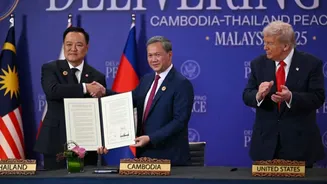
“They have agreed to CEASE all shooting effective this evening, and go back to the original Peace Accord made with me, and them, with the help of the Great Prime Minister of Malaysia, Anwar Ibrahim,” Trump wrote in his post on Friday. It is pertient to note that the original ceasefire between the two countries was brokered by Malaysia in July.
That truce also received pressure from Trump, who went ahead and threatened to withhold trade privileges unless Thailand and Cambodia agreed. The deal was eventually formalised in October at a regional meeting in Malaysia, which was
attended by Trump.
However, despite the deal, both Thailand and Cambodia continued with their bitter propaganda war, and minor cross-border violence continued.
It is important to note that the root of these clashes lies in a history of enmity over competing territorial claims. These claims largely stem from a 1907 map created while Cambodia was under French colonial rule, which Thailand maintains is inaccurate. Tensions between the two nations intensified in 1962 when the International Court of Justice ruling awarded sovereignty to Cambodia, which still riles many Thais.
Earlier, Thailand had deployed fighter jets to carry out airstrikes on what it says are military targets. Meanwhile, Cambodia has deployed BM-21 rocket launchers with a range of 30-40km. According to the data shared by public broadcaster ThaiPBS, at least six of the Thai soldiers who were killed were hit by rocket shrapnel.
On Thursday, the Thai army's northeastern regional command said that some residential areas and homes near the border were damaged by BM-21 rocket launchers from Cambodian forces. The military also noted that it destroyed a tall crane atop a hill held by Cambodia, where the centuries-old Preah Vihear temple is located. They argued that the crane had to be destroyed because it allegedly held electronic and optical devices used for military command and control purposes.
“They have agreed to CEASE all shooting effective this evening, and go back to the original Peace Accord made with me, and them, with the help of the Great Prime Minister of Malaysia, Anwar Ibrahim,” Trump wrote in his post on Friday. It is pertient to note that the original ceasefire between the two countries was brokered by Malaysia in July.
That truce also received pressure from Trump, who went ahead and threatened to withhold trade privileges unless Thailand and Cambodia agreed. The deal was eventually formalised in October at a regional meeting in Malaysia, which was
However, despite the deal, both Thailand and Cambodia continued with their bitter propaganda war, and minor cross-border violence continued.
Tension simmers between the two
It is important to note that the root of these clashes lies in a history of enmity over competing territorial claims. These claims largely stem from a 1907 map created while Cambodia was under French colonial rule, which Thailand maintains is inaccurate. Tensions between the two nations intensified in 1962 when the International Court of Justice ruling awarded sovereignty to Cambodia, which still riles many Thais.
Earlier, Thailand had deployed fighter jets to carry out airstrikes on what it says are military targets. Meanwhile, Cambodia has deployed BM-21 rocket launchers with a range of 30-40km. According to the data shared by public broadcaster ThaiPBS, at least six of the Thai soldiers who were killed were hit by rocket shrapnel.
On Thursday, the Thai army's northeastern regional command said that some residential areas and homes near the border were damaged by BM-21 rocket launchers from Cambodian forces. The military also noted that it destroyed a tall crane atop a hill held by Cambodia, where the centuries-old Preah Vihear temple is located. They argued that the crane had to be destroyed because it allegedly held electronic and optical devices used for military command and control purposes.