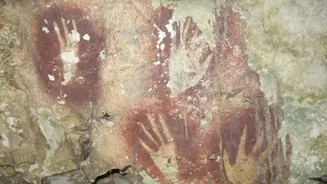









Archaeologists have uncovered evidence that prehistoric hand stencils found on the limestone walls of caves on Muna island in Indonesia may be the world’s oldest surviving paintings. Dating analysis suggests the markings could be as old as 67,800 years, pushing back the known timeline of human artistic expression.
The research, published in the journal Nature, was conducted by a joint team of Indonesian and Australian scientists, who say the discovery reveals remarkable insight into the symbolic and creative lives of early humans in Southeast Asia.
Discovery in Muna caves
The handprints were identified by Indonesian archaeologist Adhi Agus Oktaviana from the National Research and Innovation Agency, who has been exploring rock art in the Muna island region of Sulawesi province since 2015. During his surveys, Adhi came across ancient stencils beneath a set of later drawings depicting a human figure riding a horse beside a chicken.
Adhi explained that initially, his team struggled to verify that the shapes were indeed human hands. “At first glance, some appeared distorted,” he recalled, adding that closer inspection revealed clear finger outlines that had been deliberately modified to appear elongated and pointed. This stylistic choice distinguishes the artwork as unique to Sulawesi and unlike any other prehistoric rock art found so far.
Deeper cultural meaning
Professor Maxime Aubert from Griffith University in Australia, who led the study with Adhi, said the design of the prints seemed intentional and symbolic. The team observed that the finger tips had been carefully reshaped, suggesting that the artists may have wished to represent something beyond the human form.
Co-researcher Dr Adam Brumm, also from Griffith University, believes these changes were deliberate attempts to transform human hands into claw-like images representing animals or spirits. “These figures likely had cultural or spiritual significance,” Brumm said. “They may reflect how early humans saw their connection with animals and the natural world.”
Dating and analysis
To determine the artwork’s age, the research team employed cutting-edge uranium dating techniques. Scientists extracted tiny samples of calcite, mineral deposits that had built up on the cave walls over time and analysed how uranium within the samples had decayed compared to thorium, a stable element. This method allowed them to estimate when the thin mineral layers formed over the original pigment, thereby establishing a minimum age for the art.
The results revealed that the hand stencils predated all known cave art, surpassing even earlier discoveries in Sulawesi by more than 15,000 years. Aubert emphasised that the precision of the technique made the results highly reliable and that the caves had likely served as cultural canvases for thousands of years, with new paintings created over older ones.
Significance for early human history
The findings add weight to theories of early human migration through the Indonesian archipelago. According to Adhi, the artwork demonstrates that ancient populations travelling through Sulawesi possessed both advanced seafaring and artistic skills. “It shows that our ancestors were not only explorers,” he noted, “but also creators who communicated through art.”
The discovery also aligns Indonesia with other regions renowned for ancient rock art, such as East Timor and Australia. At Murujuga in northwestern Australia, for example, about one million petroglyphs, some possibly dating back 50,000 years were recently inscribed on the Unesco World Heritage list, further underscoring the richness of early human creativity across the wider region.