







What is the story about?
Amid the escalating tensions in West Asia, the US military has decided to widen its efforts beyond the blockade of Iranian ports by stopping any ship tied to Tehran. The American military would also scrutinise vessels suspected of carrying supplies that could help the Iranian government, from weapons to oil, metals and electronics.
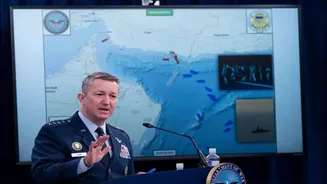
The move was announced by Gen. Dan Caine, chairman of the Joint Chiefs of Staff. During a press briefing, he pointed to the operations in the Pacific and said that the United States would be targeting vessels that left before the blockade began earlier this week outside the Strait of Hormuz, a crucial waterway for energy and other shipments.
"US forces in other areas of responsibility will actively pursue any Iranian-flagged vessel or any vessel attempting to provide material support to Iran,” he told reporters at the Pentagon. The military also shared an expansive list of goods that it considers contraband, declaring that it will board, search and seize them from merchant vessels “regardless of location.”
In light of this, the American military published a notice on Thursday, stating any “goods that are destined for an enemy and that may be susceptible to use in armed conflict” are “subject to capture at any place beyond neutral territory.”
Many analysts are looking at the US's expansion of military efforts as another way to pressure Iran to come to a deal, given that the ceasefire in the ongoing war is set to expire in mere days. However, mediators have been pressing for an extension to a truce that has paused almost seven weeks of war between Israel, the US and Iran.
Meanwhile, the American military shared a list of banned materials that can be seized from Iran-linked ships. The items included products such as weapons, ammunition and military equipment that are classified as “absolute contraband.”
However, it also lists items such as oil, iron, steel, aluminium, and other goods as “conditional contraband” that it argues can be used both for civilian and military purposes. Apart from this, items like electronics, power generation equipment or heavy machinery can be seized if “circumstances indicate intended military end-use,” the notice said.
It is pertinent to note that more than 10,000 American troops are helping enforce the blockade on Iranian ports. While no ships have yet been boarded, defence leaders say that the military is warning Iran-linked ships that it could fire warning shots or escalate to other force if they try to outrun the Navy.
According to US Central Command, which oversees the Iran war, in the first three days of the US military blockade, 14 ships turned around rather than confront the naval blockade. Some Iran-linked or sanctioned vessels that left through the strait have appeared to halt their movements, turn off their radio transponders or head back toward Iran’s coast, shipping data firms said.
With inputs from the Associated Press.
The move was announced by Gen. Dan Caine, chairman of the Joint Chiefs of Staff. During a press briefing, he pointed to the operations in the Pacific and said that the United States would be targeting vessels that left before the blockade began earlier this week outside the Strait of Hormuz, a crucial waterway for energy and other shipments.
"US forces in other areas of responsibility will actively pursue any Iranian-flagged vessel or any vessel attempting to provide material support to Iran,” he told reporters at the Pentagon. The military also shared an expansive list of goods that it considers contraband, declaring that it will board, search and seize them from merchant vessels “regardless of location.”
In light of this, the American military published a notice on Thursday, stating any “goods that are destined for an enemy and that may be susceptible to use in armed conflict” are “subject to capture at any place beyond neutral territory.”
Many analysts are looking at the US's expansion of military efforts as another way to pressure Iran to come to a deal, given that the ceasefire in the ongoing war is set to expire in mere days. However, mediators have been pressing for an extension to a truce that has paused almost seven weeks of war between Israel, the US and Iran.
The US military lists items that can be seized from Iran-linked ships
Meanwhile, the American military shared a list of banned materials that can be seized from Iran-linked ships. The items included products such as weapons, ammunition and military equipment that are classified as “absolute contraband.”
However, it also lists items such as oil, iron, steel, aluminium, and other goods as “conditional contraband” that it argues can be used both for civilian and military purposes. Apart from this, items like electronics, power generation equipment or heavy machinery can be seized if “circumstances indicate intended military end-use,” the notice said.
It is pertinent to note that more than 10,000 American troops are helping enforce the blockade on Iranian ports. While no ships have yet been boarded, defence leaders say that the military is warning Iran-linked ships that it could fire warning shots or escalate to other force if they try to outrun the Navy.
According to US Central Command, which oversees the Iran war, in the first three days of the US military blockade, 14 ships turned around rather than confront the naval blockade. Some Iran-linked or sanctioned vessels that left through the strait have appeared to halt their movements, turn off their radio transponders or head back toward Iran’s coast, shipping data firms said.
With inputs from the Associated Press.