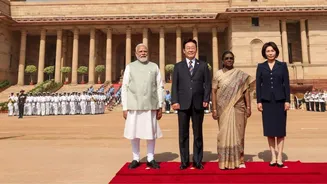







South Korean President Lee Jae-myung’s three-day state visit to India (April 19-21) has concluded with a hard-nosed, industrial pivot toward the sea.
From the modernisation of Indian shipyards to the joint production of high-tech vessels, New Delhi and Seoul are signalling that the next chapter of their "Special Strategic Partnership" will be written in salt water and steel.
In a free-wheeling interview with Firstpost, Professor Harsh V Pant, vice president of Studies and Foreign Policy at the Observer Research Foundation (ORF), argues that we are witnessing the birth of a "Naval Shipbuilding Partnership Initiative" that could fundamentally alter the balance of power in the Indo-Pacific.
The shipbuilding pivot
For years, the high-water mark of India-South Korea defence ties was the K9 Vajra self-propelled howitzer. While the "Vajra" (Thunderbolt) was a success story for "Make in India," Pant suggests that the relationship is now moving from the plains to the high seas.
"I believe shipbuilding, maritime and defence industrial collaboration is becoming the pivot of this relationship," Pant explains.
"And it is important that these discussions go beyond just the K9 Vajra co-production and address India's maritime security by focusing on indigenous shipbuilding capacity, securing sea lanes, and sea lines of communication."
This shift is not accidental. It aligns perfectly with New Delhi’s Maritime Amritkal Vision 2047, which seeks to propel India into the top five global shipbuilders. Currently, India’s share in global shipbuilding is less than 1 per cent, a stark contrast to South Korea, which, alongside China, dominates nearly 80 per cent of the world market.
"I think there are a range of issues here which converge and it is increasingly clear that both sides want to take this forward," Pant says.
"South Korea is a global leader in shipbuilding and it is well positioned to be India's important partner. And there are expectations that some of these MoUs for joint vessel construction, technology transfer will move forward."
The recent signed MoUs between New Delhi and Seoul open opportunities for Korean port developers and terminal operators to participate in India’s strong PPP mechanisation pipeline amounting to an estimated USD 13.3 billion in the next 5 years, including the 23 million TEU Vadhvan container port (Maharashtra), 150 MTPA multipurpose terminal in Bahuda (Odisha), 135 MTPA modern terminal of Deendayal Port (Gujarat), among others.
Why South Korea needs India
While India’s need for Korean technology is obvious, the logic for Seoul is equally compelling. South Korean shipbuilders — led by titans like HD Hyundai Heavy Industries (HHI), Hanwha Ocean, and Samsung Heavy Industries — are grappling with acute labour shortages and skyrocketing production costs at home.
The conversation touched upon a specific project that has become a symbol of this synergy which is the proposed 15,000-square-foot specialised shipyard facility in Tamil Nadu.
Prime Minister Narendra Modi's office highlighted this aspect, stating in a press release, "To this end, both sides took positive note of the collaborations between Korean Industries and India, such as the conclusion of a non-binding MOU among the Korean shipbuilder HD Korea Shipbuilding & Offshore Engineering Co, Ltd. (HD KSOE), the identified cluster developer and facilitator, and the capital provider Maritime Development Fund (MDF) for joint development, financing, implementation, operation of a large greenfield shipyard in southern India."
By combining South Korean design prowess with Indian scale and human resources, Seoul finds a way to remain competitive against Chinese state-subsidised yards.
"Scale, certainly" Pant points out when asked what India offers.
"I think for South Korea, given the challenges that they are facing, both strategic and operational, India gives them a very important geography to scale up. Strategic in the sense that they need diversification."
"They can't really rely on their partnerships with the US. Of course, with the US, the naval defence relationship has moved forward. But I think given the uncertainties of American foreign policy and given the challenges of diversification, India gives them a very important geography to scale up." Pant cautions.
Pant notes that the Lee administration, which took office in June 2025, has been quick to revive and expand upon the "New Southern Policy," placing a heavy emphasis on the "Global South" in its national agenda for a multipolar world.
"This aligns with India's long-standing commitment to strategic autonomy and multi-alignment," Pant adds.
"And for India, therefore, South Korea becomes a complementary partner for technology manufacturing and Indo-Pacific balancing. The operational logic is that while South Korea is facing a challenge of scaling, they are world leaders in technology. So they need to collaborate and scale up that technology at a time when the balance is changing around them."
The chokepoint factor
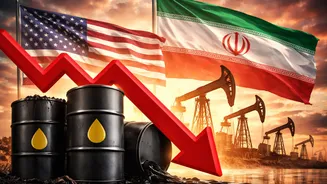
One of the most pressing drivers for this maritime cooperation at the moment is the extreme volatility in West Asia. For both India and South Korea, the Strait of Hormuz is a strategic juggernaut.
India receives nearly 60 per cent of its crude oil and a significant portion of its LPG from the Gulf. South Korea is equally vulnerable, with 50 per cent of its NAFTA imports and a vast majority of its energy needs passing through the same narrow chokepoint.
As the Strait of Hormuz remains blocked or disrupted depending on who you ask, both economies face a dooming paralysis. This vulnerability is pushing the two nations to collaborate on Very Large Crude Carriers (VLCCs) and LNG Tankers.
Pant agrees. "I think both countries have been quite explicit in underscoring the security of critical maritime routes for the safety and prosperity of their own peoples. Both countries have heavy reliance on Middle Eastern energy. And if you look at the geography and if you look at the impact of the Strait of Hormuz, that is going to be far more substantial in Asia than anywhere else."
The gap with China & South Korea
While India has been successful in building naval assets (like the INS Vikrant), its commercial and cargo shipbuilding capacity remains abysmal.
Global shipping is currently a duopoly between China (approximately 47 per cent market share) and South Korea (approximately 33 per cent market share). India’s inability to build its own cargo fleet means it pays billions of dollars in freight charges to foreign shipping lines every year.
"From India's point of view, boosting indigenous shipbuilding and naval capacity, securing critical maritime routes and energy security — together with like-minded partners like Korea advancing the Indo-Pacific maritime strategy — all of these are important," Pant notes.
"India's trade-dependent economy and naval ambitions depend on this. This partnership allows for the possibility of a more capable, self-reliant Indian Navy and resilient logistics."
By partnering with Korean giants, India hopes to leapfrog decades of inefficiency. Pant points to the existing partnership between Hyundai and Cochin Shipyard Limited (CSL) as the gold standard for this transition.
"Partnerships like the ones that Hyundai has with Cochin Shipyard Limited are aimed at creating these integrated clusters and modernising those yards, enabling green shipbuilding. India is becoming more open to such collaboration and South Korea is well positioned to leverage that."
To this extent, the Korea Marine Equipment Association (KOMEA) recently opened a branch in Mumbai and the Korea Marine Equipment Research Institute (KOMERI) has shown interest for related cooperation.
The two sides have also agreed to cooperate on skill training in the shipbuilding sector in India through a project to be implemented by Korea International Cooperation Agency (KOICA) in partnership with the Ministry of Ports, Shipping and Waterways (MoPSW) of India.
The chain of trusted shipyards
As Lee departs Delhi for Hanoi (April 21-24), a clear pattern is emerging in South Korean diplomacy. By visiting India and Vietnam back-to-back — two nations known for their fierce strategic autonomy — Seoul is attempting to build what analysts call a chain of trusted shipyards.
The goal is simple: to create a network across the Indo-Pacific where South Korean commercial and naval vessels can be maintained, repaired, and even built without relying on Chinese-controlled infrastructure.
"I think it is very interesting, the visit and the way this has been framed," Pant tells Firstpost.
"It intends to send a message to multiple stakeholders in the Indo-Pacific, not simply China, but also in some ways to the US, and to other regional players — that look, South Korea is embarking on a multi-aligned foreign policy posture through which it wants to retain its strategic autonomy as much as possible."
The choice of Vietnam as the next stop is particularly telling. Like India, Vietnam is a critical node in the global supply chain and has a sophisticated, albeit developing, defence manufacturing base.
"Vietnam is a very independent-minded country — a country that has ties with both US and China, but not subservient to either — that is also a message that South Korea wants to take forward," Pant observes.
"South Korea wants to move beyond trade investment and critical minerals to defence shipbuilding and stabilising supply chains. South Korea looks at India and looks at Vietnam as critical nodes which are independent enough to sustain their own independent defence manufacturing bases."
This strategy allows South Korea to "de-risk" from the major powers while empowering "Middle Powers" who share the same vision of a rules-based order.
The new normal
Lee's visit to Vietnam also brings into focus Hanoi’s famous "Bamboo Diplomacy" — the art of being firm yet flexible, maintaining ties with all while staying committed to none.
Just last week newly elected Vietnamese President To Lam engaged extensively with Chinese President Xi Jinping in Beijing, and now the former is gearing up to welcome the South Korean president days later.
Pant argues that this is not unique to Vietnam, it is the "New Normal" for the 2026 geopolitical environment. "I think it is happening everywhere, right?" Pant says.
"What we are witnessing is multi-alignment becoming the norm in most countries' foreign policy approaches, and diversification becoming the norm. Diversification is something that most countries feel comfortable with in today's environment because they don't know where this present flux may lead to."
The underlying message is that economic partnership with China does not mandate strategic submission. "China is a very important partner for both South Korea, Vietnam, and for India — an economic partner," Pant concludes.
"But that does not mean that strategically, India's or Vietnam's or South Korea's strategic interest should be subservient to China's economic dominance. And I think that's the message that most countries want to send out at this very critical point."
Also Watch:
With $50 billion in trade on the horizon and a concrete "Special Strategic Partnership" now in the works, the India-South Korea relationship has finally found its sea legs.
For India, the partnership is a shortcut to becoming a maritime superpower. For South Korea, it is a necessary expansion into a geography that offers the scale and strategic depth they lack at home.