







What is the story about?
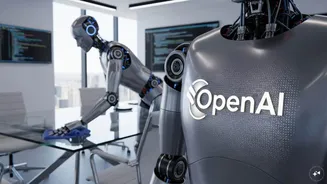
What if your next co-worker isn't a human, but a robot? And what if that robot was built by OpenAI?
The company behind ChatGPT is taking a significant step into the world of physical robotics, with CEO Sam Altman announcing a fresh hiring drive aimed at building robots designed to help people in the real world. The move marks one of OpenAI's clearest signals yet that its ambitions extend far beyond software and conversational AI.
In a post on X, Altman revealed that the newly formed OpenAI Robotics team is looking for engineers across hardware, machine learning, systems and operations to help design, build and manufacture robots that are "useful for society".
The announcement arrives at a time when humanoid robots are rapidly moving from science fiction into everyday reality, with countries such as China and South Korea already making significant strides in the field.
Altman said OpenAI believes AI should eventually be able to assist people in the physical world, not just on screens.
"In the short term, we are focused on robots to support skilled workers to build our future infrastructure; in the long term, we imagine everyone having a personal robot doing anything they need," he wrote.
According to Altman, OpenAI's robotics effort has evolved from its world simulation research programme, led by researcher Aditya Ramesh. The initiative has now grown into a dedicated robotics division focused on combining machine learning advances with purpose-built hardware.
The company is specifically seeking full-stack hardware engineers, machine learning specialists, systems engineers and operations professionals. Rather than directing applicants through a traditional careers portal, Altman encouraged interested candidates to send details of their background and achievements directly to OpenAI's robotics recruitment team.
The announcement is notable because OpenAI has so far largely focused on software-based AI systems. While the company has explored robotics research in the past, products such as ChatGPT, GPT-4o and its reasoning models have primarily existed in the digital world. Building robots would represent a major expansion into hardware and real-world automation.
OpenAI's renewed robotics ambitions arrive as several Asian countries are rapidly pushing humanoid technology into the mainstream.
South Korea, in particular, has embraced humanoids as both technological showcases and entertainment stars. In recent weeks, robots have appeared at
Buddhist temple ceremonies, walked fashion runways alongside human models and performed choreographed dance routines in front of audiences.
At a recent fashion event in Seoul, humanoid robots posed next to models, synchronising their movements under bright stage lights. The spectacle also included robot dance performances and even a boxing match, where humans controlled the machines through motion-mirroring systems.
Meanwhile, China has emerged as one of the most aggressive players in the global robotics race.
At the Humanoids Summit Tokyo, Chinese companies were among the most prominent exhibitors, demonstrating robots capable of dancing, threading needles, tightening tiny bolts and carrying out practical tasks. Firms including Booster Robotics, LimX Dynamics, Unitree and High Torque showcased increasingly capable machines that are reaching the market faster and at lower costs.
Japanese companies such as Honda and Toyota highlighted precision engineering and manufacturing quality, but many observers noted China's growing advantage in commercialisation speed and scale.
For OpenAI, that means entering a field where competition is already fierce. Yet the company may believe its expertise in advanced AI models can provide a crucial advantage. If successful, the same technology powering ChatGPT could eventually help robots navigate homes, workplaces and public spaces.
The company behind ChatGPT is taking a significant step into the world of physical robotics, with CEO Sam Altman announcing a fresh hiring drive aimed at building robots designed to help people in the real world. The move marks one of OpenAI's clearest signals yet that its ambitions extend far beyond software and conversational AI.
In a post on X, Altman revealed that the newly formed OpenAI Robotics team is looking for engineers across hardware, machine learning, systems and operations to help design, build and manufacture robots that are "useful for society".
OpenAI Robotics is hiring, looking for exceptional full-stack hardware, ops, systems, and ML engineers to help us program and manufacture robots that are useful for society.
AI should be able to help people in the physical world. In the short term, we are focused on robots to…
— Sam Altman (@sama) May 31, 2026
The announcement arrives at a time when humanoid robots are rapidly moving from science fiction into everyday reality, with countries such as China and South Korea already making significant strides in the field.
OpenAI is hiring to build AI-powered robots: How can you apply?
Altman said OpenAI believes AI should eventually be able to assist people in the physical world, not just on screens.
"In the short term, we are focused on robots to support skilled workers to build our future infrastructure; in the long term, we imagine everyone having a personal robot doing anything they need," he wrote.
According to Altman, OpenAI's robotics effort has evolved from its world simulation research programme, led by researcher Aditya Ramesh. The initiative has now grown into a dedicated robotics division focused on combining machine learning advances with purpose-built hardware.
The company is specifically seeking full-stack hardware engineers, machine learning specialists, systems engineers and operations professionals. Rather than directing applicants through a traditional careers portal, Altman encouraged interested candidates to send details of their background and achievements directly to OpenAI's robotics recruitment team.
The announcement is notable because OpenAI has so far largely focused on software-based AI systems. While the company has explored robotics research in the past, products such as ChatGPT, GPT-4o and its reasoning models have primarily existed in the digital world. Building robots would represent a major expansion into hardware and real-world automation.
China, South Korea are currently in the lead for humanoids
OpenAI's renewed robotics ambitions arrive as several Asian countries are rapidly pushing humanoid technology into the mainstream.
South Korea, in particular, has embraced humanoids as both technological showcases and entertainment stars. In recent weeks, robots have appeared at
At a recent fashion event in Seoul, humanoid robots posed next to models, synchronising their movements under bright stage lights. The spectacle also included robot dance performances and even a boxing match, where humans controlled the machines through motion-mirroring systems.
Meanwhile, China has emerged as one of the most aggressive players in the global robotics race.
At the Humanoids Summit Tokyo, Chinese companies were among the most prominent exhibitors, demonstrating robots capable of dancing, threading needles, tightening tiny bolts and carrying out practical tasks. Firms including Booster Robotics, LimX Dynamics, Unitree and High Torque showcased increasingly capable machines that are reaching the market faster and at lower costs.
Japanese companies such as Honda and Toyota highlighted precision engineering and manufacturing quality, but many observers noted China's growing advantage in commercialisation speed and scale.
For OpenAI, that means entering a field where competition is already fierce. Yet the company may believe its expertise in advanced AI models can provide a crucial advantage. If successful, the same technology powering ChatGPT could eventually help robots navigate homes, workplaces and public spaces.