







What is the story about?
The Democratic Republic of Congo’s government said on Sunday it feared that at least 200 people may have been killed after a large landslide hit a mine controlled by an armed militia in the country’s eastern region.
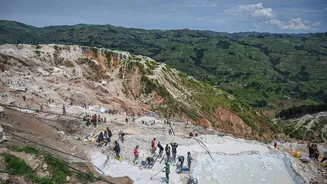
The disaster occurred at the Rubaya mine in North Kivu province, an area under the control of the M23 rebel group, which has expanded its presence across the mineral-rich east of the country since its renewed offensive in 2021. The group seized Rubaya in April 2024 with backing from Rwanda.
Rubaya is a major source of coltan, accounting for an estimated 15 to 30 percent of global supply. The mineral is essential for manufacturing electronic devices, including smartphones and laptops.
Thousands of artisanal miners work at the site each day, often in highly unsafe conditions, relying on basic tools such as shovels and wearing minimal protective gear.
In a statement sent to AFP, the Congolese communications ministry said a “massive landslide” had likely claimed at least 200 lives, expressing shock and sorrow over the scale of the tragedy.
Sources cited by AFP said a section of the hillside at the mine gave way on Wednesday afternoon, followed by a second collapse on Thursday morning.
Erasthon Bahati Musanga, the M23-appointed governor of North Kivu, who visited Rubaya on Friday, told AFP that the death toll stood at a minimum of 200. He said bodies had been pulled from the rubble, though he did not provide an exact count.
AFP said it was unable to independently confirm the number of fatalities.
Efforts to assess the situation have been hampered by communication outages in the area. Phone networks have been down for several days, and government officials and civil society organisations had fled the region following the M23 takeover.
As a result, information has been trickling in slowly via motorcycle couriers travelling through the area, a humanitarian source told AFP, complicating attempts to determine the true scale of the disaster.
Another aid source said that injured survivors were being treated at nearby health facilities that are struggling with severe resource constraints.
Eastern Congo, which borders Rwanda and Burundi, has endured decades of instability and violence. United Nations experts say the M23 has established a shadow administrative system at Rubaya to oversee mining operations since capturing the site.
According to UN estimates, the group earns roughly $800,000 a month from the mine by imposing a tax of about seven dollars per kilogram on coltan production and sales.
UN experts also accuse Rwanda -- which denies providing the M23 with military support -- of using the militia to syphon off the DRC's mineral riches.
Kinshasa on Sunday urged "the international community to fully grasp the scale of this tragedy" which it blamed on "armed occupation and an organised system of looting" by the Rwanda-backed militia.
The government noted "all mining and commercial activity" had been banned in Rubaya as of February 2025, but between 112 and 125 tonnes are extracted each month and sent "exclusively to Rwanda".
With inputs from agencies
The disaster occurred at the Rubaya mine in North Kivu province, an area under the control of the M23 rebel group, which has expanded its presence across the mineral-rich east of the country since its renewed offensive in 2021. The group seized Rubaya in April 2024 with backing from Rwanda.
Rubaya is a major source of coltan, accounting for an estimated 15 to 30 percent of global supply. The mineral is essential for manufacturing electronic devices, including smartphones and laptops.
Thousands of artisanal miners work at the site each day, often in highly unsafe conditions, relying on basic tools such as shovels and wearing minimal protective gear.
In a statement sent to AFP, the Congolese communications ministry said a “massive landslide” had likely claimed at least 200 lives, expressing shock and sorrow over the scale of the tragedy.
Sources cited by AFP said a section of the hillside at the mine gave way on Wednesday afternoon, followed by a second collapse on Thursday morning.
Erasthon Bahati Musanga, the M23-appointed governor of North Kivu, who visited Rubaya on Friday, told AFP that the death toll stood at a minimum of 200. He said bodies had been pulled from the rubble, though he did not provide an exact count.
AFP said it was unable to independently confirm the number of fatalities.
Efforts to assess the situation have been hampered by communication outages in the area. Phone networks have been down for several days, and government officials and civil society organisations had fled the region following the M23 takeover.
As a result, information has been trickling in slowly via motorcycle couriers travelling through the area, a humanitarian source told AFP, complicating attempts to determine the true scale of the disaster.
Another aid source said that injured survivors were being treated at nearby health facilities that are struggling with severe resource constraints.
Eastern Congo, which borders Rwanda and Burundi, has endured decades of instability and violence. United Nations experts say the M23 has established a shadow administrative system at Rubaya to oversee mining operations since capturing the site.
According to UN estimates, the group earns roughly $800,000 a month from the mine by imposing a tax of about seven dollars per kilogram on coltan production and sales.
UN experts also accuse Rwanda -- which denies providing the M23 with military support -- of using the militia to syphon off the DRC's mineral riches.
Kinshasa on Sunday urged "the international community to fully grasp the scale of this tragedy" which it blamed on "armed occupation and an organised system of looting" by the Rwanda-backed militia.
The government noted "all mining and commercial activity" had been banned in Rubaya as of February 2025, but between 112 and 125 tonnes are extracted each month and sent "exclusively to Rwanda".
With inputs from agencies