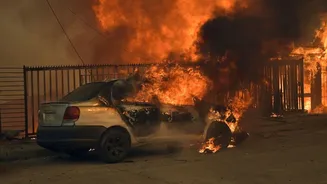

President Gabriel Boric announced the emergency measures for the Ñuble and Bío Bío regions, located roughly 500 km south of Santiago, after fires intensified amid strong winds and high summer temperatures. The declaration allows the armed forces to be deployed alongside civilian agencies to support firefighting and evacuation efforts.
According to Chile’s CONAF forestry agency, firefighters were battling 24 active wildfires nationwide as of Sunday morning. The most severe blazes were concentrated in Ñuble and Bío Bío, where at least 14 fires have been burning for the past two days, Security Minister Luis Cordero said.
Nearly 4,000 firefighters have been deployed to contain the flames, which Interior Minister Alvaro Elizalde described as creating a “complicated situation”. Boric announced the emergency decision in a post on X, saying that “all resources are available” to respond to the crisis.
Authorities said the fires have already scorched close to 8,500 hectares across the two regions, threatening several communities and prompting evacuation orders. Chile’s disaster response agency, Senapred, said nearly 20,000 people had been moved to safety, while at least 250 homes were destroyed as the fires continued to spread.
Authorities say adverse conditions like strong winds and high temperatures helped wildfires spread and complicated firefighters’ abilities to control the fires. Much of Chile was under extreme heat alerts, with temperatures expected to reach up to 38 C (100 F) from Santiago to Bío Bío on Sunday and Monday.
Both Chile and Argentina have experienced extreme temperatures and heat waves since the beginning of the year, with devastating wildfires breaking out in Argentina’s Patagonia earlier this month.