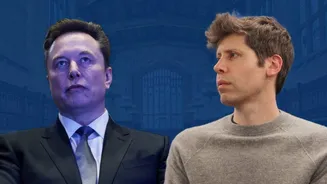

Elon Musk is taking OpenAI, the company he helped found, to court, accusing it of betraying its original non-profit promise and turning into a profit-making machine.
In a lawsuit filed in 2024, Musk claimed that Sam Altman, Greg Brockman, and other OpenAI leaders abandoned the company’s founding principles after he bankrolled its early development. The tech billionaire insists that his millions were meant to fund an altruistic research mission, not the commercial empire OpenAI and its partner Microsoft have built.
Now, after months of legal wrangling, US District Judge Yvonne Gonzalez Rogers has ruled that the case deserves its day in court. The trial, set to begin on April 27, will put the world’s most powerful AI company under scrutiny and could unearth new details about OpenAI’s murky transition from non-profit idealism to corporate dominance.
Unsealed documents reveal what really went on inside OpenAI
Last week, more than 100 previously sealed court documents were made public, offering a rare glimpse into the chaotic early days of OpenAI.
The records include testimony from Sam Altman, Greg Brockman, Ilya Sutskever, Mira Murati, and Satya Nadella, along with ex-board members Helen Toner and Tasha McCauley, who were reportedly involved in Altman’s brief ouster in 2023.
Among the most striking revelations are diary entries written by Brockman, which shed light on the internal power struggle that preceded Musk’s departure.
In one note, he wrote, “Some chance that rejecting Elon will actually lose us Sam… This is the only chance we have to get out from Elon. Is he the ‘glorious leader’ that I would pick?”
They openly discuss their conspiracy to commit fraud and steal the charity https://t.co/AI6oFll2yV
— Elon Musk (@elonmusk) January 16, 2026
Other entries hint at doubts about the company’s supposed non-profit commitment, “Cannot say that we are committed to the non-profit. Don’t want to say that we’re committed. If three months later we’re doing B-corp then it was a lie.”
In another, he reflected bluntly, “It all comes down to the money. We can get it from Tesla, probably. We could also probably get it from Google.”
Judge Rogers cited these notes when deciding to send the case to trial, saying they could support Musk’s claim that OpenAI’s founders misled him while quietly plotting a shift to a for-profit structure.
The documents also detail how Microsoft became OpenAI’s first major backer after Musk refused to collaborate with Jeff Bezos. “I think Jeff is a bit of a tool and Satya is not, so I slightly prefer Microsoft, but I hate their marketing dept,” Musk wrote in an email to Altman.
OpenAI fires back
OpenAI has dismissed Musk’s accusations, arguing that he is selectively quoting evidence to portray himself as the victim.
In a blog post titled “The truth Elon left out,” the company said Musk was the one who originally pushed to make OpenAI a for-profit entity, and demanded majority control.
lots more here: https://t.co/C0DMZdr8ej
elon is cherry-picking things to make greg look bad, but the full story is that elon was pushing for a new structure, and greg and ilya spent a lot of time trying to figure out if they could meet his demands.
— Sam Altman (@sama) January 16, 2026
According to OpenAI’s account, Musk told the team he wanted to accumulate $80 billion to build a self-sustaining city on Mars and claimed he “needed and deserved majority equity.” He also reportedly said his children should control OpenAI’s AGI (artificial general intelligence) projects in the future.
On social media, Musk has been equally combative, accusing OpenAI of having “stolen a charity” and conspiring to defraud him. Meanwhile, Sam Altman has shared excerpts of old meeting notes on X (formerly Twitter) to back his version of events, including annotated documents showing Musk himself talking about turning OpenAI into a B-corp or C-corp.
— Sam Altman (@sama) January 16, 2026
What’s next
When the case heads to court in April, a jury will decide whether OpenAI violated its non-profit obligations and whether Microsoft knowingly benefited from the shift.
Musk is demanding $134 billion in damages, arguing that his early funding and influence laid the foundation for OpenAI’s current valuation, estimated at up to $109 billion.
Musk’s lawyers say he contributed $38 million, around 60 per cent of the company’s initial funding, and that he helped recruit early staff and investors.
OpenAI and Microsoft have countered with their own filings, calling Musk’s damage estimates “unverifiable” and “implausible.” They argue that the lawsuit is less about justice and more about xAI, Musk’s rival venture launched in 2023.
Whatever the verdict, the trial is set to reveal how one of the most influential tech companies of the decade grew out of broken partnerships, shifting ideals, and a battle for control over the future of AI.