
However, interestingly, the Economic Survey 2025-2026 flagged the rapid rise of digital addiction and screen-related mental health challenges in India, particularly among children and adolescents.
Terming digital addiction alarming, the report warned that excessive engagement with smartphones, social media, gaming, and online platforms is beginning to take a measurable toll on wellbeing, learning outcomes, and long-term economic productivity.
And the Economic Survey didn’t just point out the dangers of digital addiction, but also called on the government to implement age-based limits for social media usage for children and digital advertisements targeted at them.
Does this mean an Australia-like ban is coming to India? For those unaware, the country Down Under has prohibited social media apps to children below the age of 16. We decode the report as well as what could be coming next.
The Economic Survey and digital addiction
The report tabled on Thursday noted, “Just as increased UPF (ultra-processed food) consumption and rising obesity reveal how modern lifestyles shape health outcomes, the growing prevalence of digital addiction highlights another critical behavioural risk in today’s society.”
“While obesity and inadequate nutrition threaten the physical health of youth, digital addiction undermines their cognitive and social development,” added the report.
The Economic Survey also pointed out that compulsive and high-intensity use of smartphones and digital devices can impose real economic and social costs, ranging from lost study hours and reduced productivity to healthcare burdens and financial losses resulting from risky online behaviours.
It further highlighted the dangers of digital addiction — stating that it negatively impacts academic performance and workplace productivity due to distractions, ‘sleep debt’, and reduced focus. It also erodes social capital through weaker peer networks, lower community participation, and diminished offline skills.
Apart from the direct economic costs from online purchases, gaming, and cyber fraud, digital addiction can also reduce employability, productivity, and lifetime earnings. Compulsive digital use is linked to anxiety, stress, depression, and sleep disturbances, especially among students facing academic pressure and exposure to cyberbullying and high stimulus platforms.
Citing studies, the Economic Survey noted that digital addiction has distinct health consequences among the youth. It said that social media addiction is strongly associated with anxiety, depression, low self-esteem, and cyberbullying stress.
Prevalence of digital addiction in India
Digital addiction — addictive behaviour linked to digital devices, including smartphones, the internet, gaming, and social media addiction, as noted by the Economic Survey — has become very prevalent in India.
India's digital addiction stems from its huge digital footprint. Internet connections have risen drastically that has led to India’s youth living in an intensely digital environment. File image/AFP
And it stems from India’s huge digital footprint. Take these numbers into account: internet connections in India grew from 25.15 crore in 2014 to 96.96 crore in 2024. Additionally, 85.5 per cent of households own at least one smartphone.
All of this data points to one thing — India’s youth are living in an intensely digital environment.
The survey even noted that with near-universal mobile/internet use among 15–29-year-olds, access is no longer the binding constraint and finds the behavioural pattern as persistent, excessive, or obsessive.
Ways to counter digital addiction
So, if India is facing a problem of digital addiction, what can be done?
In India, multiple measures address digital addiction among children. There’s the CBSE guidelines on safe internet use, the Ministry of Education’s Pragyatah framework on screen time in education,and child protection guidelines on online safety.
There’s also Tele-MANAS (Tele Mental Health Assistance and Networking Across States), the national mental health helpline launched in 2022, which has received over 32 lakh calls. The Online Gaming (Regulation) Act, 2025 banned online money games involving wagering and restricted any such advertising.
Moreover, at state level, some government have taken steps or considering ways to counter this problem. For instance, Kerala has launched the ‘D-DAD’ (Digital De-Addiction Center) project, which focuses on combating excessive mobile, social media, and gaming addiction among children through free counselling, therapy, and expert guidance.
States like Goa and Andhra Pradesh are also mulling a social media ban for children, similar to the one in Australia. In fact, representatives of Meta, Google and ShareChat have been contacted by officials from the Andhra Pradesh government to discuss this issue.

A message the reads ‘Let them be kids’ is projected onto the Sydney Harbour Bridge to mark a law banning social media for users under 16 in Australia in Sydney, Australia. File image/Reuters
Meanwhile, the Economic Survey pointed to Australia’s ban on social media accounts for children under 16 as a way forward for the nation struggling with digital addiction. Last year, Australia became the first country in the world to enforce a minimum age for social media use, requiring platforms such as Instagram, YouTube and Snap to block more than a million accounts of users below the age of 16.
Other countries such as Britain and France are also closely observing the Australian law and considering similar age-based measures. China also has its own measures in place — the “minor mode” programme that requires device-level restrictions and app-specific rules to restrict screen time depending on age. Similarly, in Germany, minors between the ages of 13 and 16 are allowed to use social media only if their parents provide consent.
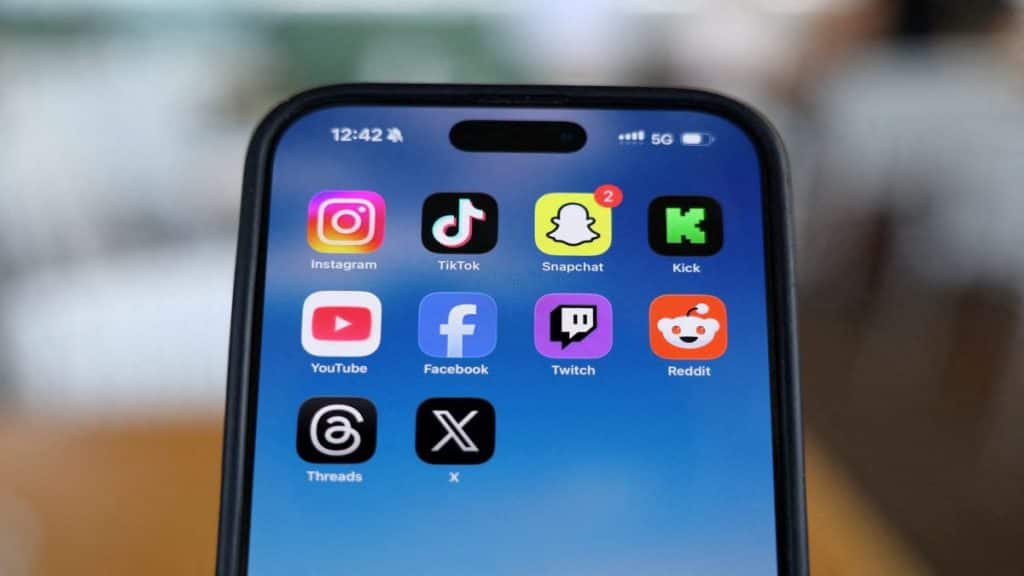
Instagram, TikTok, Snapchat, Kick, YouTube, Facebook, Twitch, Reddit, Threads and X applications are displayed on a mobile phone. Most parents and experts conclude that social media and digital addiction are a problem for the youth. Representational image/Reuters
However, the question many are asking is do such bans work? While many conclude that its imperative to protect children’s mental health, not all agree that such bans are an effective solution, and there is growing reason to believe they may raise as many challenges as they aim to solve.
Most tech companies argue that such bans are hard to implement, as children often find ways to circumvent restrictions. Even if bans could be successfully implemented, barring kids from social media might not meaningfully reduce screen time. One study concludes that restricting access to certain platforms does not necessarily encourage kids to spend more time offline, but rather pushes them toward other activities like watching television, playing video games, or even exploring “darker corners of the internet.”
It’s left to be seen if India, indeed, passes a ban on social media. As the Economic Survey states, “India’s challenge is to rebalance youth engagement by combining restrictive safeguards with positive offline opportunities and not to demonise technology.”
With inputs from agencies