







What is the story about?
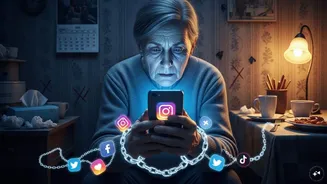
In Vadodara, Gujarat, a 62-year-old woman’s life took an unlikely turn: she became addicted to Instagram reels. It began innocently enough, a few minutes of scrolling after lunch, an innocent escape from the activities of the day. It wasn’t long before her entire day was dedicated to the steady stream of reels. When I read this news report, I was intrigued. Whilst we assume new generations of native digitals do run a real risk of becoming addicted to social media, the older generation is assumed to be immunised from its obsessive circuit.
The 62-year-old grew up in an era before the internet and even television; there were other activities that consumed her time through childhood and most of her adulthood. She was not the demographic that one would assume will fall prey to online addiction. But this is where we don’t quite understand the circuitry of addiction and its ability to override common sense explanations.
Soon, the woman was skipping meals and neglecting sleep. She became emotionally upset when her comments were not answered, taking these instances as a personal rejection. Her family, having grown increasingly concerned, decided they must remove Instagram from her phone. What followed was a petulance that one usually associates with teenagers. The woman stopped eating in protest and became increasingly irritable, exhibiting classic withdrawal symptoms, with extreme mood shifts and acting out when denied Instagram.
This isn’t fiction; it’s reality. So imagine the audacity of Instagram’s leadership’s claim that social media “can’t be addictive”. This is but one example; there are hundreds and thousands more.
The paradigm of addiction has changed; it doesn’t present as a bottle of alcohol or an injectable. It comes in different forms that are just as compelling, more so because their use is normalised and can be done in the open. Social media is that addiction. Acceptable as social behaviour, ubiquitous and deceptively harmless.
Multiple scientific studies define problematic or addictive social media use in behavioural terms similar to other recognised addictive behaviours – cravings, failed attempts to cut down, interference with real-life activities, and withdrawal symptoms when trying to disengage.
An extensive review published in PMC found that habitual social media use among adolescents can negatively affect school performance, social interaction, and interpersonal relationships, and that users can develop patterns of engagement driven by uncontrollable desires to browse, rather than conscious choice.
Another meta-analysis spanning 32 nations documented that up to 25–31 per cent of social media users show moderate to high signs of addiction-like behaviour, depending on how addiction is defined. This is not something that can be dismissed with an offhand comment.
These figures do not indicate a fringe issue but one that is growing in scale, and as technology develops with the arrival of AI, the problem is scalable in a way we could not have imagined.
Social media executives cite behavioural patterns that present as a pathology and can be clinically diagnosed; those addictions, like nicotine, alcohol or heroin, have clear symptoms and patterns. So the question then is not if social media is addictive; it is whether we need to redefine the pathology of addiction in our rapidly evolving world. Because addiction is no longer only chemical; it is technological.
It isn’t only compulsive scrolling or engagement that is the issue with social media; it is its association with higher risks of loneliness, anxiety, depression and even suicidal ideation, particularly in young people.
Recently three sisters addicted to Korean subculture died by suicide in Ghaziabad, shocking the nation but not triggering the conversation that we must all have – how much exposure to social media and its often-manufactured world is too much?
But this is not only a case of unconscious user patterns, wherein some people are more prone to addiction than others. This is wilful and carefully designed. Social media runs on algorithms; “engagement” isn’t only about producing content that engages, it is about keeping you hooked and triggering behaviours that are compulsive and all-consuming. That’s the blueprint, and it cannot be disassociated from the rising concerns around the use of social media.
Neuroscience research has shown that short-form videos, as available on Instagram, can alter reward pathways and reduce enjoyment as well as engagement in everyday activities. These are addiction patterns that are found in alcoholism or gambling. It’s clear that this isn’t accidental; it’s engineering.
And it's important we tackle it now, before it becomes an epidemic.
(Advaita Kala is a best-selling novelist and award-winning screenwriter. The views expressed in this article are those of the author and do not represent the stand of Firstpost.)
The 62-year-old grew up in an era before the internet and even television; there were other activities that consumed her time through childhood and most of her adulthood. She was not the demographic that one would assume will fall prey to online addiction. But this is where we don’t quite understand the circuitry of addiction and its ability to override common sense explanations.
Soon, the woman was skipping meals and neglecting sleep. She became emotionally upset when her comments were not answered, taking these instances as a personal rejection. Her family, having grown increasingly concerned, decided they must remove Instagram from her phone. What followed was a petulance that one usually associates with teenagers. The woman stopped eating in protest and became increasingly irritable, exhibiting classic withdrawal symptoms, with extreme mood shifts and acting out when denied Instagram.
This isn’t fiction; it’s reality. So imagine the audacity of Instagram’s leadership’s claim that social media “can’t be addictive”. This is but one example; there are hundreds and thousands more.
The paradigm of addiction has changed; it doesn’t present as a bottle of alcohol or an injectable. It comes in different forms that are just as compelling, more so because their use is normalised and can be done in the open. Social media is that addiction. Acceptable as social behaviour, ubiquitous and deceptively harmless.
Multiple scientific studies define problematic or addictive social media use in behavioural terms similar to other recognised addictive behaviours – cravings, failed attempts to cut down, interference with real-life activities, and withdrawal symptoms when trying to disengage.
An extensive review published in PMC found that habitual social media use among adolescents can negatively affect school performance, social interaction, and interpersonal relationships, and that users can develop patterns of engagement driven by uncontrollable desires to browse, rather than conscious choice.
Another meta-analysis spanning 32 nations documented that up to 25–31 per cent of social media users show moderate to high signs of addiction-like behaviour, depending on how addiction is defined. This is not something that can be dismissed with an offhand comment.
These figures do not indicate a fringe issue but one that is growing in scale, and as technology develops with the arrival of AI, the problem is scalable in a way we could not have imagined.
Social media executives cite behavioural patterns that present as a pathology and can be clinically diagnosed; those addictions, like nicotine, alcohol or heroin, have clear symptoms and patterns. So the question then is not if social media is addictive; it is whether we need to redefine the pathology of addiction in our rapidly evolving world. Because addiction is no longer only chemical; it is technological.
It isn’t only compulsive scrolling or engagement that is the issue with social media; it is its association with higher risks of loneliness, anxiety, depression and even suicidal ideation, particularly in young people.
Recently three sisters addicted to Korean subculture died by suicide in Ghaziabad, shocking the nation but not triggering the conversation that we must all have – how much exposure to social media and its often-manufactured world is too much?
But this is not only a case of unconscious user patterns, wherein some people are more prone to addiction than others. This is wilful and carefully designed. Social media runs on algorithms; “engagement” isn’t only about producing content that engages, it is about keeping you hooked and triggering behaviours that are compulsive and all-consuming. That’s the blueprint, and it cannot be disassociated from the rising concerns around the use of social media.
Neuroscience research has shown that short-form videos, as available on Instagram, can alter reward pathways and reduce enjoyment as well as engagement in everyday activities. These are addiction patterns that are found in alcoholism or gambling. It’s clear that this isn’t accidental; it’s engineering.
And it's important we tackle it now, before it becomes an epidemic.
(Advaita Kala is a best-selling novelist and award-winning screenwriter. The views expressed in this article are those of the author and do not represent the stand of Firstpost.)