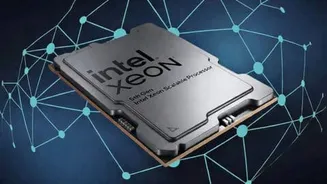








As a resolute example of expansion of an existing partnership, Google has committed to using multiple generations of Intel Central Processing Units in its Artificial Intelligence data centres. The partnership has continued for long, dating back to its earliest server rack.
Google has relied on Intel processors for a long time, dating back to its earliest server rack ambitions nearly three decades ago. Intel’s newest Xeon 6 CPUs will now run AI training and inference workloads, potentially giving the chipmaker a stronger position in an AI market that has been dominated by Nvidia.
The expansion of the partnership comes as AI data centres take centre stage in the next phase of the AI race. Intel had previously sold a 10% stake to the US government in August, with the Trump administration touting the chipmaker’s ability to make advanced chips in the US.
Intel has been producing the latest Xeon processors on its most advanced 18A technology at its Arizona chip fabrication plant that opened last year. In recent days, Intel has been tapped by Elon Musk to design and fabricate custom chips for SpaceX, xAI, and Tesla at the Terrafab project in Texas, though no financial details or timelines were announced.
Google and Intel have reiterated that they’re collaborating on another type of chip, the Infrastructure Processing Unit, or IPU, which the two companies have worked on together since 2022.
Lip-Bu Tan, CEO of Intel, stated, “AI is reshaping how infrastructure is built and scaled. Scaling AI requires more than accelerators—it requires balanced systems. CPUs and IPUs are central to delivering the performance, efficiency, and flexibility modern AI workloads demand.”
“CPUs and infrastructure acceleration remain a cornerstone of AI systems—from training orchestration to inference and deployment,” said Amin Vahdat, SVP & Chief Technologist, AI Infrastructure, Google. “Intel has been a trusted partner for nearly two decades, and their Xeon roadmap gives us confidence that we can continue to meet the growing performance and efficiency demands of our workloads.”
Intel states that the open collaboration reflects a shared commitment to advance towards an open, scalable infrastructure for the AI era by combining general-purpose compute with purpose-built infrastructure acceleration. It further stated that Google and Intel are working together to strengthen the foundation for the next generation of AI-driven cloud services, supporting innovation across enterprises.