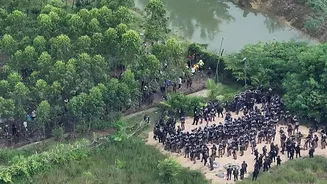









Cambodia has accused the Thai military of bombing the bustling casino town of Poipet, a major crossing point on the Cambodia‑Thailand border, as renewed hostilities continue with no ceasefire in sight.
According to Cambodia’s defence ministry, Thai forces “dropped 2 bombs in the area of Poipet Municipality, Banteay Meanchey Province” at around 11 am on Thursday. The ministry, as per AFP, said the strikes hit the casino hub—a place usually busy with Thai gamblers—but Thailand had not immediately responded to the claims by early afternoon.
The attack comes amid a flare‑up of violence along the frontier, which has claimed dozens of lives and displaced hundreds of thousands of people from both sides.
Officials say the renewed clashes, which reignited earlier this month, have already killed at least 21 people in Thailand and 17 in Cambodia, while forcing roughly 800,000 residents to flee their homes.
Watch the video here:
Thai airstrikes have hit Poipet, Cambodia’s high-profile casino hub near the Thai border, as cross-border clashes intensify and tensions spill into one of Southeast Asia’s most sensitive frontier zones raising fears of a broader confrontation between the two neighbors.#Europost pic.twitter.com/iAlwGJLOge
— EuroPost Agency (@EuroPostAgency) December 18, 2025
No truce, despite outside claims
The recent violence has shattered hopes for peace after a tentative ceasefire that was brokered in previous months. United States President Donald Trump had publicly claimed last week that both Bangkok and Phnom Penh agreed to revive a truce. But Thai officials quickly denied any such agreement, insisting no ceasefire had actually been arranged and that fighting remains daily.
In the meantime, Cambodia’s interior ministry confirmed that several casinos across the country have already been damaged by Thai attacks since fighting resumed. Poipet’s border closures—which Cambodian officials describe as a “necessary measure” to protect civilians—have left thousands of Thai citizens stranded on the Cambodian side with limited options to return home.
What’s driving the conflict?
At the root of the this tension is a century‑old territorial dispute over parts of the shared 800‑kilometre (500‑mile) border and contested ancient temple ruins. Both governments accuse each other of instigating violence and violating sovereignty, with neither showing signs of backing down soon.
Efforts by international mediators, including diplomatic visits from China’s special envoy, aim to de‑escalate the situation, yet for now, peace remains elusive here.