






What is the story about?
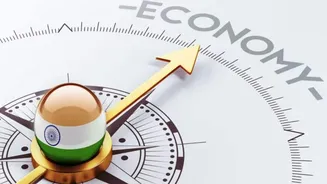
India used the World Economic Forum in Davos to project confidence in its economic trajectory, with political leaders and business executives striking a rare bipartisan note on growth, stability, and long-term scale.
Union minister Ashwini Vaishnaw said India is currently the fastest-growing major economy globally, with a consistent growth path of 6–8 per cent projected over the next five years.
He noted that the combination of moderate inflation and strong growth signals a deeper economic transformation over the past decade, drawing increasing global attention.
India’s ambition to move beyond headline rankings was sharpened by Sunil Bharti Mittal, who argued that becoming the world’s third-largest economy is only a milestone, not the destination.
“We will become the world’s third-largest economy, but six or seven trillion dollars for a population of over 1.5 billion does not add up,” Mittal said in Davos. “To truly arrive, we must scale to $25–30 trillion. The timing may vary, but the destination is clear and unavoidable.”
Mittal emphasised the need for trade partnerships, policy stability, and technology-led growth, while cautioning that the global environment is more competitive than ever. “What the business community needs is an enabling environment, a committed government, and long-term stability—all of which are in place today,” he said.
India’s political leadership echoed that confidence. Andhra Pradesh Chief Minister N. Chandrababu Naidu said India is already the world’s fourth-largest economy and is on track to become the third within two to three years.
“We are fighting with giants, but India is a sleeping giant,” Naidu said. “If we wake up fully, we will be number one by 2047.”
In a notable show of unity, senior Union ministers, chief ministers, and leaders from nearly 10 states, cutting across party lines, came together in Davos to highlight India’s investment prospects.
Speaking at a session organised by the Confederation of Indian Industry and KPMG, ministers Harsh Sanghavi and K. Rammohan Naidu said India has transitioned from an “emerging” economy to a “pivotal” global economic force over the last decade.
They credited robust growth and the spread of digital public infrastructure for improving productivity, formalisation and investor confidence across sectors.
Together, the messages from Davos painted a coherent picture: India sees itself not just climbing global rankings but scaling its economy decisively, through stable policy, competitive manufacturing, technology adoption, and deeper global integration, towards a $30 trillion horizon.
Union minister Ashwini Vaishnaw said India is currently the fastest-growing major economy globally, with a consistent growth path of 6–8 per cent projected over the next five years.
He noted that the combination of moderate inflation and strong growth signals a deeper economic transformation over the past decade, drawing increasing global attention.
India’s ambition to move beyond headline rankings was sharpened by Sunil Bharti Mittal, who argued that becoming the world’s third-largest economy is only a milestone, not the destination.
“We will become the world’s third-largest economy, but six or seven trillion dollars for a population of over 1.5 billion does not add up,” Mittal said in Davos. “To truly arrive, we must scale to $25–30 trillion. The timing may vary, but the destination is clear and unavoidable.”
Mittal emphasised the need for trade partnerships, policy stability, and technology-led growth, while cautioning that the global environment is more competitive than ever. “What the business community needs is an enabling environment, a committed government, and long-term stability—all of which are in place today,” he said.
India’s political leadership echoed that confidence. Andhra Pradesh Chief Minister N. Chandrababu Naidu said India is already the world’s fourth-largest economy and is on track to become the third within two to three years.
“We are fighting with giants, but India is a sleeping giant,” Naidu said. “If we wake up fully, we will be number one by 2047.”
In a notable show of unity, senior Union ministers, chief ministers, and leaders from nearly 10 states, cutting across party lines, came together in Davos to highlight India’s investment prospects.
Speaking at a session organised by the Confederation of Indian Industry and KPMG, ministers Harsh Sanghavi and K. Rammohan Naidu said India has transitioned from an “emerging” economy to a “pivotal” global economic force over the last decade.
They credited robust growth and the spread of digital public infrastructure for improving productivity, formalisation and investor confidence across sectors.
Together, the messages from Davos painted a coherent picture: India sees itself not just climbing global rankings but scaling its economy decisively, through stable policy, competitive manufacturing, technology adoption, and deeper global integration, towards a $30 trillion horizon.