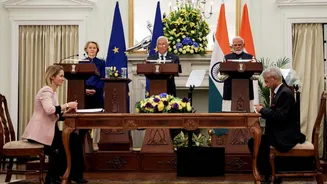

The pact is aimed at expanding bilateral commerce while lowering dependence on the United States.
According to the EU, the agreement could see European exports to India double by 2032, as duties are either removed or reduced on 96.6 per cent of traded goods by value. European companies are projected to save around 4 billion euros ($4.75 billion) in tariff costs as a result.
India, for its part, said the EU will phase out tariffs on 99.5 per cent of Indian goods over a seven-year period.
Duties on Indian exports such as marine products, leather and textiles, chemicals, rubber, base metals, and gems and jewellery will eventually be brought down to zero, India’s trade ministry said in a statement.
Both sides clarified that sensitive agriculture-linked products — including soya, beef, sugar, rice and dairy — have been excluded from the scope of the agreement.
"Yesterday, a big agreement was signed between the European Union and India," Prime Minister Narendra Modi said earlier.
"People around the world are calling this the mother of all deals. This agreement will bring major opportunities for the 1.4 billion people of India and the millions of people in Europe," he said.
"Europe and India are making history today," European Commission President Ursula von der Leyen said. "This is only the beginning."
Trade between India and the EU reached $136.5 billion in the fiscal year ending March 2025. This compared with $132 billion in trade between India and the United States, and $128 billion between India and China.
How previously guarded sectors have opened up
According to an EU statement, tariffs on automobiles will be reduced to 10 per cent over five years from levels as high as 110 per cent, benefiting European carmakers such as Volkswagen, Renault, Mercedes-Benz and BMW.
Both sides said the lower auto tariffs would apply to up to 250,000 cars annually, each valued above 15,000 euros. Once the agreement comes into force, these duties will immediately fall to between 30 per cent and 35 per cent.
India will also sharply reduce tariffs on alcoholic beverages. Duties on wines will be cut to 75 per cent immediately from 150 per cent, before being gradually lowered to 20 per cent. Tariffs on spirits will be brought down to 40 per cent, the EU said.
In addition, the agreement will lower tariffs on a wide range of EU exports to India, including machinery, electrical equipment, chemicals, and iron and steel products.
Despite these concessions, Indian exporters did not receive immediate relief from the EU’s carbon tax under the Carbon Border Adjustment Mechanism (CBAM), which came into effect on January 1.
Beyond steel, the levy also applies to cement, electricity, fertilisers and other products.
India said it has secured an assurance from the EU that it would be granted flexibility under the carbon tax regime if similar concessions are extended to third countries.
Separately, the EU committed to providing financial assistance of 500 million euros over the next two years to support India’s efforts to reduce greenhouse gas emissions.
How India-EU ties have evolved
India-EU relations have evolved from a 1960s trade-and-aid framework into a sophisticated Strategic Partnership formalised in 2004.
After the foundational 1994 Cooperation Agreement, the relationship focused on institutionalizing annual summits, though economic ties hit a plateau in 2013 when initial free trade negotiations stalled due to disagreements over market access and regulatory standards.
So the framework itself builds on more than 30 years of cooperation and nearly six decades of formal diplomatic relations.
Over time, the partnership has expanded to include regular summits, ministerial dialogues, and cooperation across economic, political, and people-to-people domains.
India’s growing importance to the EU is closely linked to its economic and demographic profile. With more than one billion people of working age and a median age of 31, India is projected to become the world’s third-largest economy by 2030.
The country has also emerged as a major manufacturing and technology hub, hosting 45 per cent of global capability centres and investing heavily in advanced and frontier technologies.
Despite these convergences, the relationship has not been without friction. Differences over geopolitical issues — most notably the Russia-Ukraine war — have created discomfort among some European countries.
India has consistently conveyed to its European partners that its ties with Russia are rooted in a historical relationship dating back to the Soviet era, a position that has at times contributed to mistrust.
How India-EU trade ties are faring
The European Union is currently one of India’s largest trading partner, with bilateral trade in goods valued at €120 billion in 2024. This accounts for approximately 11.5 per cent of India’s total trade.
From the European perspective, India ranks as the bloc’s ninth-largest trading partner, representing 2.4 per cent of the EU’s total goods trade. This places India behind partners such as the United States, China, and the United Kingdom, but still highlights its growing relevance to the European economy.
Over the past decade, trade in goods between India and the EU has increased by almost 90 per cent, reflecting deeper integration and expanding commercial ties. The composition of this trade highlights the industrial nature of the relationship.
European imports from India are largely made up of machinery and appliances, chemicals, base metals, mineral products, and textiles. Meanwhile, EU exports to India are dominated by machinery and appliances, transport equipment, and chemicals.
Services trade has also emerged as a significant component of the relationship. In 2023, trade in services between India and the EU reached €59.7 billion, including €26 billion in EU exports. This reflects strong linkages in sectors such as information technology, professional services, research, and engineering.
Investment ties further reinforce the economic partnership. The EU’s share of foreign direct investment stock in India stood at €140.1 billion in 2023, a sharp rise from €82.3 billion in 2019.
This makes the EU one of India’s leading sources of foreign investment. By contrast, India’s FDI stock in the EU amounted to €10.3 billion, indicating scope for future expansion.
The scale of European business presence in India is also notable, with around 6,000 European companies operating across the country. These firms are active in sectors ranging from manufacturing and infrastructure to energy, pharmaceuticals, and digital services.
Why the India-EU deal also reflects strategic urgency
The evolving India-EU relationship must be understood within a broader global context marked by economic nationalism, supply-chain disruptions, and geopolitical competition.
Both New Delhi and Brussels are seeking to diversify partnerships and reduce vulnerabilities as the Trump administration in the United States adopts an increasingly tariff-driven trade policy.
India has already been subjected to 50 per cent tariffs by the US, with additional measures threatened over its continued purchase of Russian crude oil. Europe, too, has faced tariff threats from Washington, including most recently over Greenland.
Against this backdrop, the EU-India summit is seen as part of a wider effort by both sides to strengthen ties with like-minded partners.
While the European Union continues to emphasise values and multilateralism in its foreign policy, India is increasingly viewed as a credible partner given its democratic credentials and growing economic weight.
The EU has identified India as a critical partner in its efforts to reduce strategic dependencies, particularly in key and emerging technologies. This thinking underpins initiatives such as the EU-India Trade and Technology Council, which held its first meeting in 2023.
The Council focuses on cooperation in areas such as artificial intelligence, semiconductors, cybersecurity, and digital infrastructure.
In October, the European Council endorsed a New Strategic EU-India Agenda aimed at deepening cooperation across a wide range of sectors. This agenda is expected to form the basis of discussions at the upcoming summit.
Beyond multilateral frameworks, regular high-level interactions have continued to shape the relationship. Earlier this month, Jaishankar participated in the Weimar Triangle format meeting with Germany, France, and Poland. Modi is also scheduled to travel to Europe later this year for the India-Nordic Summit.
Much of the momentum in India’s engagement with Europe has traditionally come through bilateral relationships.
Germany, France, and other key European states maintain strong ties with India. German Chancellor Friedrich Merz’s recent visit to India resulted in agreements covering defence industrial cooperation, semiconductors, and critical minerals.
France, in particular, has been a long-standing strategic partner for India. French President Emmanuel Macron is expected to visit India in February, and France has served as the chief guest at India’s Republic Day parade more times than any other country.
The clearest signal of the EU’s intent to reset ties with India came from Kaja Kallas, the bloc’s High Representative for Foreign Affairs and Security Policy.
Addressing the European Parliament earlier this month, Kallas described India as becoming “indispensable” to Europe’s economic resilience and framed the upcoming summit as a moment of renewed political momentum.
“Two major democracies cannot afford to hesitate,” she said.
According to Kallas, leaders intend to move beyond declarations and endorse “concrete deliverables” that would take the partnership “from words to actions”.
This momentum has now culminated in the historic 16th India-EU Summit, where both sides finalised the comprehensive Free Trade Agreement (FTA) and also established a new Security and Defence Partnership.
With inputs from agencies