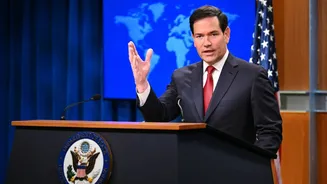

The remarks from Rubio came while he was addressing the Senate Foreign Relations Committee. The plan soon drew sharp, sceptical Democrats, with the American diplomat admitting that it was “novel” and hastily designed. It is pertinent to note that the Wednesday hearing was Rubio’s first public testimony to Congress since American forces captured Venezuela’s leader, Nicolás Maduro, on January 3.
During the hearing, Rubio assured senators that the Trump administration had established a “very respectful and productive line of communication” with the government of
However, in his opening statement to the committee, Rubio warned that the United States was “prepared to use force to ensure maximum cooperation” from Ms Rodríguez’s government if other methods fail.”
Rubio details Trump's ambition
It is important to note that Trump had previously maintained that the United States would control Venezuela’s oil and “run the country,” but Rubio provided more details of the plan. The Secretary of State noted that the US would help Venezuela’s government fund basic public services by disbursing proceeds from the sale of Venezuelan oil that is subject to American sanctions.
Rubio insisted that the approach was necessary because of a “fiscal crunch” in Venezuela and that it was a “short-term mechanism” not meant to become permanent. “They needed money in the immediacy to fund the police officers, the sanitation workers, the daily operations of government,” Rubio averred. “They have pledged to use a substantial amount of those funds to purchase medicine and equipment directly from the United States," he added.
While he acknowledged that the arrangement is unusual, he noted that the funds would initially be held in an offshore account controlled by Qatar before eventual transfer to a US Treasury account. “I understand it’s novel, but it’s the best we could come up with in the short term,” Rubio said.
He explained that a third-party account was necessary because of US financial sanctions on Venezuela and because creditors to whom the country owes money, mainly from its seizure of American energy company assets roughly 20 years ago, could otherwise make legal claims on the funds that would complicate their disbursement. Meanwhile, the Venezuelan government has yet to comment on the matter.