







What is the story about?
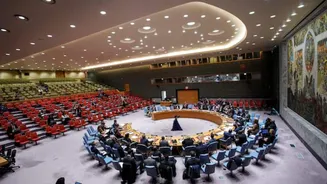
The United Nations Security Council on Wednesday adopted a resolution which was cosponsored by India along with 134 other nations, condemning the Iranian attacks on Gulf countries and Jordan. The resolution went on to demand that Tehran immediately halt hostilities in the region.
According to Al Jazeera, 13 of the 15 members of the UNSC voted on Wednesday in favour of the resolution sponsored by the Gulf Cooperation Council (GCC) and cosponsored by India, among other nations. None of the UNSC members rejected the resolution, while China and Russia have decided to abstain from voting.
The resolution was led by Bahrain and some of the other prominent countries included, Australia, Austria, Bangladesh, Bhutan, Canada, Egypt, France, Germany, Greece, Italy, Japan, Kuwait, Malaysia, Maldives, Myanmar, New Zealand, Norway, Oman, Pakistan, Qatar, Saudi Arabia, Singapore, Spain, Ukraine, United Arab Emirates, United Kingdom, United States, Yemen and Zambia.
It condemned in the “strongest terms the egregious attacks” by Iran against the territories of Bahrain, Kuwait, Oman, Qatar, Saudi Arabia, the United Arab Emirates and Jordan and maintained that such acts constitute a major breach of international law. The resolution also denounced threats of closure of the Strait of Hormuz.
The resolution in question called for the immediate cessation of all attacks by Iran against the GCC countries and Jordan. It also asked Tehran to “immediately and unconditionally” cease from any provocation or threats to neighbouring states, including the use of proxies.
The countries reaffirmed that the exercise of navigational rights and freedoms by merchant and commercial vessels, in accordance with international law, must be respected, particularly around critical maritime routes, and take note of the right of Member States, in accordance with international law, to “defend their vessels from attacks and provocations, including those that undermine navigational rights and freedoms”.
The resolution also condemned any actions or threats by Iran aimed at closing, obstructing, or otherwise interfering with international navigation through the Strait of Hormuz, or threatening maritime security in the Bab Al Mandab.
After the resolution was passed, US Representative to the United Nations Ambassador Mike Waltz said the adoption of the resolution “is a direct and unequivocal statement from the Gulf countries condemning the brutality of the Iranian regime, whose practice of targeting civilians and civilian infrastructure is reprehensible, and the entire world is calling it out for what it is”.
Waltz maintained that President Donald Trump and his team exhausted every attempt at diplomatic negotiations. "He sought peace and to end 47 years of hostility and attacks, while Iran only sought more missiles, more drones, and a pathway to nuclear Armageddon. President Trump has drawn his red line here. Iran crossed it once again, and now the world is facing the consequences."
“And these consequences that the United States does not bring alone,” Waltz added. Meanwhile, Iran’s Permanent Representative to the UN, Ambassador Amir Saeid Iravani, described the Council’s action as “unjust and unlawful". He insisted that the resolution is inconsistent with the United Nations Charter and international law, and an action that completely disregards the established principles governing the determination of acts of aggression and breaches of the peace.
With Inputs from PTI.
According to Al Jazeera, 13 of the 15 members of the UNSC voted on Wednesday in favour of the resolution sponsored by the Gulf Cooperation Council (GCC) and cosponsored by India, among other nations. None of the UNSC members rejected the resolution, while China and Russia have decided to abstain from voting.
The resolution was led by Bahrain and some of the other prominent countries included, Australia, Austria, Bangladesh, Bhutan, Canada, Egypt, France, Germany, Greece, Italy, Japan, Kuwait, Malaysia, Maldives, Myanmar, New Zealand, Norway, Oman, Pakistan, Qatar, Saudi Arabia, Singapore, Spain, Ukraine, United Arab Emirates, United Kingdom, United States, Yemen and Zambia.
It condemned in the “strongest terms the egregious attacks” by Iran against the territories of Bahrain, Kuwait, Oman, Qatar, Saudi Arabia, the United Arab Emirates and Jordan and maintained that such acts constitute a major breach of international law. The resolution also denounced threats of closure of the Strait of Hormuz.
'Immediate cessation of all attacks'
The resolution in question called for the immediate cessation of all attacks by Iran against the GCC countries and Jordan. It also asked Tehran to “immediately and unconditionally” cease from any provocation or threats to neighbouring states, including the use of proxies.
The countries reaffirmed that the exercise of navigational rights and freedoms by merchant and commercial vessels, in accordance with international law, must be respected, particularly around critical maritime routes, and take note of the right of Member States, in accordance with international law, to “defend their vessels from attacks and provocations, including those that undermine navigational rights and freedoms”.
The resolution also condemned any actions or threats by Iran aimed at closing, obstructing, or otherwise interfering with international navigation through the Strait of Hormuz, or threatening maritime security in the Bab Al Mandab.
After the resolution was passed, US Representative to the United Nations Ambassador Mike Waltz said the adoption of the resolution “is a direct and unequivocal statement from the Gulf countries condemning the brutality of the Iranian regime, whose practice of targeting civilians and civilian infrastructure is reprehensible, and the entire world is calling it out for what it is”.
Waltz maintained that President Donald Trump and his team exhausted every attempt at diplomatic negotiations. "He sought peace and to end 47 years of hostility and attacks, while Iran only sought more missiles, more drones, and a pathway to nuclear Armageddon. President Trump has drawn his red line here. Iran crossed it once again, and now the world is facing the consequences."
“And these consequences that the United States does not bring alone,” Waltz added. Meanwhile, Iran’s Permanent Representative to the UN, Ambassador Amir Saeid Iravani, described the Council’s action as “unjust and unlawful". He insisted that the resolution is inconsistent with the United Nations Charter and international law, and an action that completely disregards the established principles governing the determination of acts of aggression and breaches of the peace.
With Inputs from PTI.