






What is the story about?
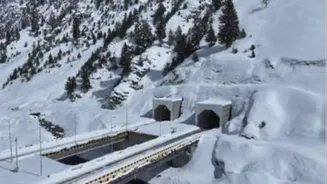
The Zoji La Tunnel, a 13.153-km strategic project being built to provide all-weather connectivity between Kashmir and Ladakh, moved a step closer to completion on Tuesday after achieving a major construction milestone.
Authorities carried out the scheduled breakthrough operation inside the tunnel, bringing the ambitious Himalayan infrastructure project closer to opening one of India's most challenging mountain routes throughout the year.
Union Minister for Road Transport and Highways Nitin Gadkari attended the breakthrough ceremony alongside Jammu & Kashmir Lieutenant Governor Manoj Sinha and Chief Minister Omar Abdullah.
The 13.153-km-long tunnel has now reached a stage where only three metres of rock remain between its two ends.
The final blast will remove the remaining section, physically connecting the Sonamarg (Baltal) side in Kashmir with Minamarg in Ladakh.
Constructed between Baltal (Sonamarg) and Meenamarg (Drass and Kargil), the project spans the Union Territories of Jammu & Kashmir and Ladakh.
The tunnel is designed to provide uninterrupted access through a region frequently cut off by heavy snowfall, avalanches and severe weather conditions.
Built at an altitude of around 11,578 feet above sea level, the project involves an investment of Rs 6,500 crore and is regarded as one of India's most ambitious mountain infrastructure developments.
As part of the Srinagar-Kargil-Leh National Highway, the tunnel is expected to improve both civilian transportation and military mobility in the strategically important region.
Officials said that once the tunnel is connected end-to-end, ventilation inside the structure will improve, allowing construction activities on the remaining sections to accelerate.
The project incorporates a range of modern safety and monitoring features, including a semi-transverse ventilation system, CCTV surveillance, radio communication systems, uninterrupted power supply and advanced ventilation facilities.
The Smart Tunnel (SCADA) system has been developed using the New Austrian Tunneling Method.
According to project officials, the use of advanced construction technologies has generated savings of more than Rs 5,000 crore for the government.
On Monday, Gadkari highlighted the significance of the project in a post on X, writing: "India's most challenging infrastructure taking shape in the remote heights of the Himalayas -- Zoji La Tunnel!"
The project has been carried out under demanding conditions, with around 1,400 workers engaged in construction activities.
Temperatures at the site fall between -20°C and -30°C for nearly 100 days every year.
The project also faced five major avalanches, including two incidents that damaged machinery and workshop facilities.
Harpal Singh, Joint Chief Operating Officer of Megha Engineering and Infrastructures Ltd. (MEIL), said a limited number of vehicles would be allowed to pass through the tunnel after the breakthrough as a symbolic gesture.
"Nearly 80% of our workforce is from Kashmir. They have done a wonderful job," Singh said.
The overall project is targeted for completion in 2028, with officials estimating that the remaining work could take around two to two-and-a-half years.
Yusuf, Authority Engineer for the Zojila Project, told ANI, "I am from Iran. I am proud of it. I can say I am proud that about 80% of the project is already finished; the remaining 20% might take another two years or so to complete fully. Regardless, the breakthrough is a major event for the tunnel, and we are happy that, under the current system, we have managed to execute this project effectively. It will take roughly another two and a half years for the tunnel to fully open."
He added, "However, in a dire emergency, especially if the Army needed to use it, it might be possible to utilise the tunnel for a short period, although under normal circumstances, it is not feasible to use it yet..."
Once completed, the Zoji La Tunnel is expected to rank among the world's longest single-tube, bi-directional road tunnels at such a high altitude and serve as a benchmark for future infrastructure projects in challenging mountain terrain.
Authorities carried out the scheduled breakthrough operation inside the tunnel, bringing the ambitious Himalayan infrastructure project closer to opening one of India's most challenging mountain routes throughout the year.
Union Minister for Road Transport and Highways Nitin Gadkari attended the breakthrough ceremony alongside Jammu & Kashmir Lieutenant Governor Manoj Sinha and Chief Minister Omar Abdullah.
जम्मू-कश्मीर और लदाख के बीच ऑल-वेदर कनेक्टिविटी का और भारत के इन्फ्रास्ट्रक्चर विकास यात्रा का महत्वपूर्ण अध्याय : जोजिला टनल - मुख्य सुरंग का ऐतिहासिक ब्रेकथ्रू!#ZojilaTunnel #AllWeatherRoad #TunnelBreakthrough #PragatiKaHighway #GatiShakti
#BuildingTheNation@manojsinha_… pic.twitter.com/RqJ2kEgB8v
— Nitin Gadkari (@nitin_gadkari) June 9, 2026
Final rock barrier removed
The 13.153-km-long tunnel has now reached a stage where only three metres of rock remain between its two ends.
The final blast will remove the remaining section, physically connecting the Sonamarg (Baltal) side in Kashmir with Minamarg in Ladakh.
Constructed between Baltal (Sonamarg) and Meenamarg (Drass and Kargil), the project spans the Union Territories of Jammu & Kashmir and Ladakh.
Year-round connectivity for a difficult route
The tunnel is designed to provide uninterrupted access through a region frequently cut off by heavy snowfall, avalanches and severe weather conditions.
Built at an altitude of around 11,578 feet above sea level, the project involves an investment of Rs 6,500 crore and is regarded as one of India's most ambitious mountain infrastructure developments.
As part of the Srinagar-Kargil-Leh National Highway, the tunnel is expected to improve both civilian transportation and military mobility in the strategically important region.
Officials said that once the tunnel is connected end-to-end, ventilation inside the structure will improve, allowing construction activities on the remaining sections to accelerate.
Advanced technology and safety systems
The project incorporates a range of modern safety and monitoring features, including a semi-transverse ventilation system, CCTV surveillance, radio communication systems, uninterrupted power supply and advanced ventilation facilities.
The Smart Tunnel (SCADA) system has been developed using the New Austrian Tunneling Method.
According to project officials, the use of advanced construction technologies has generated savings of more than Rs 5,000 crore for the government.
On Monday, Gadkari highlighted the significance of the project in a post on X, writing: "India's most challenging infrastructure taking shape in the remote heights of the Himalayas -- Zoji La Tunnel!"
Workers battled extreme conditions
The project has been carried out under demanding conditions, with around 1,400 workers engaged in construction activities.
Temperatures at the site fall between -20°C and -30°C for nearly 100 days every year.
The project also faced five major avalanches, including two incidents that damaged machinery and workshop facilities.
Harpal Singh, Joint Chief Operating Officer of Megha Engineering and Infrastructures Ltd. (MEIL), said a limited number of vehicles would be allowed to pass through the tunnel after the breakthrough as a symbolic gesture.
"Nearly 80% of our workforce is from Kashmir. They have done a wonderful job," Singh said.
Completion targeted within the next few years
The overall project is targeted for completion in 2028, with officials estimating that the remaining work could take around two to two-and-a-half years.
Yusuf, Authority Engineer for the Zojila Project, told ANI, "I am from Iran. I am proud of it. I can say I am proud that about 80% of the project is already finished; the remaining 20% might take another two years or so to complete fully. Regardless, the breakthrough is a major event for the tunnel, and we are happy that, under the current system, we have managed to execute this project effectively. It will take roughly another two and a half years for the tunnel to fully open."
He added, "However, in a dire emergency, especially if the Army needed to use it, it might be possible to utilise the tunnel for a short period, although under normal circumstances, it is not feasible to use it yet..."
Once completed, the Zoji La Tunnel is expected to rank among the world's longest single-tube, bi-directional road tunnels at such a high altitude and serve as a benchmark for future infrastructure projects in challenging mountain terrain.