







What is the story about?
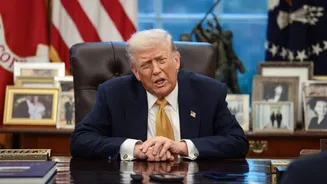
US President Donald Trump has imposed 25 per cent tariffs on AI chips on Wednesday, which is seen as a necessary step in the White House's decision to allow Nvidia to sell advanced AI chips to China.
Trump signed an order which will be effective from Thursday, and applies to chips that are "transshipped through the United States to other foreign countries," White House staff secretary Will Scharf said at an event.
This covers technology like the Nvidia H200 chip and AMD's MI325X, a government fact sheet added.
The proclamation follows a nine-month investigation under Section 232 of the Trade Expansion Act of 1962 and targets a number of high-end semiconductors meeting certain performance benchmarks and devices containing them for import duties.
Last month, Trump said that he reached an agreement with his Chinese counterpart Xi Jinping to allow US chip giant Nvidia to export the H200s into China, with the US government getting a 25-percent cut of sales and under certain restrictions.
The deal was confirmed by the US Commerce Department on Tuesday.
The changes introduced will allow Nvidia to sell its H200 chip to Chinese buyers under certain conditions.
"China wants them, and other people want them, and we're going to be making 25 percent on the sale of those chips," Trump said at an event on Wednesday.
However, uncertainty has grown over how much demand there will be from Chinese companies, as Beijing has reportedly been encouraging tech companies to use homegrown chips.
Trump in December said he would slap tariffs on Chinese semiconductor imports over Beijing's "unreasonable" pursuit of chip industry dominance, but delayed the action until June 2027.
Separately, Wednesday's order directed US trade officials to continue negotiations relating to the imports of semiconductors and chip-making equipment into the United States, as Washington tries to spur domestic manufacturing in the critical sector.
Trump signed an order which will be effective from Thursday, and applies to chips that are "transshipped through the United States to other foreign countries," White House staff secretary Will Scharf said at an event.
This covers technology like the Nvidia H200 chip and AMD's MI325X, a government fact sheet added.
The proclamation follows a nine-month investigation under Section 232 of the Trade Expansion Act of 1962 and targets a number of high-end semiconductors meeting certain performance benchmarks and devices containing them for import duties.
US allows Nvidia to export H200 chip to China
Last month, Trump said that he reached an agreement with his Chinese counterpart Xi Jinping to allow US chip giant Nvidia to export the H200s into China, with the US government getting a 25-percent cut of sales and under certain restrictions.
The deal was confirmed by the US Commerce Department on Tuesday.
The changes introduced will allow Nvidia to sell its H200 chip to Chinese buyers under certain conditions.
25 per cent tariffs on chips
"China wants them, and other people want them, and we're going to be making 25 percent on the sale of those chips," Trump said at an event on Wednesday.
However, uncertainty has grown over how much demand there will be from Chinese companies, as Beijing has reportedly been encouraging tech companies to use homegrown chips.
Trump in December said he would slap tariffs on Chinese semiconductor imports over Beijing's "unreasonable" pursuit of chip industry dominance, but delayed the action until June 2027.
Separately, Wednesday's order directed US trade officials to continue negotiations relating to the imports of semiconductors and chip-making equipment into the United States, as Washington tries to spur domestic manufacturing in the critical sector.