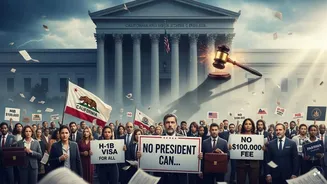

The fee, announced in September, is far higher than existing H-1B visa charges, which typically range between $2,000 and $5,000. It marks at least the third legal challenge to the policy, which opponents argue could severely disrupt a programme widely used by the technology industry, universities, and healthcare providers.
California Attorney General Rob Bonta, who is leading the case, has said the Trump administration does not have the authority to impose such a surcharge. His office argues that federal law allows immigration agencies to collect only fees that cover administrative costs, not to raise revenue.
“No presidential administration can rewrite immigration law,” Bonta said at a press conference in San Francisco. “No president can ignore the co-equal branch of government of Congress, ignore the Constitution, or ignore the law.”
Impact on H-1B programme and employers
The H-1B programme permits US employers to hire foreign professionals in specialised roles that usually require at least a bachelor’s degree or an equivalent qualification. Technology firms, many based in California, are among the largest users of the visas, along with hospitals, schools, and research institutions.
Bonta warned that a six-figure fee would place heavy financial pressure on both state and private employers delivering essential services. He said it could worsen labour shortages and lead to reductions in education, healthcare, and public services, noting that tens of thousands of educators and healthcare professionals nationwide work on H-1B visas.
“Congress has refined this program, setting caps, establishing fees, enhancing enforcement, and strengthening protections, but what Congress has never done is authorise a President to impose a six-figure surcharge designed to dismantle the program entirely,” Bonta said at a press conference.
The states joining California in the lawsuit include New York, Massachusetts, Illinois, New Jersey, and Washington, all represented by Democratic attorneys general. The case is being led jointly by Bonta and Massachusetts Attorney General Andrea Joy Campbell.
Legal battle and federal response
Under the Trump administration’s order, new H-1B visa recipients are barred from entering the United States unless their sponsoring employer pays the $100,000 fee. The administration has said the rule does not apply to existing H-1B holders or to applicants who filed before September 21. The order relies on presidential powers under federal immigration law to restrict the entry of foreign nationals considered harmful to US interests.
The White House has defended the policy as lawful and necessary to address what it describes as abuse of the H-1B system. Critics of the programme, including some conservative groups, argue that it allows companies to replace American workers with lower-paid foreign labour. Business groups and major employers dispute this, saying the visas are critical to filling gaps where qualified US workers are in short supply.
Legal opposition to the fee has been growing. The US Chamber of Commerce, along with a coalition of unions, employers, and religious groups, has filed separate lawsuits. A judge in Washington, DC, is scheduled to hear arguments in the Chamber’s case next week.
Bonta’s office has said the $100,000 fee has no link to the actual cost of processing H-1B applications and therefore breaches federal law. It has also argued that the US Constitution prevents a president from unilaterally imposing revenue-raising fees, a power reserved for Congress.
“This is about the separation of powers,” Bonta said at a press conference, adding that no administration can rewrite immigration law or destabilise schools, hospitals and universities through executive action alone.
The Trump administration announced the fee in September, describing the H-1B programme as overused. While the president has previously taken a tough stance on high-skilled immigration, he has more recently acknowledged the need for foreign talent in certain industries, highlighting ongoing tensions between his populist supporters and allies in the technology sector.
The Justice Department declined to comment on the lawsuit, and the Department of Homeland Security did not immediately respond to requests for comment.