








What is the story about?
It is rare in Indian stock markets for hours to equal a year or more. Yet this is precisely what happened between the closing bells on February 1 and the opening bells on February 3. Here is the brief story:
February 1 – Key indices Sensex and Nifty tanked in response to the Union Budget. The Sensex closed at 80,722.94, down 1,546.84 points, or 1.88 per cent, while Nifty fell 495.20 points, or 1.96 per cent, to settle at 24,825.45.
February 2 – The BSE Sensex rose 943.5 points, or 1.17 per cent, to close at 81,666.46, while the Nifty 50 advanced 261 points, or 1.06 per cent, to 25,088.4. This followed the market factoring in the true import of the budget and the state of the Indian economy.
February 3 – Just minutes after the market opened at around 9:31 am, the Sensex surged 2,291.17 points to 83,966.99, while the Nifty 50 traded 702 points higher at 25,790.40. At the closing bell at 15:30 hours, the BSE Sensex surged 2,072.67 points, or 2.54 per cent, to settle at 83,739.13, while the NSE Nifty 50 mirrored this strength, rising 639.15 points, or 2.55 per cent, to close at 25,727.5.
The Change That Happened
What occurred on February 1 was the market’s knee-jerk reaction to Nirmala Sitharaman’s budget. The February 2 jump of over 1 per cent reflected rational thinking and acceptance of the sound fundamentals of the Indian economy and its growth trajectory.
However, the stratospheric jump in the indices on February 3 represented something else: the occurrence of an event that both Indian stock markets and the world had awaited for nearly a year – “the mega trade deal between Bharat (the most populous country and soon-to-be third-largest economy in the world) and the United States of America, the world’s largest economy.”
Indian markets had been battered since Washington levied tariffs, making it the worst-performing market among emerging nations in 2025, amid record outflows of foreign investors. The Indian rupee had also plummeted. On Tuesday, the rupee rose 119 paise to 90.30 against the dollar, following US tariff cuts that boost India’s trade prospects.
Make no mistake, the deal, when consummated (Trump says it is effective immediately), will open new vistas for Indian goods and services exports to the US.
The Crux of the Piece
This op-ed traces the trajectory of the deal-making process, the twists and turns it encountered, and how Bharat remained unfazed and did not blink amid the litany of woes posed by Trump’s punitive tariffs. It also discusses the nuances of the deal and the benefits it brings beyond trade to both partners.
Trump Announces
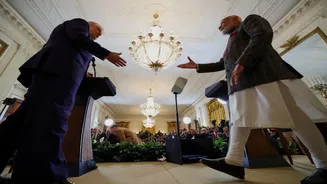
After months of impasse and a punitive tariff of 25 per cent (over and above the reciprocal tariff of 25 per cent) imposed in August on India for buying Russian oil, in a dramatic move on Monday, February 2, Trump wrote on his Truth Social post:
“It was an honour to speak with Prime Minister Modi of India this morning. He is one of my greatest friends and a powerful, respected leader of his country. We spoke about many things, including trade and ending the war between Russia and Ukraine. He agreed to stop buying Russian oil, and to buy much more from the United States and, potentially, Venezuela. This will help END THE WAR in Ukraine, which is taking place right now, with thousands of people dying each week!
Out of friendship and respect for Prime Minister Modi, and as per his request, effective immediately, we agreed to a Trade Deal between the United States and India, whereby the United States will charge a reduced Reciprocal Tariff, lowering it from 25% to 18%. They will likewise move forward to reduce their tariffs and non-tariff barriers against the United States to ZERO.
The Prime Minister also committed to ‘BUY AMERICAN’ at a much higher level, in addition to over $500 BILLION of US energy, technology, agricultural, coal, and other products. Our amazing relationship with India will be even stronger going forward. Prime Minister Modi and I are two people who GET THINGS DONE, something that cannot be said for most. Thank you for your attention to this matter!”
Rescinded
While Trump’s post was silent on the removal of the punitive tariff on India for buying Russian oil, citing officials familiar with the matter, Bloomberg reported that “the US is also removing the extra 25 per cent duty on Indian goods applied in response to India’s purchases of crude from Russia.” Reuters also quoted a White House official confirming that “the US was rescinding a punitive 25 per cent duty on all imports from India over its purchases of Russian oil, which had stacked on top of a 25 per cent 'reciprocal' tariff rate.”
Modi Confirms
Confirming the telephonic conversation with Trump and acknowledging their agreement on the mega deal, Prime Minister Narendra Modi wrote on his X handle:
“Wonderful to speak with my dear friend President Trump today. Delighted that Made-in-India products will now have a reduced tariff of 18 per cent. Big thanks to President Trump on behalf of the 1.4 billion people of India for this wonderful announcement.”
Prime Minister Modi further added:
“When two large economies and the world’s largest democracies work together, it benefits our people and unlocks immense opportunities for mutually beneficial cooperation. President Trump’s leadership is vital for global peace, stability and prosperity, and India fully supports his efforts for peace. I look forward to working closely with him to take our partnership to unprecedented heights.”
Fifty and Counting
The trade deal with the USA comes shortly after India finalised the “mother of all trade deals” with the 27-country European Union, the world’s second-largest economic bloc. The Indo-US deal also represents the tenth such agreement for the country in less than five years. More importantly, India has now finalised Free Trade Agreements (FTAs), Comprehensive Economic Partnership Agreements (CEPAs), and similar trade pacts with partners in over 50 countries. This includes bilateral deals with 15+ countries and multilateral blocs such as ASEAN (10 countries), EFTA (4 countries), and the European Union (27 countries).
This brings over fifty per cent of Indian exports within the ambit of the FTA, paving the way for growth in the fast lane.
Significance: India’s Number One Exporting Destination
In FY2024-25, India’s total goods exports were $437.42 billion, of which exports to the USA accounted for $86.5 billion, making America India’s top export destination with a 20 per cent share. Merchandise trade between the two countries reached $132 billion, including India’s record $86.5 billion in exports to the US and around $45.7 billion in imports. Services trade totalled about $83 billion, nearly balanced with US exports to India at $41.8 billion and imports from India at $41.6 billion. Total bilateral trade (merchandise plus services) exceeded $215 billion in FY2025.
Since 2020-21, India’s merchandise exports to the USA have shown robust growth, rising from $57 billion amid pandemic disruptions to a record $86.5 billion in FY2024-25, a cumulative increase of over 50 per cent.
Even if the fine print of the final India-US FTA holds a few minor surprises, it is clearly time to press ahead and aggressively tap the India-US export market, which has been largely dormant since August 2025.
Advantage Bharat
As with all trade deals, the devil lies in the details, which are yet to emerge. However, the sheer fact that US tariffs on India (as Trump says, almost immediately) will be sharply reduced from a killer 50 per cent to 18 per cent not only brings relief for Indian exporters but also gives India a significant comparative advantage over its Asian peers.
Comparative Advantage
India’s new 18 per cent rate is now more favourable than China’s punitive levels and most Asian peers, positioning India competitively in Asia and marginally worse than Europe, enhancing its "China+1" appeal for US importers.
Mission $500 Billion
With US tariffs on Indian exports reset to 18 per cent and reciprocal action by India, India-US bilateral trade is likely to reach $500 billion by 2030, a goal reiterated by PM Modi, Commerce Minister Piyush Goyal, and officials since 2022, and reaffirmed after the February 2026 reduction. The deal could unlock 8–12 per cent faster export growth annually, potentially lifting merchandise exports from $86.5 billion (FY25) to $150–180 billion by 2030, with services adding $250–300 billion, aligning with the $500 billion ambition amid PLI schemes and supply chain shifts. Exemptions for pharma/electronics (80 per cent of exports) minimise effective rates to ~5–10 per cent, accelerating "China+1" momentum; without the deal, projections would have been $350–400 billion.
Strategic Reset
The India-US strategic partnership is approximately 21 years old, formally established in 2005 by then President George W Bush and PM Manmohan Singh, shifting ties from Cold War frictions to a "global partnership". The relationship strengthened under PM Modi but was disrupted by Trump’s tariff chaos.
The new trade deal, slashing tariffs to 18 per cent, resets ties, exempts 80 per cent of exports, targets $500 billion in trade by 2030, and launches initiatives like 'Compact' for military-tech pacts and iCET expansion, boosting the Quad revival and critical minerals supply chains despite lingering friction over H-1B and trade surpluses.
Last Country, Last Man Standing
While many countries bent to Trump’s tariff pressures, Bharat and PM Modi refused to yield, standing tall despite some collateral damage before the US–India deal was concluded. During this period, India also finalised:
With the Indo-American FTA now concluded, India looks to a strategic reset of comprehensive ties with the US, demonstrating to the world that a resurgent Bharat has secured its place under the sun. Moreover, with Trump being Trump, the caveat is that despite the market’s irrational exuberance, Bharat must proceed with caution and resolve.
(The author is a multi-disciplinary thought leader with Action Bias and an India-based impact consultant. He is President of Advisory Services at BARSYL. Views expressed are personal and do not necessarily reflect Firstpost’s position.)
February 1 – Key indices Sensex and Nifty tanked in response to the Union Budget. The Sensex closed at 80,722.94, down 1,546.84 points, or 1.88 per cent, while Nifty fell 495.20 points, or 1.96 per cent, to settle at 24,825.45.
February 2 – The BSE Sensex rose 943.5 points, or 1.17 per cent, to close at 81,666.46, while the Nifty 50 advanced 261 points, or 1.06 per cent, to 25,088.4. This followed the market factoring in the true import of the budget and the state of the Indian economy.
February 3 – Just minutes after the market opened at around 9:31 am, the Sensex surged 2,291.17 points to 83,966.99, while the Nifty 50 traded 702 points higher at 25,790.40. At the closing bell at 15:30 hours, the BSE Sensex surged 2,072.67 points, or 2.54 per cent, to settle at 83,739.13, while the NSE Nifty 50 mirrored this strength, rising 639.15 points, or 2.55 per cent, to close at 25,727.5.
The Change That Happened
What occurred on February 1 was the market’s knee-jerk reaction to Nirmala Sitharaman’s budget. The February 2 jump of over 1 per cent reflected rational thinking and acceptance of the sound fundamentals of the Indian economy and its growth trajectory.
However, the stratospheric jump in the indices on February 3 represented something else: the occurrence of an event that both Indian stock markets and the world had awaited for nearly a year – “the mega trade deal between Bharat (the most populous country and soon-to-be third-largest economy in the world) and the United States of America, the world’s largest economy.”
Indian markets had been battered since Washington levied tariffs, making it the worst-performing market among emerging nations in 2025, amid record outflows of foreign investors. The Indian rupee had also plummeted. On Tuesday, the rupee rose 119 paise to 90.30 against the dollar, following US tariff cuts that boost India’s trade prospects.
Make no mistake, the deal, when consummated (Trump says it is effective immediately), will open new vistas for Indian goods and services exports to the US.
The Crux of the Piece
This op-ed traces the trajectory of the deal-making process, the twists and turns it encountered, and how Bharat remained unfazed and did not blink amid the litany of woes posed by Trump’s punitive tariffs. It also discusses the nuances of the deal and the benefits it brings beyond trade to both partners.
Trump Announces
After months of impasse and a punitive tariff of 25 per cent (over and above the reciprocal tariff of 25 per cent) imposed in August on India for buying Russian oil, in a dramatic move on Monday, February 2, Trump wrote on his Truth Social post:
“It was an honour to speak with Prime Minister Modi of India this morning. He is one of my greatest friends and a powerful, respected leader of his country. We spoke about many things, including trade and ending the war between Russia and Ukraine. He agreed to stop buying Russian oil, and to buy much more from the United States and, potentially, Venezuela. This will help END THE WAR in Ukraine, which is taking place right now, with thousands of people dying each week!
Out of friendship and respect for Prime Minister Modi, and as per his request, effective immediately, we agreed to a Trade Deal between the United States and India, whereby the United States will charge a reduced Reciprocal Tariff, lowering it from 25% to 18%. They will likewise move forward to reduce their tariffs and non-tariff barriers against the United States to ZERO.
The Prime Minister also committed to ‘BUY AMERICAN’ at a much higher level, in addition to over $500 BILLION of US energy, technology, agricultural, coal, and other products. Our amazing relationship with India will be even stronger going forward. Prime Minister Modi and I are two people who GET THINGS DONE, something that cannot be said for most. Thank you for your attention to this matter!”
Rescinded
While Trump’s post was silent on the removal of the punitive tariff on India for buying Russian oil, citing officials familiar with the matter, Bloomberg reported that “the US is also removing the extra 25 per cent duty on Indian goods applied in response to India’s purchases of crude from Russia.” Reuters also quoted a White House official confirming that “the US was rescinding a punitive 25 per cent duty on all imports from India over its purchases of Russian oil, which had stacked on top of a 25 per cent 'reciprocal' tariff rate.”
Modi Confirms
Confirming the telephonic conversation with Trump and acknowledging their agreement on the mega deal, Prime Minister Narendra Modi wrote on his X handle:
“Wonderful to speak with my dear friend President Trump today. Delighted that Made-in-India products will now have a reduced tariff of 18 per cent. Big thanks to President Trump on behalf of the 1.4 billion people of India for this wonderful announcement.”
Prime Minister Modi further added:
“When two large economies and the world’s largest democracies work together, it benefits our people and unlocks immense opportunities for mutually beneficial cooperation. President Trump’s leadership is vital for global peace, stability and prosperity, and India fully supports his efforts for peace. I look forward to working closely with him to take our partnership to unprecedented heights.”
Fifty and Counting
The trade deal with the USA comes shortly after India finalised the “mother of all trade deals” with the 27-country European Union, the world’s second-largest economic bloc. The Indo-US deal also represents the tenth such agreement for the country in less than five years. More importantly, India has now finalised Free Trade Agreements (FTAs), Comprehensive Economic Partnership Agreements (CEPAs), and similar trade pacts with partners in over 50 countries. This includes bilateral deals with 15+ countries and multilateral blocs such as ASEAN (10 countries), EFTA (4 countries), and the European Union (27 countries).
This brings over fifty per cent of Indian exports within the ambit of the FTA, paving the way for growth in the fast lane.
Significance: India’s Number One Exporting Destination
In FY2024-25, India’s total goods exports were $437.42 billion, of which exports to the USA accounted for $86.5 billion, making America India’s top export destination with a 20 per cent share. Merchandise trade between the two countries reached $132 billion, including India’s record $86.5 billion in exports to the US and around $45.7 billion in imports. Services trade totalled about $83 billion, nearly balanced with US exports to India at $41.8 billion and imports from India at $41.6 billion. Total bilateral trade (merchandise plus services) exceeded $215 billion in FY2025.
Since 2020-21, India’s merchandise exports to the USA have shown robust growth, rising from $57 billion amid pandemic disruptions to a record $86.5 billion in FY2024-25, a cumulative increase of over 50 per cent.
Even if the fine print of the final India-US FTA holds a few minor surprises, it is clearly time to press ahead and aggressively tap the India-US export market, which has been largely dormant since August 2025.
Advantage Bharat
As with all trade deals, the devil lies in the details, which are yet to emerge. However, the sheer fact that US tariffs on India (as Trump says, almost immediately) will be sharply reduced from a killer 50 per cent to 18 per cent not only brings relief for Indian exporters but also gives India a significant comparative advantage over its Asian peers.
Comparative Advantage
India’s new 18 per cent rate is now more favourable than China’s punitive levels and most Asian peers, positioning India competitively in Asia and marginally worse than Europe, enhancing its "China+1" appeal for US importers.
Mission $500 Billion
With US tariffs on Indian exports reset to 18 per cent and reciprocal action by India, India-US bilateral trade is likely to reach $500 billion by 2030, a goal reiterated by PM Modi, Commerce Minister Piyush Goyal, and officials since 2022, and reaffirmed after the February 2026 reduction. The deal could unlock 8–12 per cent faster export growth annually, potentially lifting merchandise exports from $86.5 billion (FY25) to $150–180 billion by 2030, with services adding $250–300 billion, aligning with the $500 billion ambition amid PLI schemes and supply chain shifts. Exemptions for pharma/electronics (80 per cent of exports) minimise effective rates to ~5–10 per cent, accelerating "China+1" momentum; without the deal, projections would have been $350–400 billion.
Strategic Reset
The India-US strategic partnership is approximately 21 years old, formally established in 2005 by then President George W Bush and PM Manmohan Singh, shifting ties from Cold War frictions to a "global partnership". The relationship strengthened under PM Modi but was disrupted by Trump’s tariff chaos.
The new trade deal, slashing tariffs to 18 per cent, resets ties, exempts 80 per cent of exports, targets $500 billion in trade by 2030, and launches initiatives like 'Compact' for military-tech pacts and iCET expansion, boosting the Quad revival and critical minerals supply chains despite lingering friction over H-1B and trade surpluses.
Last Country, Last Man Standing
While many countries bent to Trump’s tariff pressures, Bharat and PM Modi refused to yield, standing tall despite some collateral damage before the US–India deal was concluded. During this period, India also finalised:
- Comprehensive Economic and Trade Agreement (CETA) with the UK in July 2025
- Comprehensive Economic Partnership Agreement (CEPA) with Oman in December 2025
- Free Trade Agreement (FTA) with New Zealand in December 2025
- Free Trade Agreement (FTA) with the European Union in January 2026
With the Indo-American FTA now concluded, India looks to a strategic reset of comprehensive ties with the US, demonstrating to the world that a resurgent Bharat has secured its place under the sun. Moreover, with Trump being Trump, the caveat is that despite the market’s irrational exuberance, Bharat must proceed with caution and resolve.
(The author is a multi-disciplinary thought leader with Action Bias and an India-based impact consultant. He is President of Advisory Services at BARSYL. Views expressed are personal and do not necessarily reflect Firstpost’s position.)