







What is the story about?
In the post-Second World War history, Tibet is a tragedy. It's a civilisation that chose peace — and was punished for it.
There are societies that build their greatness on conquest. They forge identity through banners, armies, and the myth that violence is destiny.
And then there is Tibet — the rare civilisation that tried, for centuries, to build greatness on something else: inner discipline, spiritual authority, and the belief that the highest form of power is the ability to restrain power.
Tibet’s tragedy was not that it valued peace. Tibet’s tragedy was that it trusted peace to protect it.
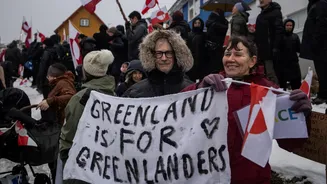
Writing in the New York Times, Naaja Nathanielsen — Greenland’s minister of business, mineral resources, energy, justice and gender equality — expresses the pain of a nation that has preferred peace over power while remaining a part of the kingdom that colonised it for centuries. Nathanielsen says, “Living in Greenland is a great privilege, and, in many ways, we have it all. But the one thing we don’t have is strength in numbers.”
“A population of just 57,000 people living along the coast of the world’s largest island is not a great power player. We could all fit into an American sports stadium, and there would still be plenty of empty seats. That seems to be why some Americans find it difficult to acknowledge us,” she writes.
“Why should so few people claim the right to a vast piece of land?”
Greenland today faces two options to choose its fate from: be sold out or be acquired.
The nation of the world’s largest island had little idea a year ago that by the time the US President Donald Trump completes one year of his second presidency, Greenland will be one the most contested lands on the planet. Trump is threatening to break Nato up over the control of the island. His argument is that Greenland would anyway be seized by China or Russia if the US doesn’t.
Denmark, which manages the autonomous territory with the legal provision to announce independence, has rejected the idea of acquisition of Greenland by the use of capital power or military might. Europe is backing Greenland, and fearing Trump’s unpredictability is also ramping up its military presence in Greenland, slowly and steadily. Trump, however, looks to be in a hurry, having already sent a new batch of the US air force.
Clearly, peace is not something that is going to help Greenland maintain the status quo. Its belief in peace stands shattered — something Tibet witnessed when China came under a new regime led by communist commander Mao Zedong in the late 1940s, and continued its expansion through the 1950s and 1960s.
The Tibetan plateau produced one of the world’s most distinctive political cultures: a religious civilisation led by scholars and monks, governed through a system in which spiritual legitimacy was inseparable from political order. From the mid-17th century, Tibet was ruled under the Ganden Phodrang system of government associated with the Dalai Lama’s institution.
This was not a modern liberal democracy. It had hierarchy, rigid structures, and deep inequalities like most pre-modern societies. Yet it also represented something deeply rare: a state that set out to centre compassion as governing ideology, that sought to reduce violence as a way of life, and that built national purpose around spiritual development rather than military expansion.
That choice produced a unique identity — but also a fatal vulnerability.
Because history is full of predators. And predators do not respect monasteries.
Pre-1950 Tibet was intensely shaped by Buddhism and monastic institutions, with large monasteries functioning as power centres, cultural academies, and social anchors. Even in the 1950s, Tibet still had enormous monastic establishments — among the largest in the world — which Tibetans viewed as proof of their civilisation’s distinctive greatness.
That matters because when a society invests most of its discipline into the cultivation of inner strength, it can begin to neglect the outward disciplines that protect borders — the hard skills of deterrence, logistics, and organised defence.
It is not that Tibetans were naïve. They understood violence. Tibetan history has wars, rivalries, and political intrigue like anywhere else — Greenland, for example, when Danish colonial regimes mastered the island. But Tibet’s political culture increasingly came to treat militarism as morally inferior, almost a regression — something that, it argued, better societies should grow out of.
In a kinder world, that might have looked like enlightenment. In the real world, it looked like an invitation.
The People’s Republic of China’s leadership viewed Tibet not as a neighbour but as unfinished business — part of China’s territorial imagination. In 1950, the People’s Liberation Army (PLA) moved into eastern Tibet. The result was not a contest between equal forces; Tibet was outmatched in modern warfare.
By May 1951, Tibetan representatives signed the Seventeen Point Agreement in Beijing — officially framed as Tibet’s “peaceful liberation”, promising autonomy under China while affirming Chinese sovereignty.
The Tibetan side would later argue that the agreement was signed under coercion and did not reflect genuine consent. China continues to insist that the deal was lawful, and signed voluntarily by the Tibetan leadership. But whatever one believes about that dispute, the strategic reality is harder to argue with: once Tibet faced a modern war machine, its moral and civilisational achievements offered no shield.
A society can be spiritually advanced and geopolitically helpless at the same time. Tibet became the world’s most painful illustration. Its provincial leaders and of border watchers tried to put up a fight, but their weapons were no match to sophisticated guns and artillery that Chinese came with to invade Tibet.
By the late 1950s, tensions between Tibetans and Chinese authorities deepened. In March 1959, an uprising erupted in Lhasa. Thousands gathered around the Dalai Lama’s palace, fearing he would be abducted or coerced. Fighting followed, and Chinese artillery reportedly landed near his residence, triggering the decision to flee.
The Dalai Lama escaped into India, where he was granted asylum. His exile — and the exile of Tibet’s sovereignty — has lasted ever since.
The psychological impact is as important as the political one: for many Tibetans, 1959 was not merely a defeat. It was a rupture in continuity, the moment a civilisation began living as memory.
A nation can survive occupation, history has shown to the world — India being a prime example. But what is harder to survive is the feeling for a nation that it has become a guest in history, not its author.
When we speak about Tibet, we often reduce the story to geopolitics: occupation, autonomy, rights. But Tibet lost more than territory. It lost:
- its sovereign confidence — the belief that their own system would continue
- the authority of their institutions — the lived experience of self-rule
- the cultural ecology — the easy transmission of language, ritual, and
- its identity from one generation to another without fear.
- its faith in the future — the idea that tomorrow would be Tibetan in the same way yesterday was.
Today, the Tibetan cause lives largely through diaspora institutions, activism, and the moral authority of the Dalai Lama — who himself has urged a non-violent path and speaks chiefly of cultural and religious preservation rather than full political separation.
The irony is cruel: Tibet tried to avoid violence — and became the victim of a violence it was not built to counter. The historical pattern: peace without deterrence attracts conquest. Tibet is not the only society that learned this lesson the hard way. History repeatedly shows a grim pattern: those who treat war as morally beneath them often become ruled by those who treat war as policy.
For decades after the Cold War, Europe built a model: integration, economic growth, welfare, and the belief that war belonged to history books. Then came the return of raw power politics — Russia’s aggression, China’s economic leverage, and political disruption from America’s internal storms, including the re-emergence of Trumpism and its transactional approach to alliances.
While Trump intends to acquire Greenland by whatever means, as he says, the autonomous island may not be another Tibet if Europe stays solid behind it. Europe looks vulnerable, but is still powerful, wealthy, industrialised. With Russia mocking and taunting Europe over Trump’s Greenland control pressure and China watching the new great game from a distance and using every window of opportunity to plant a foot wherever there is a geopolitical or geostratic crack, the Tibet story still leaves a message to the world.
Tibet’s story is not proof that peace is foolish. It is proof that peace is incomplete if it is not guarded. The idea that peace flows from power still holds despite exceptions such as Iceland and Costa Rica which have denounced armies. Tibet built a near-perfect inner civilisation, at least it believed it did — something similar Nathanielsen hints at in her NYT column as she pleads “we ask only that you don’t harm Greenland”.
There are societies that build their greatness on conquest. They forge identity through banners, armies, and the myth that violence is destiny.
And then there is Tibet — the rare civilisation that tried, for centuries, to build greatness on something else: inner discipline, spiritual authority, and the belief that the highest form of power is the ability to restrain power.
Tibet’s tragedy was not that it valued peace. Tibet’s tragedy was that it trusted peace to protect it.
Is Greenland facing a similar prospect today?
Writing in the New York Times, Naaja Nathanielsen — Greenland’s minister of business, mineral resources, energy, justice and gender equality — expresses the pain of a nation that has preferred peace over power while remaining a part of the kingdom that colonised it for centuries. Nathanielsen says, “Living in Greenland is a great privilege, and, in many ways, we have it all. But the one thing we don’t have is strength in numbers.”
“A population of just 57,000 people living along the coast of the world’s largest island is not a great power player. We could all fit into an American sports stadium, and there would still be plenty of empty seats. That seems to be why some Americans find it difficult to acknowledge us,” she writes.
“Why should so few people claim the right to a vast piece of land?”
Greenland today faces two options to choose its fate from: be sold out or be acquired.
The nation of the world’s largest island had little idea a year ago that by the time the US President Donald Trump completes one year of his second presidency, Greenland will be one the most contested lands on the planet. Trump is threatening to break Nato up over the control of the island. His argument is that Greenland would anyway be seized by China or Russia if the US doesn’t.
Denmark, which manages the autonomous territory with the legal provision to announce independence, has rejected the idea of acquisition of Greenland by the use of capital power or military might. Europe is backing Greenland, and fearing Trump’s unpredictability is also ramping up its military presence in Greenland, slowly and steadily. Trump, however, looks to be in a hurry, having already sent a new batch of the US air force.
Clearly, peace is not something that is going to help Greenland maintain the status quo. Its belief in peace stands shattered — something Tibet witnessed when China came under a new regime led by communist commander Mao Zedong in the late 1940s, and continued its expansion through the 1950s and 1960s.
What happened to Tibet?
The Tibetan plateau produced one of the world’s most distinctive political cultures: a religious civilisation led by scholars and monks, governed through a system in which spiritual legitimacy was inseparable from political order. From the mid-17th century, Tibet was ruled under the Ganden Phodrang system of government associated with the Dalai Lama’s institution.
This was not a modern liberal democracy. It had hierarchy, rigid structures, and deep inequalities like most pre-modern societies. Yet it also represented something deeply rare: a state that set out to centre compassion as governing ideology, that sought to reduce violence as a way of life, and that built national purpose around spiritual development rather than military expansion.
That choice produced a unique identity — but also a fatal vulnerability.
Because history is full of predators. And predators do not respect monasteries.
A nation, a civilisation organised around restraint
Pre-1950 Tibet was intensely shaped by Buddhism and monastic institutions, with large monasteries functioning as power centres, cultural academies, and social anchors. Even in the 1950s, Tibet still had enormous monastic establishments — among the largest in the world — which Tibetans viewed as proof of their civilisation’s distinctive greatness.
That matters because when a society invests most of its discipline into the cultivation of inner strength, it can begin to neglect the outward disciplines that protect borders — the hard skills of deterrence, logistics, and organised defence.
It is not that Tibetans were naïve. They understood violence. Tibetan history has wars, rivalries, and political intrigue like anywhere else — Greenland, for example, when Danish colonial regimes mastered the island. But Tibet’s political culture increasingly came to treat militarism as morally inferior, almost a regression — something that, it argued, better societies should grow out of.
In a kinder world, that might have looked like enlightenment. In the real world, it looked like an invitation.
1950: When war met a society not built for war
The People’s Republic of China’s leadership viewed Tibet not as a neighbour but as unfinished business — part of China’s territorial imagination. In 1950, the People’s Liberation Army (PLA) moved into eastern Tibet. The result was not a contest between equal forces; Tibet was outmatched in modern warfare.
By May 1951, Tibetan representatives signed the Seventeen Point Agreement in Beijing — officially framed as Tibet’s “peaceful liberation”, promising autonomy under China while affirming Chinese sovereignty.
The Tibetan side would later argue that the agreement was signed under coercion and did not reflect genuine consent. China continues to insist that the deal was lawful, and signed voluntarily by the Tibetan leadership. But whatever one believes about that dispute, the strategic reality is harder to argue with: once Tibet faced a modern war machine, its moral and civilisational achievements offered no shield.
A society can be spiritually advanced and geopolitically helpless at the same time. Tibet became the world’s most painful illustration. Its provincial leaders and of border watchers tried to put up a fight, but their weapons were no match to sophisticated guns and artillery that Chinese came with to invade Tibet.
1959: The breaking point — and the exile that never ended
By the late 1950s, tensions between Tibetans and Chinese authorities deepened. In March 1959, an uprising erupted in Lhasa. Thousands gathered around the Dalai Lama’s palace, fearing he would be abducted or coerced. Fighting followed, and Chinese artillery reportedly landed near his residence, triggering the decision to flee.
The Dalai Lama escaped into India, where he was granted asylum. His exile — and the exile of Tibet’s sovereignty — has lasted ever since.
The psychological impact is as important as the political one: for many Tibetans, 1959 was not merely a defeat. It was a rupture in continuity, the moment a civilisation began living as memory.
A nation can survive occupation, history has shown to the world — India being a prime example. But what is harder to survive is the feeling for a nation that it has become a guest in history, not its author.
What Tibet lost — beyond land
When we speak about Tibet, we often reduce the story to geopolitics: occupation, autonomy, rights. But Tibet lost more than territory. It lost:
- its sovereign confidence — the belief that their own system would continue
- the authority of their institutions — the lived experience of self-rule
- the cultural ecology — the easy transmission of language, ritual, and
- its identity from one generation to another without fear.
- its faith in the future — the idea that tomorrow would be Tibetan in the same way yesterday was.
Today, the Tibetan cause lives largely through diaspora institutions, activism, and the moral authority of the Dalai Lama — who himself has urged a non-violent path and speaks chiefly of cultural and religious preservation rather than full political separation.
The irony is cruel: Tibet tried to avoid violence — and became the victim of a violence it was not built to counter. The historical pattern: peace without deterrence attracts conquest. Tibet is not the only society that learned this lesson the hard way. History repeatedly shows a grim pattern: those who treat war as morally beneath them often become ruled by those who treat war as policy.
Europe’s Greenland warning: Prosperity may create strategic blindness
For decades after the Cold War, Europe built a model: integration, economic growth, welfare, and the belief that war belonged to history books. Then came the return of raw power politics — Russia’s aggression, China’s economic leverage, and political disruption from America’s internal storms, including the re-emergence of Trumpism and its transactional approach to alliances.
While Trump intends to acquire Greenland by whatever means, as he says, the autonomous island may not be another Tibet if Europe stays solid behind it. Europe looks vulnerable, but is still powerful, wealthy, industrialised. With Russia mocking and taunting Europe over Trump’s Greenland control pressure and China watching the new great game from a distance and using every window of opportunity to plant a foot wherever there is a geopolitical or geostratic crack, the Tibet story still leaves a message to the world.
Tibet’s story is not proof that peace is foolish. It is proof that peace is incomplete if it is not guarded. The idea that peace flows from power still holds despite exceptions such as Iceland and Costa Rica which have denounced armies. Tibet built a near-perfect inner civilisation, at least it believed it did — something similar Nathanielsen hints at in her NYT column as she pleads “we ask only that you don’t harm Greenland”.